Self-growth
 Business & Career
 Success
 Communication
 Healing
 Relationships
 Psychology
 Happiness
Picture yourself on the couch, watching Gordon Ramsay chop vegetables while swearing and yelling as he goes. Three hours later, you're in your kitchen staring at a pile of carrots — and you realize you still can't cook like him.
That's what MasterClass is all about. Sure, it's beautiful and exciting, but does it actually change your life?
This MasterClass review isn't here to trash the platform. It's here to ask a simple question: After the class ends, have you changed your life? Or did you just watch someone else live theirs?
If you want real growth that fits your life, check out practical microlearning with Headway.
Is MasterClass worth it? The brief verdict
Watching a lesson from Serena Williams is thrilling. After all, the videos look amazing, like something out of a mini-documentary. But after an hour, try asking yourself: Am I actually learning, or just enjoying the show?
If you want skills that you can actually use, MasterClass often falls short. The concept looks amazing, but the lessons often don't teach enough.
Bottom line: If you need practical takeaways fast, apps based on microlearning perform better. MasterClass is a form of edutainment. It's attractive and inspiring, but it's not designed to change your daily habits.
What is MasterClass? The Netflix of learning
MasterClass is an online learning platform where stars introduce video lessons. We're talking Serena Williams on tennis, Margaret Atwood on creative writing, Neil Gaiman on storytelling, Chris Voss on negotiation, and Thomas Keller on cooking classes.
Each course includes high-quality video lessons — usually 10–25 episodes. You also receive a workbook and, in some cases, access to the MasterClass community forum. Through your MasterClass subscription, you gain unlimited access to everything.
That sounds great, doesn't it? But in reality, the platform is designed more like a streaming service than a learning tool. So, you end up watching tutorials about excellence, but you don't learn how to achieve it yourself.
The platform launched in 2015. It now has over 200 MasterClass classes in 11 categories. You can learn filmmaking from Martin Scorsese, acting by Helen Mirren and Samuel L. Jackson, and space exploration from Chris Hadfield. And the variety of topics is impressive, spanning from wellness to entrepreneurship.
But when you're watching these classes, what you're really seeing is someone else's creative processes — their journey to their philosophy, without the space to develop your own skills as a result of that observation.
Subscription cost: Masterclass pricing 2026
So, how much does MasterClass cost in 2026? The pricing has shifted over time. But one thing stays the same: the annual membership requirement.
Standard Plan is $120 per year (that's $10/month)
Plus Plan is $180 per year ($15/month with offline downloads)
Premium Plan is $240 per year ($20/month for up to 6 devices)
All plans include:
Unlimited access to over 200 classes
Workbook materials for each course
MasterClass app for iPhone, iPad, and Android
30-day money-back guarantee
Here's the tricky part. Unlike Skillshare or Udemy, there's no monthly option. You either pay for a full year, or you're out.
And according to honest review sites like Trustpilot, canceling is hard. MasterClass scores just 1.5 out of 5 there. Users say it feels like being in a relationship with a partner who just won't let you go.
The feedback from users is consistent across the board. Users are shocked to find that their accounts auto-renew without a clear warning. They struggle to get refunds for charges they didn't expect. And when they reach out to customer service, it often feels like talking to a robot. One user described the billing as predatory, sharing that they were charged with no notice and spent weeks fighting to get their money back.
Now, compare that to how bite-sized learning tools work. You can pay monthly, cancel at any time, and actually learn what you need to know.
There's no extra cost for the MasterClass content itself. But if you want hands-on practice in cooking or art, you'll need to budget for materials separately.
The variety of classes is genuinely impressive. But here's what no one tells you: To actually get your money's worth based on what's available, you'd need to finish at least 10–12 courses per year. Each course takes anywhere from 2 to 5 hours of focused viewing. That adds up to between 20 and 60 hours dedicated to watching each year. When was the last time you had that much free time?
The core problem: Watching excellence isn't the same as building it
Most MasterClass reviews miss this. They praise the production value (which is stunning). They love the variety of topics (which is huge). But they miss the real issue: watching doesn't equal learning.
After taking a Steve Martin comedy class, you might feel ready to write your own jokes. But then, when you actually start, all you see is a blank page. Most likely, the step-by-step method of how to write a joke is somewhere buried in the third hour of his lecture.
This thought isn't a theory; it's a concept that has been proven by research performed by Peter Brown in 'Make It Stick.' Learners who only watch videos passively retain very little. In most cases, they'll only remember 30% or less of what they learned after just 48 hours.
Let's take Gordon Ramsay's cooking MasterClass as an example. One of the first things he does is share his philosophy and passion for cooking, along with his background (for example, his struggles becoming a chef and ultimately earning those Michelin stars). And as you watch Gordon prepare his dishes, you'll see stunning visual shots of the beautiful food he creates.
What you won't get:
Practice with knife skills
Repeating basic techniques
Feedback on your mistakes
Clear steps from beginner to competent
The platform assumes you'll practice at your own pace. But that's exactly where most people fail. Without structure or real-world training, inspiration fades fast.
📘 Stop just watching experts and start thinking like them. Headway turns the world's biggest ideas into 15-minute daily habits that fit perfectly into your busy schedule.
What MasterClass offers: A detailed look
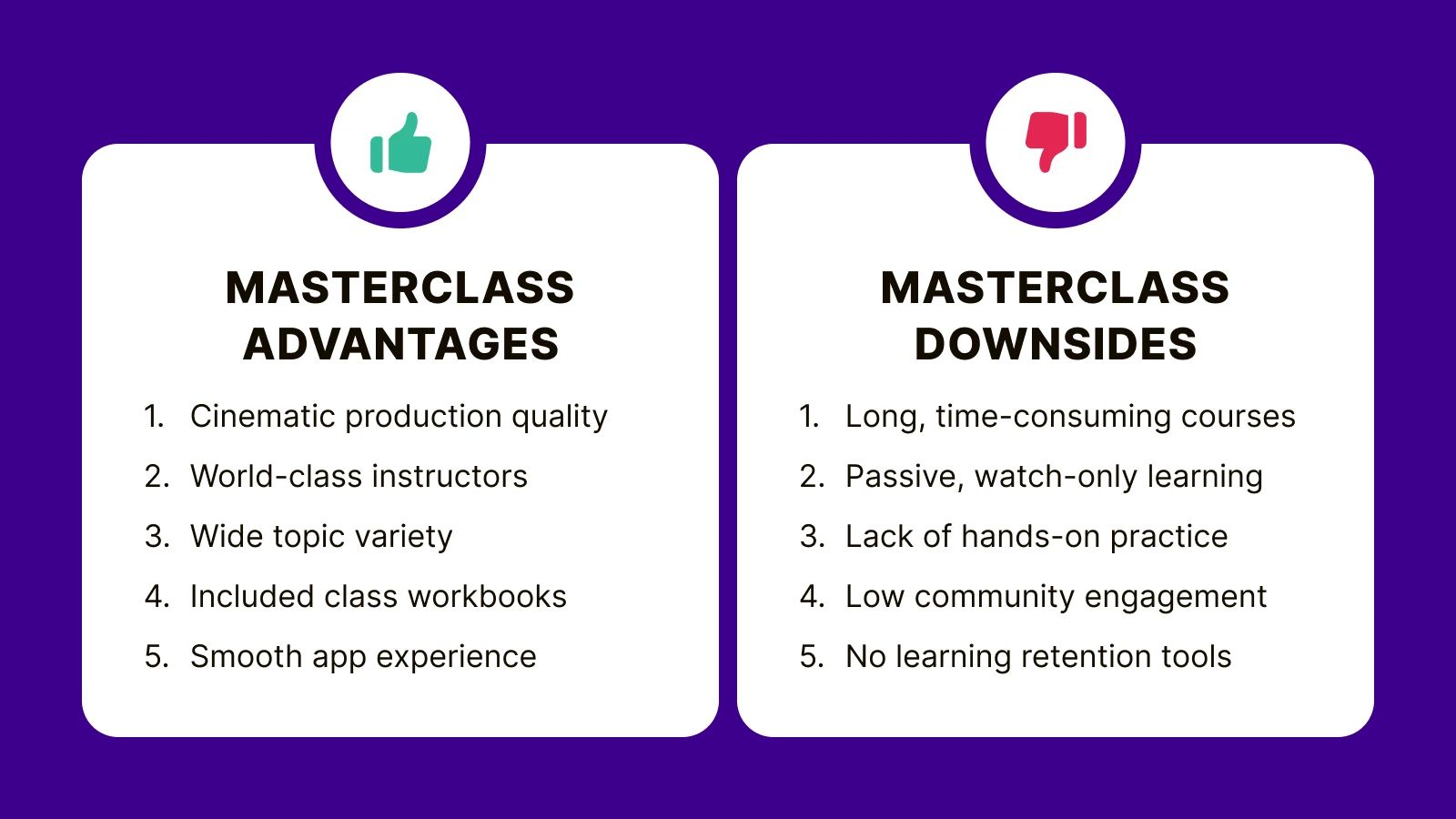
Advantages:
Production quality that makes TED Talks look amateur. Each scene feels like a movie. The lighting, sound, and editing are all exceptional. You're not just taking a lesson — it feels like watching a high-quality TV show.
Access to real legends: Neil deGrasse Tyson teaching science, Chris Hadfield on space, Serena Williams on tennis, and Anna Wintour on business creativity. These aren't just famous names. They're people who've truly mastered their crafts.
A huge variety of classes covering entrepreneurship, wellness, filmmaking, creative writing, music, cooking, and sports. The 11 categories cover basically any interest you might have.
Workbooks with some takeaways. Each class includes PDFs with exercises and key concepts. In theory, these help you practice. In reality? Most users never open them. You'll probably forget to download them in the first place.
The MasterClass app works smoothly on your iPhone, iPad, or laptop. You can stream at your own pace. Plus and Premium plans let you download content for offline viewing, turning your learning into a podcast-style experience for your commute.
The downsides:
Courses last between two and five hours. That might sound short, but over 10 hours for just three subjects adds up quickly — far more than what actual skill-building platforms break into manageable pieces.
Content is watch-only. There's no hands-on practice built in. You have to figure out the application yourself. No guided practice. No projects. No way to check if you actually learned anything.
There is a MasterClass community, but it's not nearly as active as other platforms. There are forums and comments under courses, but people rarely engage. Questions often go unanswered. It's more like an app that "has" a community feature but doesn't really foster one.
New classes appear slowly. Monthly at best. The initial library is impressive. But the rate of new content doesn't match competitors who release multiple courses every week.
You're on your own for retention. There's no spaced repetition, no quizzes, no reminders to keep practicing. Once you finish watching, the platform basically assumes you're done.
According to 'Make It Stick,' the best way to learn is through spaced repetition, active recall, and applying knowledge quickly. MasterClass doesn't offer any of this. It's like reading a cookbook and expecting to become a chef without ever setting foot in the kitchen.
The problem with watching someone like Neil Gaiman talk about writing is that it doesn't really help you learn how to write. Sure, while you are watching him talk, you'll think you're learning about story structures. You might even feel like you understand these concepts.
But when you go to write your own story, you may find yourself drawing a complete blank on what to write about. This example illustrates the gap between the ability to comprehend information and the ability to apply it properly.
MasterClass vs. real learning tools: The honest comparison
Let's compare MasterClass classes to tools that are actually designed for growth:
| Feature | MasterClass | Real learning tools (Microlearning) |
|---|
Time investment | 2–5 hours per topic, plus extra time to practice on your own | Around 15 minutes per topic, designed for better retention |
Format | Long-form videos you need to sit down and watch | Short text and audio summaries you can learn from while commuting |
Main goal | Inspiration and entertainment | Retention and real action |
What you actually get | The celebrity's story and personal experience | The key ideas and frameworks from their books |
Cost structure | $120–$240 annual commitment, no monthly option | Monthly subscriptions, cancel anytime |
Here's the real question for learners: If Gordon Ramsay wrote 'Kitchen Confidential' or Chris Voss wrote 'Never Split the Difference,' wouldn't you rather get the key ideas from their books? Instead of watching them talk about their work?
That's the difference between the two. You can get the book summary, which contains the wisdom developed by an expert over a lifetime, or you can have the expert's persona on video through MasterClass.
Think about how learning works. Learners need three things: clear instruction, practice, and quick feedback. MasterClass resolves the first part. But completely ignores the other two.
However, the microlearning platforms cover all three. They give you clear frameworks, practical exercises to put them into action, and tools to track what you actually remember.
What happens to your brain after watching MasterClass
Here's the uncomfortable truth: You'll forget almost everything you watch on MasterClass. And it's not because you're not smart enough. It's not because MasterClass has bad content. It's because the passive watching format doesn't match how memory actually works.
When you watch Margaret Atwood teach creative writing for three hours, you're passively consuming material. Research shows that memory requires active engagement. You need to summarize what you learn in your own words, connect the ideas to things you already know, and practice recalling the information.
Think about the last MasterClass you watched. Can you recall three specific techniques you learned? Could you use them right now? If you can't, then you wasted your time watching.
Who should actually use MasterClass?
MasterClass makes sense if you:
Have genuine free time to spare. Not just scrolling time. We're talking focused viewing hours. People who regularly watch documentaries for fun. And those who actually have weekends free from responsibilities.
Want inspiration more than instruction. If you're exploring whether you might like photography, watching Annie Leibovitz could spark genuine interest. You don't need structured learning for that.
Love high-quality filmmaking and celebrity culture. If you genuinely enjoy beautiful cinematography and hearing famous people discuss their crafts, MasterClass delivers better than almost any platform out there.
Are exploring creative hobbies without career pressure. Maybe you're retired. Maybe you want to dabble in painting, cooking, or writing without needing results. MasterClass works great for casual exploration.
Already know the basics and want expert philosophy. If you're already good at cooking and want to understand Thomas Keller's mindset, the advanced perspective might actually be valuable.
MasterClass is NOT perfect if you:
Need to build new skills quickly. If you have 15–30 minutes of free time a day, an hour-long lesson format just won't work. Adding skills to your resume requires more structure than MasterClass provides.
Want immediate, practical how-to guidance. The best learning happens through step-by-step frameworks that you can apply right away.
Need accountability or community support. If you learn better with structure, deadlines, and learning alongside others, MasterClass's solo experience won't serve you well.
Care about actually remembering information. Studies show that video has the lowest retention rate among learning formats. If you really want to master a skill, not just feel motivated, this format won't help.
In 'The Shallows' by Nicholas Carr, there's a key idea: passively watching videos reduces our ability to focus and retain information. While we watch Neil Gaiman talk about story structure, we're not actually writing our own stories based on that information.
📘 Watching an expert is great, but building their habits is what actually moves the needle. If your schedule is too tight for hour-long videos, let Headway distill those massive ideas into 15-minute daily wins that actually stick with you.
How to gain knowledge without wasting hours in front of a screen
Here's the truth most online education platforms won't tell you. You don't have time for MasterClass. Not really.
You have 15 minutes on your commute. A lunch break. Maybe a quiet evening moment before bed. What you don't have? Five uninterrupted hours to watch and then somehow apply lessons from a celebrity instructor.
That's where Headway's approach to microlearning changes everything. Instead of watching Chris Voss talk for three hours, you get the key ideas from 'Never Split the Difference' in 15 minutes. Instead of a Margaret Atwood creative writing course, you get insights from 'On Writing: A Memoir of the Craft' by Stephen King that you can use immediately.
The psychology is straightforward: shorter, more focused sessions lead to better retention. You're not trying to absorb Gordon Ramsay's 45-minute philosophy on cooking techniques. You're learning three specific techniques you can practice tonight.
This logic matches research on building a learning and development strategy that works. Short, actionable learning sessions stick better than long, drawn-out ones.
And unlike the annual membership model, you can try Headway's library without a year-long commitment. Cancel anytime without guilt. No wasted subscription.
Think about it this way: Would you rather listen to a three-hour podcast about productivity? Or spend 15 minutes learning a specific technique you can use instantly? The MasterClass classes might feel more substantial. But substance isn't measured in runtime.
Headway was built around brain science and how people actually learn and remember.
User of MasterClass experience: Expectations vs. reality
What's the actual experience with MasterClass? This gap reveals everything wrong with the platform.
MasterClass has received a very low score on Trustpilot at 1.5 out of 5, and a rating of 1.17 on the Better Business Bureau (BBB). These numbers don't just indicate average disappointment. They show that users feel genuinely deceived.
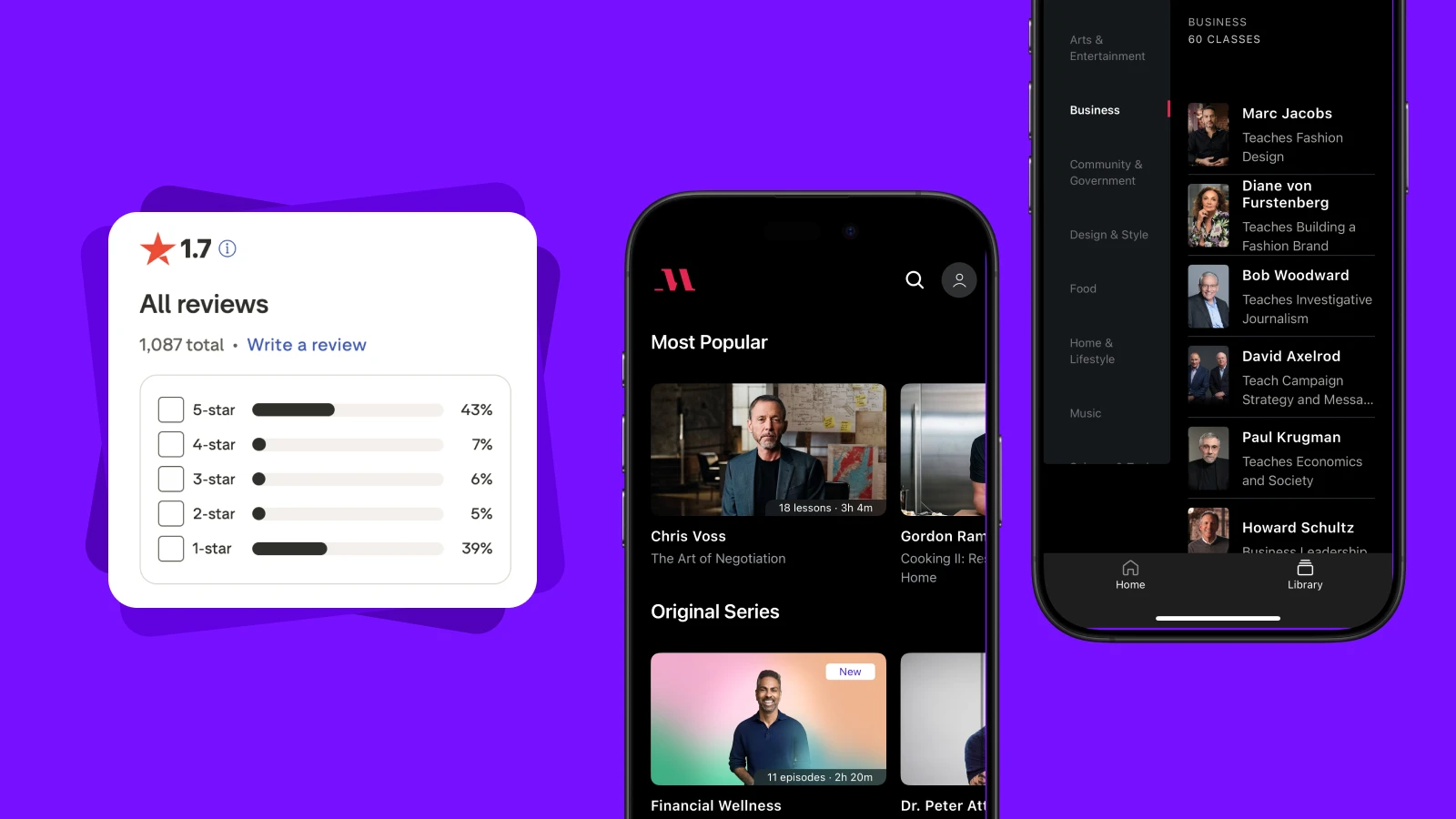
While MasterClasses are rated highly by the users of MasterClass, users express frustration about MasterClass as a company. They feel tricked into paying for a service that promised transformation but delivered inspiration instead.
One user commented, "Six months after I finished three classes, the inspiration disappeared and I'm still waiting for a positive change in my life. The classes were beautiful, but ultimately worthless time spent."
When corporate MasterClass subscriptions make sense
There's one context where MasterClass might deliver value: corporate entrepreneurship training where the goal is culture-building rather than skill development.
Some companies buy bulk subscriptions for employees. The idea is to provide in-depth access to inspiring content that broadens views. In this context, where the company pays, and the goal is general enrichment, MasterClass can work.
A marketing team might watch Seth Godin talk about branding and spark some interesting conversations. A leadership team could watch Bob Iger's discussion on running Disney and gather ideas for their own leadership philosophy.
But even with these types of videos, follow-up is essential. Without structured discussion, practice, and accountability, people will watch, feel inspired, and then change nothing about how they actually work.
The best MasterClass courses for business complement existing training. They don't replace it. Think of them as appetizers, not main courses. Use them to spark interest.
What to pick: MasterClass or other practical alternatives
MasterClass compared to other learning options:
MasterClass vs. Coursera:
Coursera aims on academic credentials by partnering with universities. Choose Coursera if you want certificates that help advance your career. But if you're looking for attractive, high-quality lessons from world-renowned instructors with no formal certificates, then MasterClass is the better option. Neither platform excels at helping you quickly apply practical skills, though.
Coursera courses take 4–6 weeks with homework. MasterClass takes 2–5 hours with no accountability. Both assume you'll somehow find time to practice.
MasterClass vs. Udemy:
Udemy offers more practical, in-depth courses at lower costs with a pay-per-course model. A single Udemy course often provides more useful step-by-step instruction than an entire MasterClass subscription.
Udemy features instructors who work full-time jobs and teach technical skills. MasterClass provides lessons from famous people who want to share their wisdom and philosophy. So if you want to learn Python coding, go with Udemy. But if you want to understand how Neil Gaiman writes, go with MasterClass.
MasterClass vs. Skillshare:
Skillshare offers a monthly subscription option. It focuses on practical creative skills. Classes are shorter and more project-based. The community actually works — students share results and get feedback.
Skillshare costs less. It offers more flexibility. It delivers better practical results. The production quality isn't as high as MasterClass's, but the learning outcomes are better.
MasterClass vs. YouTube:
YouTube tutorials often provide more practical value for learners who need immediate application. While MasterClass wins on polish, YouTube wins on practicality and variety of topics.
You can find step-by-step tutorials for basically any skill on YouTube. Taught by people who break down exactly how to replicate their process. It's less glamorous but more useful.
MasterClass vs. LinkedIn Learning:
LinkedIn Learning focuses on professional skills with certificates you can add to your profile. Courses are practical and thorough. They're designed around career advancement.
The instruction is solid but dry. MasterClass is entertaining but impractical. LinkedIn Learning is the better choice for career development.
The honest MasterClass review bottom line
MasterClass looks incredible and feels truly inspiring. Each lesson is like a little movie that you want to share with your friends. But pause for a minute: what has really changed in your life after watching it?
Have you written a novel? Have you negotiated a promotion? Have you cooked the perfect risotto? Or have you just imagined that you'll do it someday?
The platform doesn't deceive you. The videos are high-quality, and the instructors are legends. The problem is that for most people, this simply isn't enough.
Want to spend an evening watching Gordon Ramsay work with vegetables? MasterClass will suit you perfectly. Want to actually learn how to cook? You need practice, feedback, and step-by-step instructions.
The bottom line is simple: Is MasterClass worth it? It depends on what matters more to you — inspiration or real change. If listening to Serena Williams is enough for you and you enjoy it, then subscribe. But to truly improve at tennis, you need coaching and dedicated time on the court.
For most people who want to grow, improve their skills, and advance their careers, MasterClass is expensive entertainment disguised as education. The annual membership keeps you locked in, and it quickly becomes useless, like an old gym membership gathering dust.
Want real skills? Learn smarter with Headway, not just watch
You don't need celebrity instructors to change your life. You need the ideas that changed their lives. Distilled, practical, and designed to fit your daily life.
Instead of just watching Gordon Ramsay, try applying the tips from the books he recommends. You'll get real practice, and maybe even a risotto that doesn't collapse. Stop listening to entrepreneurship advice from famous founders. Start applying the frameworks from the books that built their empires.
📘 Try Headway today and discover what happens when learning actually fits your schedule. Instead of demanding you rearrange your life around it.
Real growth happens in 15-minute pieces during your commute. Not in 3-hour viewing sessions that you'll never have time for. It happens when you apply one technique today.
The choice is simple. Keep collecting inspiration you'll never use. Or start building skills that actually change your life. One feels productive. The other is productive. Choose wisely.
Frequently asked questions about MasterClass
Is MasterClass worth it?
MasterClass is great for inspiration — watching famous experts is fun. But if you want to actually pick up a skill fast, it's not the most practical choice. You're better off using microlearning platforms where the knowledge is immediately applicable and easy to remember.
Is MasterClass better than YouTube?
It depends on your goal. YouTube is like a free buffet — lots of everything, but without a system. Masterclass is like a well-written book with structure, examples, and the author's experience. If you want depth and polish, choose MasterClass. For a quick how-to or life hack, try YouTube.
What does MasterClass cost?
MasterClass subscriptions are annual, not monthly. The basic subscription provides access to all courses in the catalog for approximately $120 per year (~$10/month). The Plus plan is around $180, and the Premium plan (supporting up to 6 devices) is approximately $240 per year. Prices may vary slightly depending on promotions or your country.
Is MasterClass or Coursera better?
Coursera is like a university: in-depth courses with certificates, often with practice. MasterClass is like reading biographies of masters — inspiration and stories from the stars, but fewer exercises.
If you want practical skills, go with Coursera. If you want to be inspired by big ideas, try MasterClass.
Is Udemy better than MasterClass?
Yes, Udemy is often better than MasterClass if you care about practical skills and projects. Udemy offers tons of technical courses at low prices. MasterClass is more about inspiration and ideas from famous people. If you want step-by-step instructions with exercises, choose Udemy.
What is the best platform for online classes?
For in-depth professional courses, use Coursera or edX. For practical skills and affordability, go to Udemy. For inspiration from celebrities and beautiful production, MasterClass is solid. And Headway offers a fast path to knowledge. With our 15-minute audio and text summaries from the best nonfiction books, it's ideal for daily development without information overload.