Self-growth
 Business & Career
 Success
 Communication
 Healing
 Relationships
 Psychology
 Happiness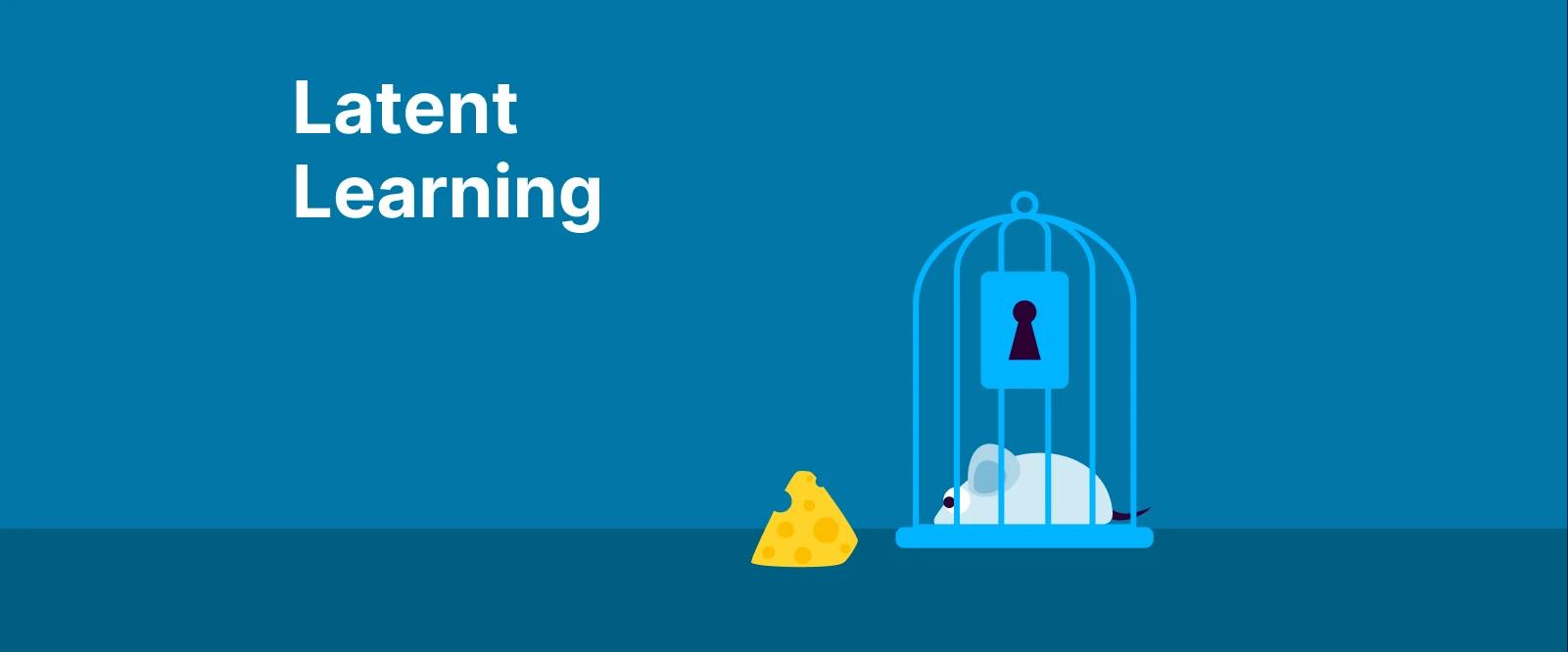
You've been absorbing information your whole life without knowing it. That shortcut you suddenly "remembered" during a stressful commute? That random fact that popped up at a dinner party? That wasn't luck. Your brain was using latent learning — your hidden superpower working behind the scenes.
Ready to understand how your brain really works and how to use it? Let's do that together!
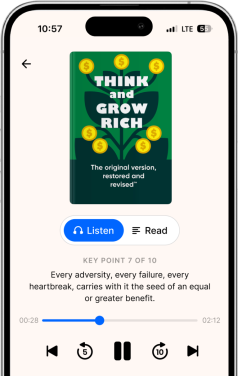
📘 And if you'd like to explore how learning actually sticks, try Headway. This microlearning app breaks down psychology and personal growth insights into bite-sized summaries you can listen to anytime, anywhere.
Quick answer: What is latent learning?
Latent learning is the subconscious absorption of knowledge that occurs without an immediate reward or motivation to display it. The information remains "hidden" in your mind until a specific need arises to use it.
Think of it like downloading a file in the background while you do other work. The file sits on your computer, invisible and unused. But when you need it? It's already there, ready to open. Your brain works the same way — storing mental maps and patterns until the moment you actually need them.
Latent learning flipped traditional learning theory on its head. Before Edward Tolman discovered the phenomenon, behaviorist psychologists believed that all learning required reinforcement. No reward? No learning. But the rats in one famous experiment proved them wrong.
Love learning new things?
Make it fun, where your knowledge is the ultimate reward!
Rethink how you learnThe science: Why your brain loves "hidden" data
Tolman's experiments
In the 1930s, psychologist Edward C. Tolman at the University of California, Berkeley, ran a series of experiments that challenged the dominant behaviorism of his time. Working alongside researchers like Honzik and Blodgett, he tested groups of rats in complex mazes.
Here's the setup: Three groups of hungry rats navigated a maze over several days.
Group 1 received a food reward at the end of the maze every time.
Group 2 never received any food.
Group 3 explored freely for ten days without reward, then received food starting on day eleven.
Group 1 quickly learned to navigate efficiently. Group 2 wandered aimlessly. But Group 3? After ten days of seemingly random exploration, they received food on day eleven — and by day twelve, their maze performance matched the rats who'd been rewarded all along.
What happened? The unrewarded rats had built a cognitive map — a mental representation of the maze — without any immediate reinforcement. They learned the layout through trial and error, but didn't show their knowledge until motivation appeared.
Blodgett originally coined the term "latent learning" to describe this phenomenon in 1929, and Tolman expanded on the concept in his landmark 1948 paper published in Psychological Review, titled Cognitive maps in rats and men.
Tolman's discovery shattered the stimulus-response model that dominated behavioral psychology. The rats weren't just reacting to rewards. Their mental processes were building internal knowledge the entire time.
What Tolman's rats still teach us about learning in 2026
Your brain still works this way. You're constantly mapping your digital environment without realizing it. You know exactly where the "back" button is on every app. You navigate websites without thinking. You've built cognitive maps of interfaces you use daily.
Your brain also does the same thing through observational learning. Watching others navigate a new system, overhearing conversations, scrolling through information — your brain absorbs patterns even when you're not actively trying to learn.
➡️ Traditional learning vs microlearning: what's the difference?
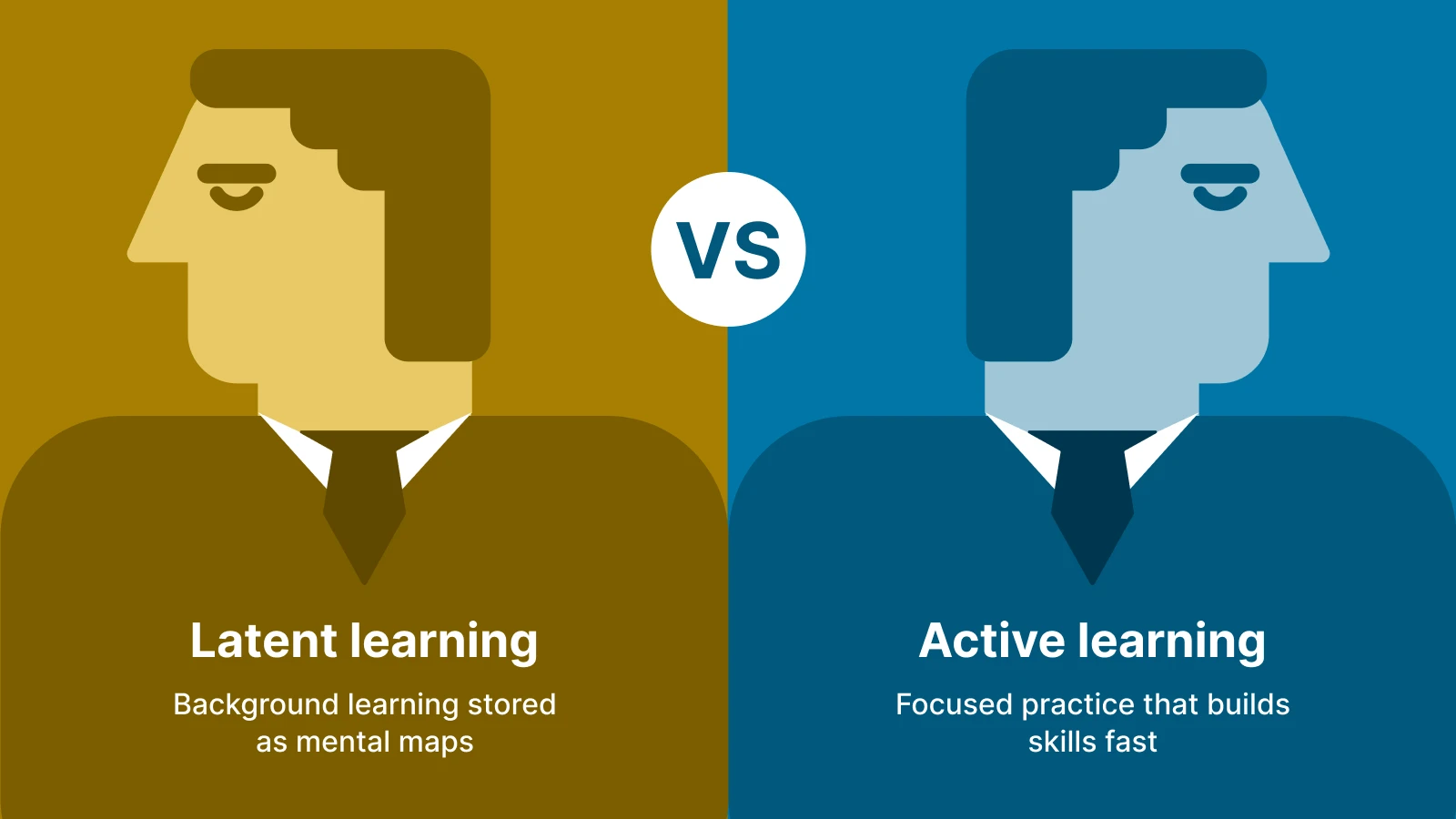
Latent learning vs active learning
| Aspect | Latent learning | Active learning |
|---|
Effort | Low — happens automatically | High — requires focus |
Reinforcement | Not required | Often required |
Awareness | Usually unconscious | Conscious and intentional |
Display | Delayed — shown at a later date | Immediate |
Retention | Stored as mental maps | Stored through practice |
Decision-making | Influences choices subconsciously | Guides deliberate choices |
Both learning styles matter. Active learning builds specific skills through operant conditioning and direct practice. Latent learning creates the background knowledge that makes learning styles like observational learning and social learning theory possible.
Here's an example of latent learning that you've probably experienced before. You walk the same route every day, so when your friend asks how to follow that route, you instantly know how to guide them through it. You weren't studying the path. Your brain just absorbed the information and stored it as a mental map.

How latent learning works in an always-on digital world
The scroll effect
Every time you scroll through social media, you're engaged in latent learning. You absorb trends, news headlines, music preferences, and cultural shifts without trying. Your brain builds mental representations of what's popular, what's changing, and what matters — all through passive exposure.
Your subconscious pattern recognition explains why you can sometimes "predict" a trend before you consciously notice it. Your problem-solving mind has been collecting data in the background.
The danger: Negative latent learning
Here's the flip side. If your environment exposes you to negativity, your brain absorbs that too. Doom-scrolling doesn't just waste time — it trains your brain against your best interests. Your mental map of the world gets filled with anxiety-triggering patterns you didn't choose to learn.
Habitual negative exposure can shape your worldview without you realizing it. That's why what you expose yourself to matters, even when you're "just browsing."
How to use latent learning for personal growth
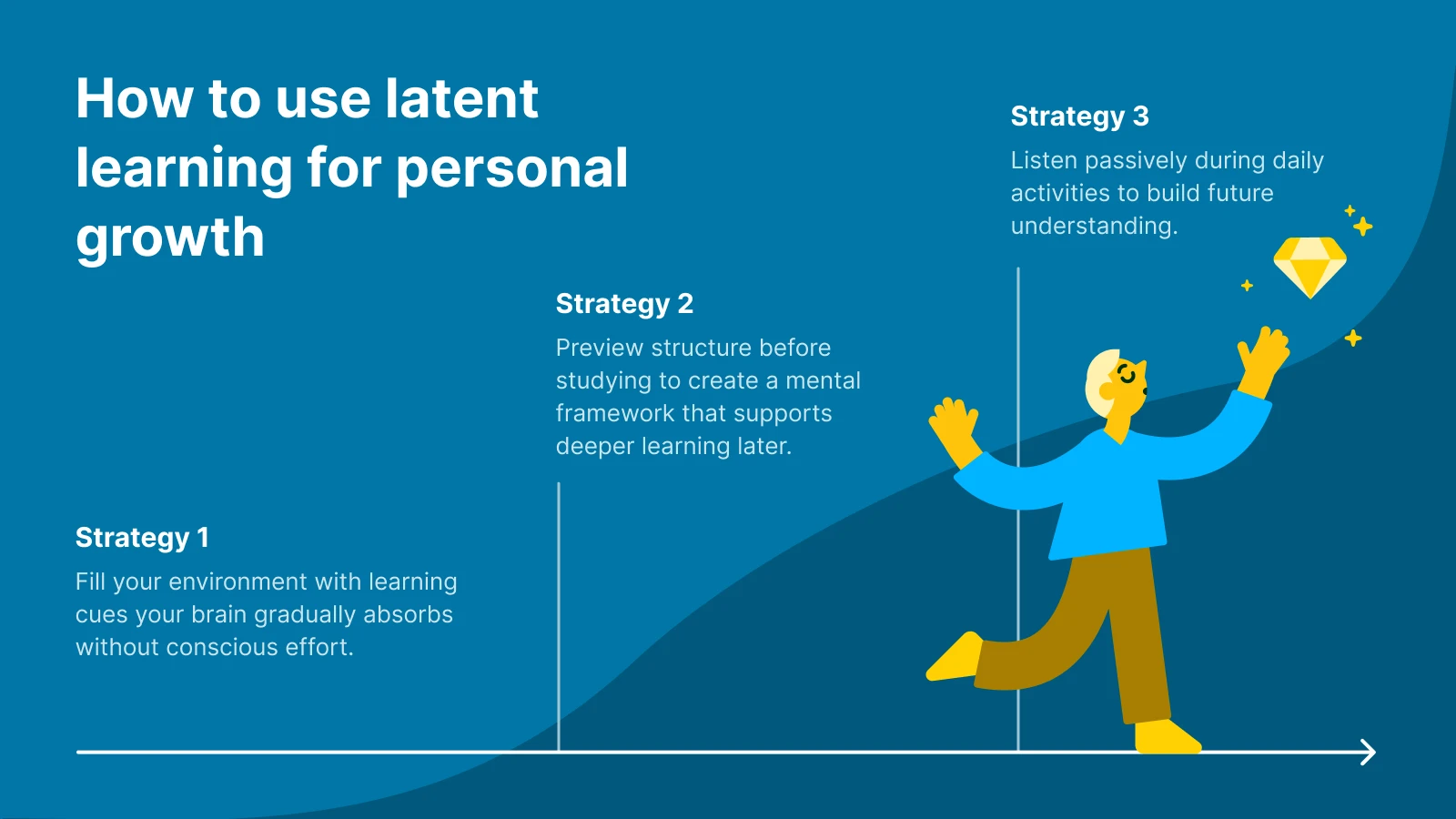
Strategy 1: Environmental immersion
Surround yourself with what you want to learn. Keep books visible. Set helpful notifications. Fill your environment with cues that trigger passive learning.
Your cognitive map will expand to include whatever consistently appears in your environment. This is the attribution effect at work — your brain assigns importance to things it encounters repeatedly.
Strategy 2: The preview method
Before diving deep into a subject, skim the structure first. Read a table of contents. Scan the headings. This practice creates a mental map of the maze before you start running through it.
A learner who previews material builds a framework that makes detailed study more efficient. You're essentially giving your brain a roadmap before the actual journey.
Strategy 3: Passive audio
Listen to ideas in the background while commuting, exercising, or doing chores. As an example, podcasts and audio summaries in apps like Headway prime your brain for later mastery. You might not remember every detail, but your mind creates connections you can access when needed.
The rats in Tolman's experiments worked the same way. They absorbed maze layouts without immediate reinforcement, and the knowledge simply waited for the right moment.
📘 Prime your mind with Headway.
Turning "latent" into "limitless" with microlearning
Microlearning bridges the gap between latent and active learning. The approach builds on the effortless absorption your brain naturally provides and adds just enough structure to make it stick.
The Headway app is built for exactly this kind of growth. Here's why it works with your brain's natural learning processes:
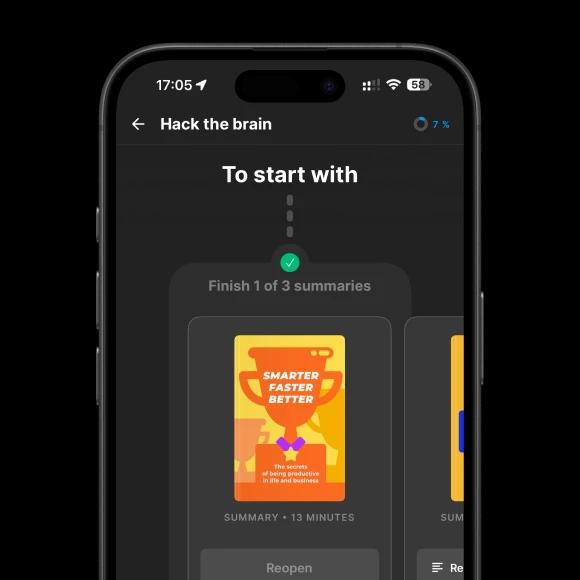
The daily spark: Just 5–15 minutes of reading creates what we might call "latent seeds" — ideas that bloom when you face a real challenge at work or in life. You absorb insights without pressure, and they surface when you need them.
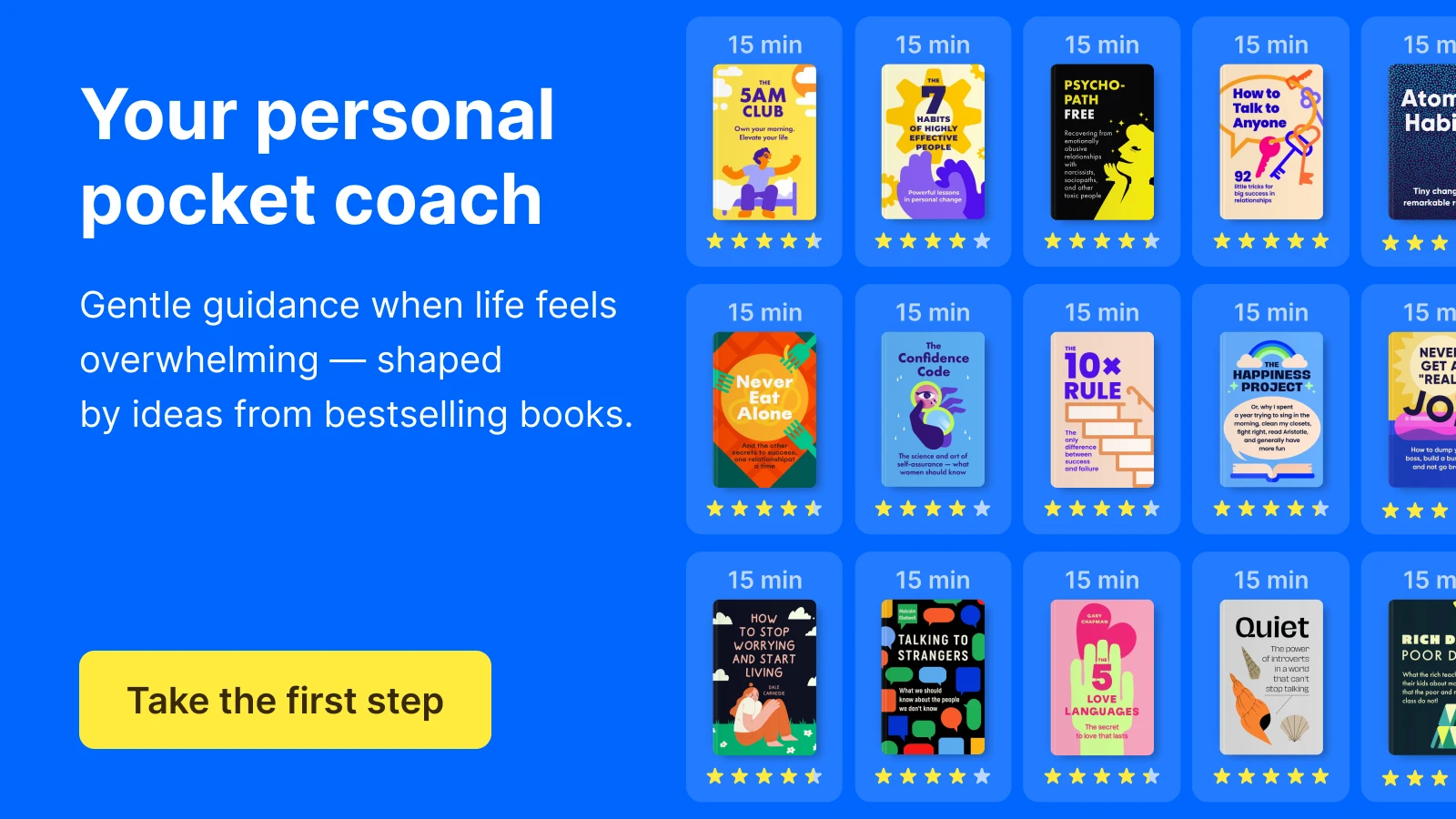
Visual cues: Book covers, skill islands, and growth plans in the app build a "growth environment" right on your phone. Instead of scrolling through negativity, you're exposing yourself to ideas that shape a positive cognitive map.
Bite-sized learning: Short summaries work with your brain's preference for background absorption. You're not cramming — you're building mental maps one small piece at a time.
Ready to understand the science behind your brain's hidden learning abilities? These Headway summaries will change how you think about thinking:
'How We Learn' by Benedict Carey explores why your brain retains information even when you're not actively studying. Carey challenges conventional wisdom about learning and reveals the surprising science of how memory really works — including the passive absorption at the heart of latent learning.
'Make It Stick' by Peter C. Brown, Mark A. McDaniel, and Henry L. Roediger III draws on cognitive psychology to explain how we acquire skills and knowledge. The authors uncover the mechanisms behind retention, including how your mind absorbs information without conscious effort.
'Thinking, Fast and Slow' by Daniel Kahneman introduces two systems of thinking. System 1 is fast, intuitive, and automatic — processing vast amounts of information without deliberate effort. Kahneman's framework connects directly to latent learning and explains why your brain knows more than you realize.
📘 Ready to put your brain's hidden superpower to work? Download the Headway app and start building knowledge that surfaces exactly when you need it. Your future self already learned that this was a good idea — it just didn't know it yet.
Frequently asked questions about latent learning
Is latent learning permanent?
Latent learning can be long-lasting, but it's not always permanent. Like any memory, these hidden mental maps can fade without reinforcement. However, knowledge stored through repeated exposure tends to stick around longer. The more often you encounter information passively, the stronger and more durable that cognitive map becomes over time.
Can adults use latent learning effectively?
Absolutely. Adults use latent learning constantly — navigating new workplaces, picking up industry jargon, or learning social dynamics without formal training. The key is intentional exposure. Surround yourself with the information you want to absorb. Adults who create learning-rich environments tap into this natural brain process just as effectively as children do.
What is an example of latent learning?
Here's a classic example: You ride to work as a passenger for months, not paying attention to the route. Then one day you need to drive yourself — and you know exactly where to turn. Your brain built a mental map without you trying. The knowledge was latent until you needed it.
What's the difference between latent and regular learning?
Regular learning happens when you actively study and immediately show what you know. Latent learning works in the background — you absorb information without rewards or conscious effort, and it stays hidden until needed. Think of regular learning as downloading a file intentionally, while latent learning downloads automatically without you noticing.
What is latent learning in education?
In education, latent learning explains why students absorb more than tests reveal. A child exploring a classroom learns spatial layouts, social rules, and procedures without direct instruction. Teachers can use this principle by creating rich learning environments where students passively absorb concepts before formal lessons begin — making active learning easier later.
What are the benefits of latent learning?
Latent learning builds knowledge without mental fatigue or pressure. The process creates flexible cognitive maps you can apply to new situations. Background learning reduces the effort needed for formal study by providing context. And it happens naturally since your brain is always learning, even during your downtime. You grow smarter just by showing up.