Self-growth
 Business & Career
 Success
 Communication
 Healing
 Relationships
 Psychology
 Happiness
Have you ever been stuck on a problem for hours, given up, and then had the answer hit you out of nowhere while doing dishes?
That's insight learning. In short, it is a form of learning through which the solution to a problem comes suddenly after perceiving relationships among elements. German psychologist Wolfgang Köhler studied this in chimpanzees by observing them as they sat motionless before a problem, before solving it in seconds without trying different approaches.
The aha moment you get when solving something this way isn't random. Your brain takes the information you already have and reorganizes it until the answer appears fully formed.
Headway's 15-minute book summaries give you concentrated knowledge that your brain can pull from later and connect to past experiences when you need it. More quality input means more raw material for those eureka moments.
📘 Download Headway and stock up on the information that leads to breakthroughs!
Quick answer: What is insight learning? With example
Insight learning means solving a problem through sudden understanding rather than testing options until one works. For example, you're moving a couch, and it won't fit through the door no matter which angle you try. You step back for a second, then it hits you — take the legs off. That's insight learning.
What makes insight learning unique
Most learning falls into three main types, and insight learning stands apart from the other two.
Trial and error is what most of us do naturally. You test an idea, watch it fail, adjust something, and try again. Each mistake teaches you a little more until something finally works. The approach takes time, but you're building knowledge with every failed attempt.
Observational learning speeds things up. You watch someone else solve a problem, then copy their method. You skip the trial-and-error phase entirely by learning from their experience instead of your own.
Insight learning works differently. Your brain pulls information from past experiences, reorganizes it without you noticing, and delivers a complete solution. The suddenness is what makes it strange. You're not working through steps or testing ideas. You just see the answer.
Here's how insight learning compares to other methods:
| Learning type | How it works | Speed | Understanding |
|---|
Insight learning | Sudden realization through restructuring | Instant aha moment | Deep — you understand why it works |
Trial and error | Test multiple solutions one at a time | Slow and gradual | Shallow — you know what works, not why |
Observational learning | Copy someone else's method | Fast to replicate | Depends on how well they explain it |
The knowledge you gain through insight applies to other contexts (transferable) as opposed to knowledge obtained through memorization, which is limited to the context in which you learned it. Therefore, cognitive processes developed through insight are more functional than those developed through rote memorization because they apply across a variety of contexts.
The science and history behind insight learning
Wolfgang Köhler was a German psychologist who conducted research on Tenerife during World War I involving chimpanzees. He was interested in determining whether animals could learn solutions to problems based on their comprehension of the situation, rather than solely on repeating behaviors that led to food. Köhler's work was part of the Gestalt psychology school of thought (the study of perception of wholes rather than individual parts).
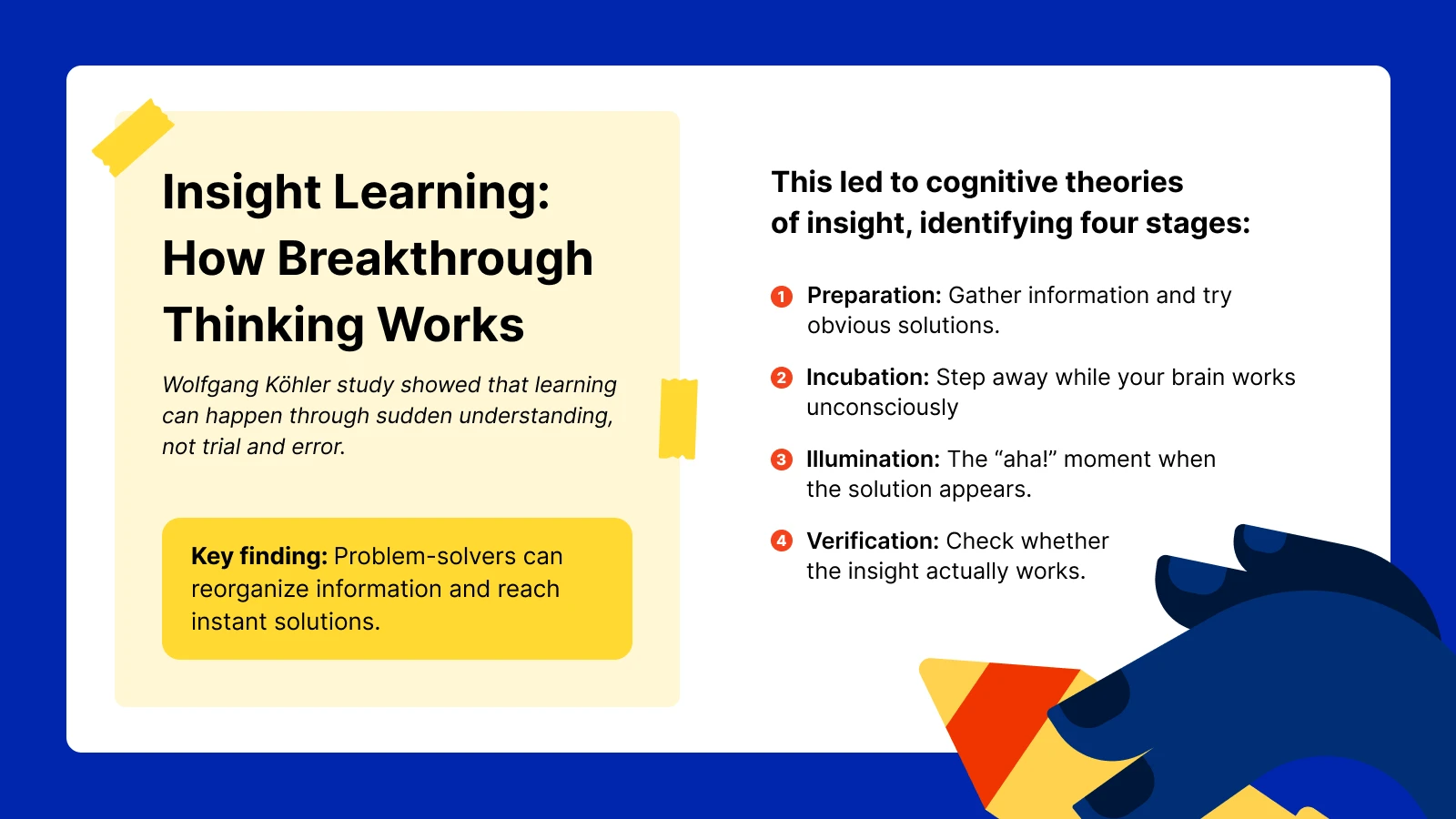
His most famous case involved a primate, a chimpanzee named Sultan. Köhler put bananas outside Sultan's cage, too far to reach, and gave him two bamboo sticks that were each too short. Sultan tried one stick, failed, sat down frustrated, then suddenly fitted the sticks together and grabbed the bananas. Köhler wrote about this in 'The Mentality of Apes,' showing that Sultan didn't use trial-and-error learning — he had an eureka moment.
Köhler's findings contradict Edward Thorndike's view that animals only learn by testing random behaviors until something works. Köhler's experiments proved that problem solvers sometimes pull from past experiences, reorganize how they see a problem, and reach breakthroughs without gradual testing.
Researchers built cognitive theories on Köhler's work later. They found four stages when people experience insight:
Preparation — Gather information and try obvious solutions.
Incubation — Step away while your brain works unconsciously.
Illumination — The aha! moment when the solution hits.
Verification — Check if your insight actually works.
Your brain hits an impasse when usual thinking patterns fail. Then something shifts, and you reorganize the information differently. The APA describes insight problem solving as sudden comprehension of how problem elements connect, which is why it feels completely different from testing options one by one.
📘 Headway gives you knowledge across different fields where insight learning happens. Download it now.
Real-life examples and aha moments
Insight learning happens all the time in real-life situations, but you probably never thought to call them by that name.
Imagine you try to park your car in a space, but you keep hitting the curb. You adjust the angle, check your mirrors, and back up slowly, but none of these things work. Frustration builds. Then suddenly it dawns on you that you turn the steering wheel too soon. You visualize the timing of your turns, and the next attempt at parking is successful.
Or suppose you're learning to play the guitar, and no matter how hard you try, one chord just doesn't sound right. You've double-checked your finger placement with diagrams, adjusted your pressure, and even tried different positions. Then, it hits you — your palm is accidentally muting a string. The moment you spot the issue, the solution becomes crystal clear. Here are a few more relatable examples:
Work: You're trying to explain a complicated concept to your team, but your usual presentations just aren't cutting it. Then, it dawns on you that using a familiar analogy could make all the difference, and suddenly, everyone understands.
Creative blocks: A writer finds themselves staring at a blank page for what feels like an eternity, only to realize that the story would be much stronger if it started from the ending.
Math homework: You're completely stumped on an equation until it suddenly clicks that it follows the same pattern as a problem from last week, just with different numbers.
Home repairs: Your sink is clogged, and despite plunging it, checking for blockages, and pouring in drain cleaner, nothing works. Then you remember installing a new faucet last month and realize the pop-up stopper is misadjusted.
Each of these is an aha moment, where your brain reorganizes information you already had. Learners who experience insight aren't slowly getting closer to an answer — they just see it. The solution shows up complete once your brain stops trying to force the wrong approach and restructures how it sees the problem.


How to develop insight learning skills
You can't force insight learning, but you can increase the likelihood by setting the right conditions.
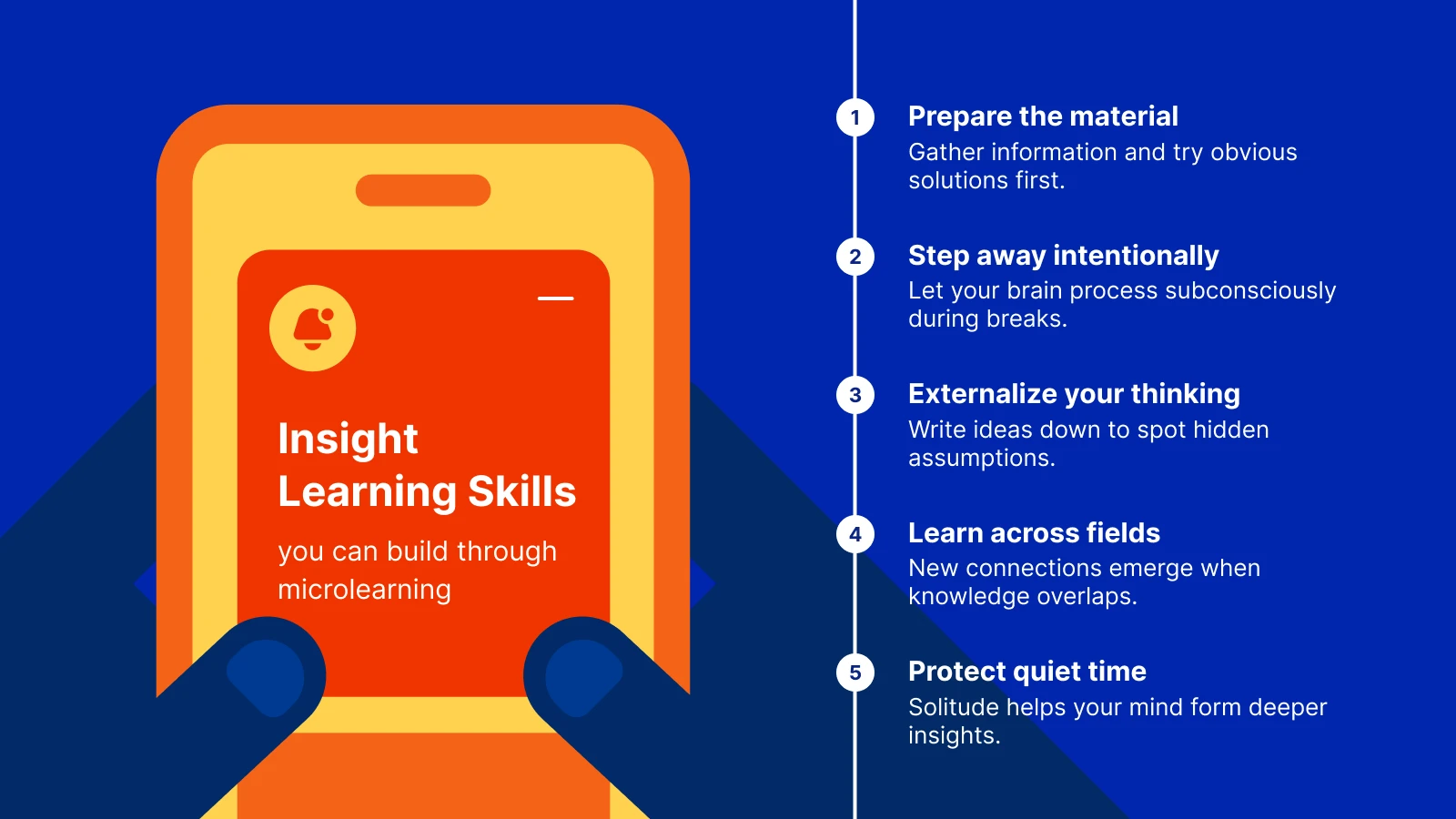
1. Load up on preparation first
Insight learning thrives on having the right raw material. Take the time to gather all the information related to your problem before you expect any lightbulb moments. Dive into research, look at examples, and try out some straightforward solutions. Remember, your brain can't rearrange information it doesn't have.
2. Step away during incubation
After you've done your prep work, step back from the problem. Go for a walk, get some sleep, or engage in a different activity. Even when you're not actively thinking about it, your brain is still processing things during this incubation phase. That's why those "aha" moments often come to you in the shower or while you're driving — your conscious mind is out of the way, allowing your cognitive processes to flow freely.
📘 Get Headway and learn about cognitive processes, creativity, and insight in 15 minutes.
3. Write things down
Keep a notebook for problems you're stuck on. Writing forces you to see your thinking from outside your head. You'll catch assumptions you didn't know you were making. Sometimes the aha moment happens right there on the page.
4. Learn across different fields
Study things unrelated to your main work. A problem solver who only knows one domain has fewer patterns and heuristics to pull from. These breakthroughs often come from connecting ideas across fields that don't usually talk to each other.
5. Protect time for solitude
Constant noise keeps your brain in reactive mode. Block out hours where you're alone without devices. Boredom and quiet create conditions where your mind can make connections it couldn't reach while distracted.
📘 Try Headway and read or listen to summaries on how insight learning works in practice.
Applications and benefits of insight learning in daily life
Insight learning matters because once you've had a breakthrough on something, you don't just get the answer — you get a new way of seeing that type of problem.
Better problem-solving comes from recognizing when you're stuck and need to take a step back. Those who grasp the concept of insight learning know not to force solutions when they hit a wall. They understand that their brains need a little breathing room to work effectively.
This approach is far more productive than spending hours banging your head against the same failed strategy.
Creative thinking thrives on connecting seemingly unrelated ideas. Artists, writers, and designers rely on these moments of inspiration. The more diverse experiences and reading material you expose your brain to, the richer the pool of insights it can draw from.
You'll pick up new concepts more quickly when you focus on understanding rather than rote memorization. Learners who grasp the core principles can apply their knowledge to different situations. Just memorizing steps for one problem can leave you feeling lost when the context changes.
Innovation often springs from spotting solutions that others overlook. Research in the social sciences indicates that individuals who frequently engage in insight learning are better at adapting to changes in their work environment. They draw on past experiences in surprising and creative ways.
The cognitive process behind insight learning is pattern recognition happening faster than conscious thought. Feed your brain better patterns.
Get more insights with Headway!
Insight learning needs enough quality information for your brain to reorganize and make new connections. The more you know across different subjects, the more options you have when you're stuck.
Headway offers book summaries that give you concentrated knowledge from thousands of books on cognitive psychology, business, science, and personal development. By doing this, you're essentially building a library of frameworks and examples of insight learning that your brain can tap into when you need those lightbulb moments.
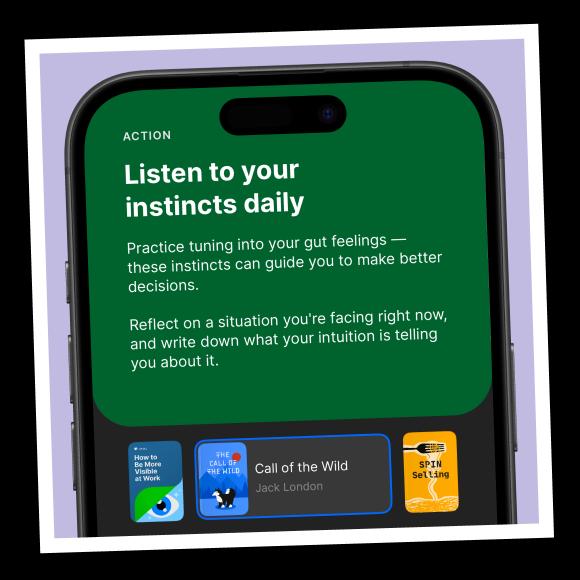
You're on your phone anyway — spend 15 minutes reading something useful instead of whatever you'd normally scroll through.
📘 Download Headway and stock up on knowledge that turns into better insights!
FAQs about insight learning
What is an example of insight learning?
Here's an example of insight learning: you're trying to hang a picture, but the nail just keeps bending, no matter how hard you hit it. You've tried different angles and put in some muscle, but nothing seems to work. Then, suddenly, it dawns on you — the wall is made of concrete, and you really need a drill instead of a hammer. You weren't tackling the wrong issue — you just needed that moment of clarity to see the real problem.
What are the 4 stages of insight learning?
Here are the 4 stages of insight learning: 1) Preparation is when you gather information and try obvious solutions. 2) Incubation happens when you step away, and your brain works on it unconsciously. 3) Illumination is the aha moment when the answer shows up. 4) Verification is checking if your insight actually fixes the problem. These stages don't always follow a clean order, though.
What are the characteristics of insight learning?
Breakthroughs happen suddenly, not gradually. You reorganize information you already have instead of testing new things. The solution shows up complete, not in pieces. You get why it works, not just what works. And you can use the same logic on different problems later because you understand the principle behind it.
Is insight a skill or a trait?
It's definitely a skill you can develop. You improve by exploring various subjects, allowing problems to simmer instead of forcing answers, and knowing when to take a break. The more knowledge you gather from different areas, the more your brain has to draw from when it's time to make those connections.