Self-growth
 Business & Career
 Success
 Communication
 Healing
 Relationships
 Psychology
 Happiness
What happens when silence becomes the loudest part of your story? Laura Nowlin shows how grief quietly sets in through the things left unsaid, exploring the consequences of loss and missed moments in her thought-provoking novel.
This complete 'If Only I Had Told Her' summary covers plot details, character analysis, and that gut-wrenching ending. You'll also find recommendations for similar books on love, grief, self-growth, trauma, and healing, conveyed in a concise way on the Headway app — a microlearning and productivity app for your daily life.
Try Headway today and become a better version of yourself with nonfiction bestsellers!
Quick summary of 'If Only I Had Told Her':
Finn's unspoken love for Autumn ends in tragedy
Three perspectives reveal grief's different faces (Jack's guilt, Autumn's depression)
Teen pregnancy becomes a symbol of hope and healing
Mental health crisis and hospitalization shape the journey
The ending offers bittersweet acceptance and new beginnings
Keep reading for the complete breakdown of this emotional rollercoaster.

Master resilience after trauma
Tackle tough challenges with proven strategies from top non-fiction bestsellers.
Get startedWhat happens in 'If Only I Had Told Her'? (spoiler-free overview)
Finn's, also known as Finny, love for Autumn has always exceeded that of a casual teenager. Their friendship is one that will last a lifetime, with a silent understanding that one will always be there for the other.
Despite his feelings being more romantic than friendship, he never finds the right moment to express his desires. Finn is dating Sylvie, and Autumn was dating Jamie until recently.
Told from three perspectives, Finn's, Jack's, and Autumn's, the novel speaks about the emotional consequences of a tragedy that completely changes their lives. Finn's chapters reveal the depth of his love and the toll silence took on him.
Jack is Finn's best friend, and his portion shows how someone can move from grieving to surviving. Autumn's part is about what it means to live with the regret of not having enough time, and of not being open enough.
📘 Learn to express love before it's too late — get Headway.
'If Only I Had Told Her' full plot breakdown (spoilers ahead)
The following section contains spoilers, so consider skipping if you'd like to preserve the mystery.
Finn's perspective: Love, timing, and tragedy
The book starts with Finny's POV, written as journal entries and memories. He's in a relationship with Sylvie, but he's in love with his best friend and doesn't have the courage to confront his feelings — for fear of ruining their friendship.
Unexpectedly, the moment arrives when he finds glimpses of himself in a novel Autumn wrote. When they finally cross a line, he formulates a plan to break up with Sylvie and finally be with the girl he has always loved.
His happiness doesn't last. Finn dies in a car accident, and this moment marks the end of part one, serving as the first turning point of the novel.

Jack's perspective: Guilt, isolation, and survival
Jack's chapters come next. As Finny's best friend, Jack was the one who knew him best, although Finny never spoke of his struggles aloud. His chapters are filled with raw emotions, with his grief manifesting through isolation and anger.
His only connection to his best friend remains Autumn, whom he didn't fully understand or appreciate before Finn's final moments.
During his first year in college, he refuses to form connections — even with his roommate — and still imagines how he and his best friend would have spent their days if life had been more generous.
Jack feels somewhat guilty for having the time to enjoy certain moments, while Finn can no longer do so.
Autumn's perspective: Depression, crisis, and hope
Autumn's chapters are the most emotionally intense. She's devastated by Finn's death and can no longer explore what their newly formed relationship could have been.
She feels guilty for not daring to move from friendship to love earlier, for allowing him to break up with his girlfriend that particular evening, and mostly for being alive without her other half.
Autumn's grief spirals into depression, and she eventually ends up hospitalized after a mental health crisis that culminates in a suicide attempt. She discovers she's pregnant and decides to keep the baby, seeing it as her only link to Finn.
She becomes close with Jack, with both finding a form of closure in each other's presence.
Critical moments that shape the story:
Finn and Autumn finally confess their feelings.
Finn's passing leaves his close friends and family in shock.
Jack's grief and final acceptance of his best friend's death.
Autumn's mental health crisis and pregnancy.
The final scene shows Autumn writing to Finn, choosing to live and honor his memory.
Who are the main characters in 'If Only I Had Told Her'?
In 'If Only I Had Told Her,' all characters are shaped by silence and grief. Laura Nowlin writes about people who carry those emotions in their bones and how their human connections are affected.
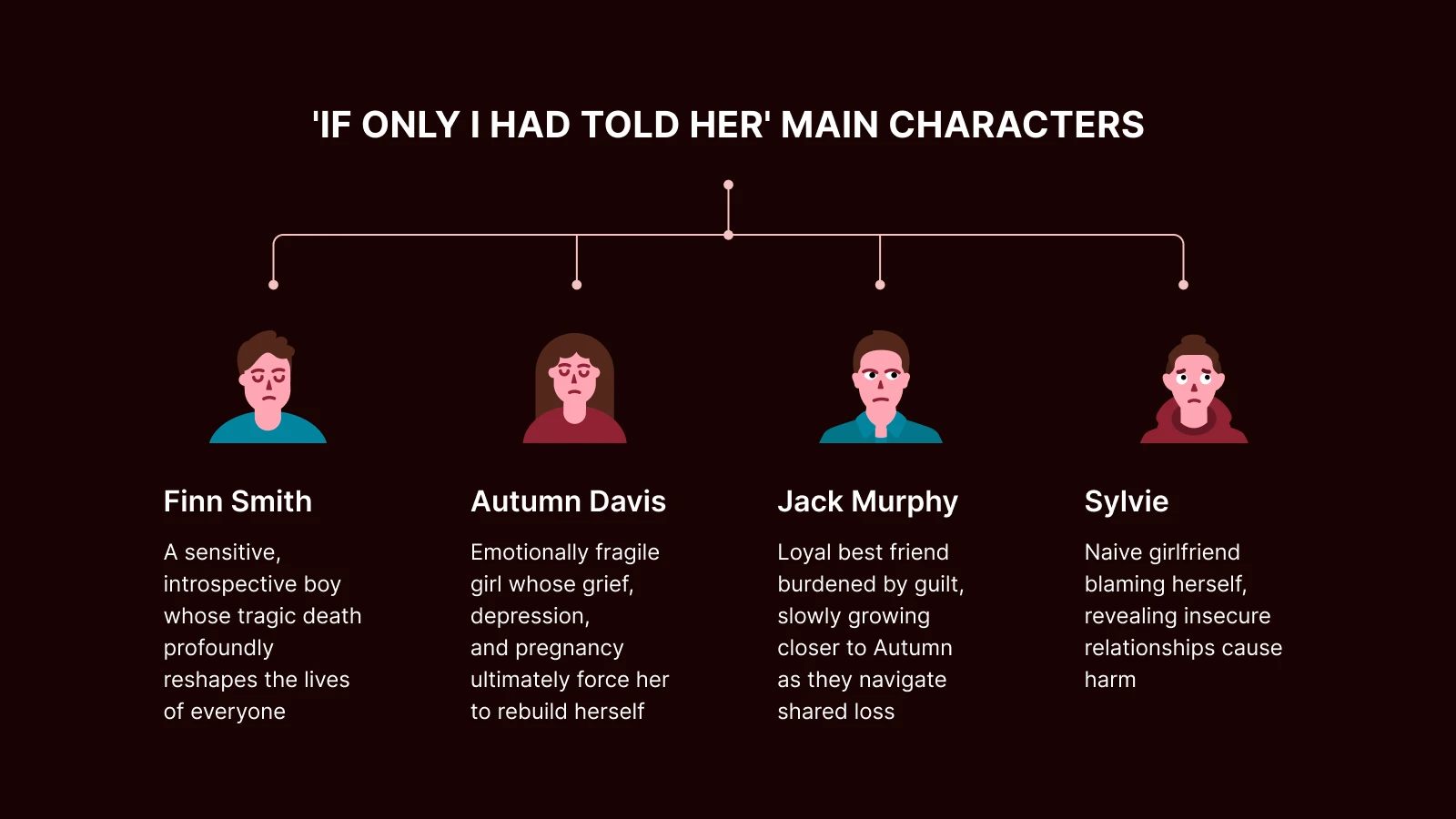
Finn (Finny) Smith is the soul of the story, even after his passing. The first chapters show him as being sensitive and introspective. His love for Autumn is all-consuming, and he feels stuck in a relationship with Sylvie that just isn't good enough. The highest emotional point is when he and Autumn finally have a chance at love. His death in a car accident is the novel's turning point, and his absence changes the lives of his best friends and family forever.
Autumn Davis is Finn's childhood friend and love interest. Her point of view is the most emotional one, representing the novel's final section. She got only a glimpse of what a relationship with the perfect boy would feel like. Her grief evolves into depression, culminating in an act of self-harm, but the discovery of her pregnancy forces her to redefine herself. Her emotional vulnerability makes her one of the most relatable characters in contemporary YA fiction.
Jack Murphy is Finn's best friend and the narrator of the middle section. His loyalty manifests as guilt for getting to live through moments that Finn will no longer experience. He feels the need to be strong for Finn's mother and even Autumn, with whom he eventually develops a friendship. While the novel doesn't fully reveal their future, there is a tenderness between them that suggests something more.
Sylvie, Finn's girlfriend at the beginning of the novel, is initially given symbolic guilt for his death. Her temporary amnesia after the accident suggests she blames herself as well. Sylvie's role is minor, but through her, the author shows how young girls can be naïve and cling to relationships that may not be healthy or solid.
📘 Understand grief and human connection — get Headway.
What themes does 'If Only I Had Told Her' explore?
With her novel, Laura Nowlin examines various themes through layered perspectives and emotionally charged scenes. Let's explore these topics, each revealing a different aspect of the story's emotional core.
1. Unspoken love and crushing regret
One of the central elements of the story is lost time and what-ifs. Finn and Autumn don't have enough time to explore their romantic relationship. She regrets not daring to speak up earlier and also all the time she spent on what now seem like meaningless friendships, instead of spending more time with her Finny.
A book with a similar theme is 'The Five Love Languages' by Gary Chapman, which speaks about understanding how people express and receive love.
2. Grief and healing
Grief and healing look different for everyone. Jack becomes consumed by guilt, while Autumn faces depression. Both have slow healing journeys and find strength in different kinds of relationships. Jack must be strong for Finn's loved ones, and Autumn finds her desire to live during her pregnancy.
The novel shows that the desire to overcome pain is a choice each person must make, and that stability can be found in unexpected places.
This theme especially resonates well with readers who have experienced loss. It validates the complexity of mourning and the quiet resilience required to keep going.
Overcome life's toughest moments
Unlock powerful strategies from best-selling non-fiction books to guide you through.
Get started3. Communication and missed moments
The novel shows how sometimes we don't have enough time to say the right things or enjoy the company of our loved ones. Autumn's relationship with Finn never took the next step publicly. Jack doesn't get to experience college with his best friend. These missed moments shape how the main characters perceive life after Finn's death.
A book that explores how to say the things that matter before it is too late is '12 Rules For Life' by Jordan B. Peterson. Its summary is available in the Headway library.
4. Identity and growing up
Both Jack and Autumn must find themselves once more, after Finn's death. Jack has trouble bonding with his new roommate, feeling as if he betrays Finn's memory, and Autumn has to learn to live without the comfort of her childhood friend and a true love story. Similarly, the adults mentioned in the story must accommodate their lives around Finn's loss.
5. Pregnancy, loss, and hope
Teen pregnancy acts as a wake-up call, in a way. It offers the power to move on, serving as a healing tool for Autumn and a means for Jack to find a new purpose by being involved in her new role. With this, the author offers a reminder that life continues, with her characters choosing hope and choosing to honor Finn's memory by building something new.



How does 'If Only I Had Told Her' end?
The novel concludes with a quiet acknowledgment of loss. Jack remains a steady presence throughout Autumn's recovery, and their bond deepens into something tender and sustaining.
At first, Jack's opinion of her wasn't great. In the end, he accepts her importance in Finn's life. Their new connection is symbolic, showing how both find comfort in the memories they have of Finn.
Autumn's letter is a promise of a life lived in full — for Finn, for a future they could have shared.
What works (and what doesn't) in Laura Nowlin's novel
'If Only I Had Told Her' has several strengths, but it also poses some challenges. This section explores aspects that may resonate with many book lovers, along with some that could be seen as less positive.
Strengths
Emotional depth: The novel offers a realistic portrayal of what it means to lose a best friend and a lover, as well as the strength it takes to overcome it.
Multiple perspectives: By presenting Finn's, Jack's, and Autumn's voices, Nowlin gives a complete overview of life before and after a traumatic event. Each perspective adds more context to the story, revealing emotions that would otherwise be invisible from a single viewpoint.
Relatable grief and healing arc: Readers can easily relate to the pain each character goes through, especially considering how Autumn's breakdown and Jack's guilt reflect the many ways people process loss and find the strength to heal.
Realistic portrayal of teenage emotions: Throughout his part, Finn is a teenage boy, dealing with adolescent emotions. We see him navigating high school, trying to fit in with the crowd and look cool for his love interest.
Weaknesses
Heavy subject matter: The novel has heavy themes, such as grief and depression, and can be overwhelming for readers seeking lighter fare or faster-paced storytelling. Content warnings should be read before diving into the story.
Slow pacing in middle chapters: Jack's section may feel repetitive, as he constantly questions how his friend died and looks for someone to blame. There are instances where he imagines a different outcome, or multiple moments where he points out his dislike for Autumn.
Limited development of side characters: Sylvie's childhood trauma is briefly mentioned, and we don't see how she fully deals with her boyfriend's death. The mention of her going to therapy may seem like something to brag about, not necessarily a significant step in her recovery.
📘 Process grief and heal stronger — get Headway.
If you loved Finn's story, read these books next
'If Only I Had Told Her' explores powerful themes that may fuel your desire to understand more about how people deal with loss. These fiction and nonfiction recommendations will help you continue the journey.
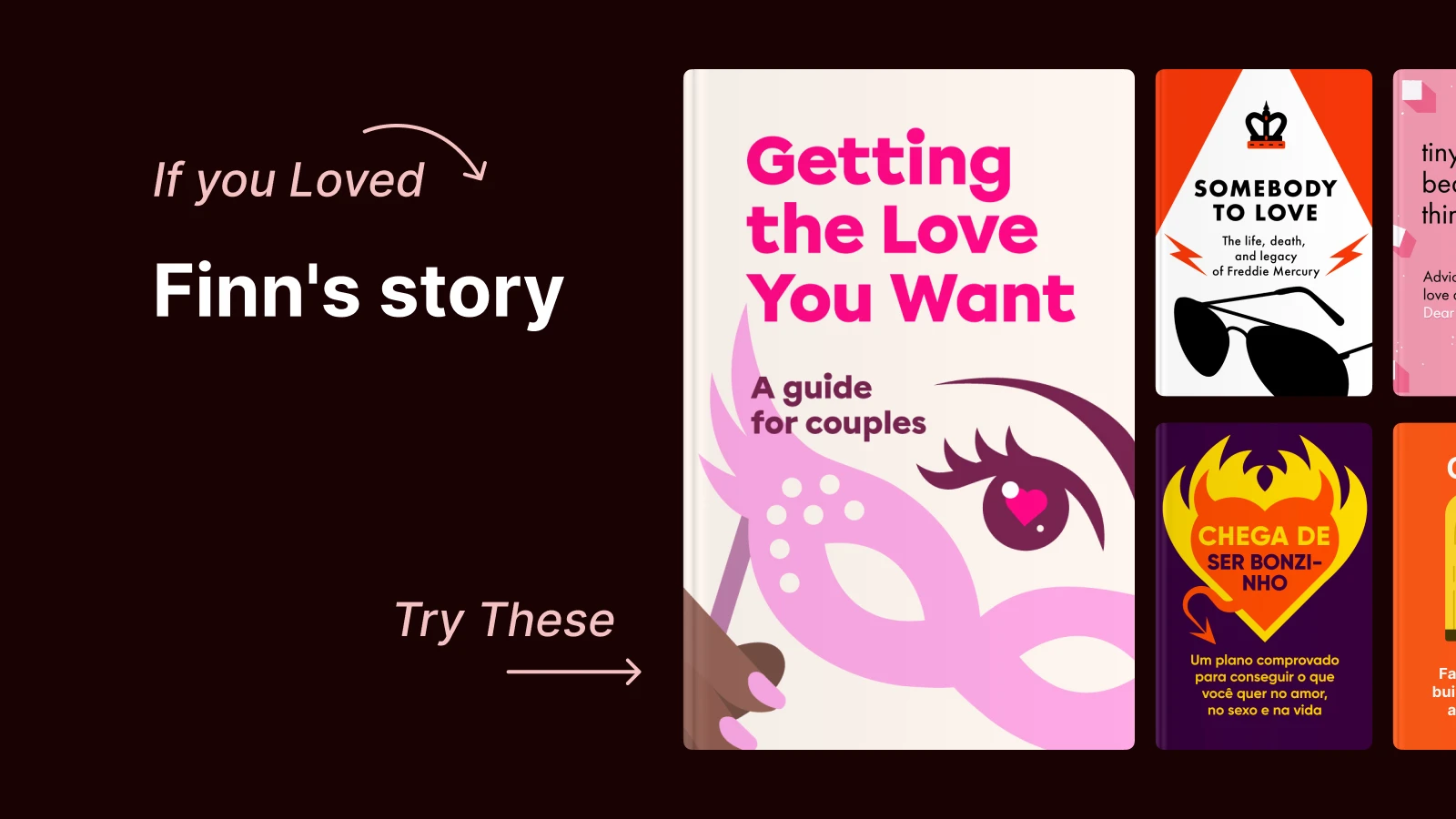
Fiction that explores similar themes
'All the Bright Places' by Jennifer Niven: A YA romance about two teens struggling with mental health and grief.
'They Both Die at the End' by Adam Silvera: A twist on mortality and connection about two strangers who meet on the last day of their lives.
'Before I Fall' by Lauren Oliver: A tragedy that forces the main character to relive the day of her death.
Nonfiction for processing grief and growth
'Option B' by Sheryl Sandberg and Adam Grant: A guide ideal for readers going through grief or supporting others through it.
'Tiny Beautiful Things' by Cheryl Strayed: A collection of advice columns that explore healing and human connection.
'No More Mr. Nice Guy' by Dr. Robert A. Glover: Learn to stop people-pleasing and start living authentically, especially valuable if you've been putting everyone else's needs first while processing loss.
'Getting the Love You Want' by Harville Hendrix, PhD, and Helen LaKelly Hunt, PhD: Find out how childhood wounds shape adult relationships and learn practical tools for building the connection you deserve.
'Somebody to Love' by Matt Richards and Mark Langthorne: A captivating overview of Freddie Mercury's life that explores fame, identity, and finding meaning.
Keep exploring stories that matter with Headway
The 'If Only I Had Told Her' summary reminds us that the stories we carry, spoken and unspoken, shape everything. Laura Nowlin's exploration of grief, regret, hope, and self-improvement through healing offers readers a mirror for their own experiences with loss and the courage required to keep living.
If themes of communication, healing, and emotional resilience resonate with you, Headway offers the perfect next step. Access bite-sized summaries of transformative books like 'Option B,' 'Crucial Conversations,' and 'The Five Love Languages,' all exploring how we connect, grieve, and grow. With both audio and text formats taking under 15 minutes, you'll absorb wisdom that once required hours.
Download the Headway app now to turn insights into daily habits. Join 50 million users who've discovered that personal growth doesn't require endless time, just the right tools and commitment to keep learning!
Frequently asked questions on 'If Only I Had Told Her' summary
What is 'If Only I Had Told Her' about?
'If Only I Had Told Her' by Laura Nowlin is the companion novel to 'If He Had Been With Me.' Published in February 2024, this young adult book features the same characters but focuses more on Finn's inner world and how his death affected others. On Goodreads and Amazon, the novel has garnered thousands of reviews, with readers appreciating the layered characters and twists that leave a lasting impact.
Was Autumn hospitalized in the story?
Yes. After Finn's death, Autumn suffers a serious mental health crisis and is hospitalized after a suicide attempt. As her grief turns into clinical depression, simply going about her usual routines and interactions becomes impossible. The hospitalization marks a crucial turning point in her journey, as this is when she discovers her pregnancy and begins to find a reason to choose life over despair.
What happens with Autumn's pregnancy?
Autumn discovers she's pregnant with Finn's child during her hospitalization and makes the life-changing decision to keep the baby. The pregnancy symbolizes hope and healing for Autumn — something she can physically hold on to as she continues living her life in Finn's honor. It is a tangible connection to him, and the grief she experiences becomes purposeful as she learns that life can go on even when a significant loss has occurred.
Do I need to read 'If He Had Been With Me' first?
It's recommended, but not required. Reading the first book provides context about Finn and Autumn's relationship history, making the emotional impact of the sequel significantly stronger. However, 'If Only I Had Told Her' works as a standalone story with enough background provided. For the fullest experience and deeper emotional resonance, reading both books in order is ideal.
How realistic is the portrayal of grief?
Very realistic. Nowlin captures grief's raw complexity with remarkable authenticity, showing how it affects a lover versus a best friend in entirely different ways. The novel portrays depression, guilt, anger, and healing journeys without romanticizing pain or offering easy answers. Readers who've experienced loss often note how accurately the book reflects their own experiences with mourning and the messy, non-linear path toward recovery.
Is the ending sad or hopeful?
Both. The ending carries deep sadness for what was lost and acknowledges that Finn's absence will always be felt, but it also offers genuine hope and resilience. Autumn chooses life for herself and her unborn child, Jack finds new purpose in supporting her, and both honor Finn's memory by building something meaningful from their grief rather than being destroyed by it.
What exactly happened to Finny?
Finn dies in a car accident while driving with his girlfriend, Sylvie. He dies on the same evening he plans to break up with Sylvie to finally be with Autumn, the girl he has loved for years. The timing of the accident adds devastating layers of guilt and "what if" for all of the survivors, as readers and characters consider what might have been different.
What happens to Autumn after Finn dies?
Autumn's grief consumes her — she attempts suicide and ends up hospitalized. There, Jack visits and they reconcile. She also discovers she's pregnant with Finn's baby. With support from both mothers and therapy, Autumn slowly begins healing. The novel ends with her choosing to live and honor Finn's memory through their child.