
 Self-growth
 Apps & Digital Tools
 Business & Career
 Success
 Growth Tools
 Psychology
 Communication
 Relationships

You finish a great book and feel completely inspired. Then, six months pass. You try to explain the core concept to a friend, but your mind goes totally blank. You can't recall a single specific strategy. Writing your own book summaries is one of the most reliable ways to solve this.
Learning how to write a book summary forces you to actually process the information. It helps you retain what you read, whether you are a student, a professional, or someone trying to sharpen your thinking. But a good summary isn't a tedious school book report. It is its own specific craft.
📘 If doing this for every book on your list feels unrealistic, Headway has already done the heavy lifting for thousands of titles — try the Headway app today.
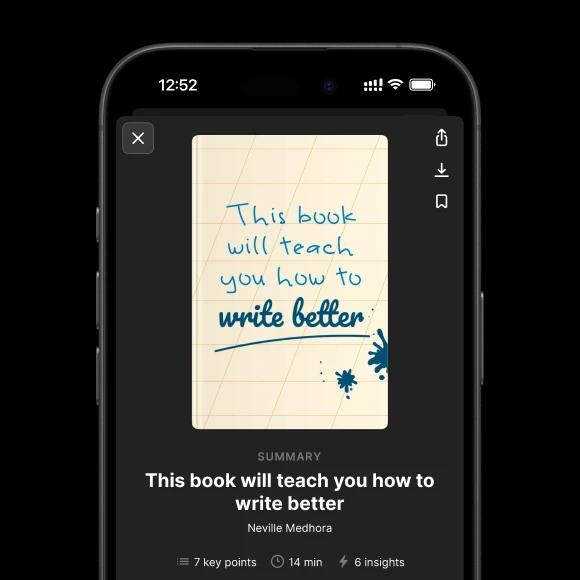
Master book summaries in just 15 minutes
Learn to extract key ideas quickly without getting bogged down in endless reviews. Save time today.
Start summarizing smarterHow to write a book summary: The short version (TL;DR)
A book summary captures the central ideas, structure, and core meaning of a book in your own words. It can be a brief paragraph or a detailed multi-page document.
The step-by-step writing process is simple: take notes while reading, map out the main points, write your first draft, and cut the fluff.
For nonfiction books, focus on the main thesis, the subheadings, and the supporting evidence the author uses to prove their point.
For fiction, focus on the main characters, the central conflict, and major plot points rather than your personal critique.
Keep the text completely objective. Your personal opinions and emotional reactions belong in a separate notebook, not in the summary of the book.
What a book summary actually is (and isn't)
A summary of a book is just a short, neutral breakdown of its core concepts and layout. When figuring out how to write a summary of a book, the main rule is to use your own words. You are capturing what the author actually said, not what you think about it. That last distinction is where most people trip up on their first try.
Three things this piece of writing is not:
Not a book review. A book review is all about your personal opinions. It tells people if you liked it, where it fell short, or if you recommend it. Summaries leave that out entirely.
Not a chaotic set of notes. Casual note-taking mixes in your own random questions and realizations. They are great to have, but they aren't a clean summary.
Not a back-cover blurb. A publisher's blurb is a marketing teaser meant to get you to buy a copy on Amazon. A true summary is completely neutral and covers the whole thing from start to finish.
If you mix these up, your text will quickly drift into an opinion piece. Keeping them separate makes the actual writing much easier.
How to write a book summary in five steps guide
Here’s a guide on how to write your first book summary:

1. Active reading with a pen
You can't learn how to write a good book summary if you just glide through the pages. The work starts while you are reading, not when you sit down at your laptop. You need to actively take notes and look for the main idea and the core frameworks.
If it's a self-help book, highlight the main arguments and the supporting evidence backing them up. If it's a story, look for the big turning points and where the characters change. Scribbling quick thoughts in the margins will save you massive amounts of time later.
2. Write a single sentence for each chapter
Do not wait until you hit the very last page to start your summary writing. Your memory will betray you. Instead, look at the headings and write one quick sentence in your own words at the end of every chapter.
Just state exactly what that section accomplished. For example: "In this section, the author explains how the environment dictates choice." By the time you close the cover, you will have a perfect skeleton outline sitting right in front of you.
📘 Master the best arguments from thousands of business and self-help authors on Headway.
3. Find the spine of the book
Before you type out a single paragraph, you need to pull out the absolute core message. What are the important points the author wanted to make? Every sentence you include in your final text needs to support this central spine.
If a random anecdote or a side study doesn't directly serve that main idea, it shouldn't make the cut. Keeping it hyper-focused separates a good summary from a random, messy brain dump.
4. Write the draft completely from memory
Hide the original text and use your chapter notes as a roadmap for your first draft. The whole point of summarizing books is to see if you actually grasp the material. If you can't paraphrase an idea without staring at the author's exact phrasing, you haven't truly learned it yet.
Force yourself to explain the concepts as if you were speaking to a friend. If you absolutely must use a specific phrase the author coined, wrap it in quotation marks so it stays accurate.
5. Brutally prune your text
Your initial attempt will always be way too wordy. Go back through your draft line by line and aggressively cut anything that isn't a core pillar of the book. If the text makes perfect sense without a specific example, delete it. A tight, punchy guide that gets straight to the key points is always the best book companion.
Here is a quick example using a major bestseller like ‘Atomic Habits.’
First draft sentence: "James Clear starts his great book by detailing a massive sports injury he suffered in high school and the incredibly grueling medical recovery process that eventually sparked his personal fascination with daily routine formation."
The cut version: "Clear's core argument developed from his own recovery after a major head injury, which forced him to learn how tiny daily routines compound into massive long-term takeaways."
The second version delivers the exact same message but cuts the biography down to focus purely on the book's core logic.
How to summarize fiction vs. nonfiction
The way you summarize a text depends entirely on the genre you are in. If you try to apply the same rigid template to every single item on your shelf, the exercise falls apart completely.
For nonfiction books: You want to map out the author's logical blueprint. Focus heavily on the core thesis, the major arguments, and the practical models the writer sets up. If you are dealing with a standard self-help book, track how the chapters build on each other to prove the main point. Skip the long personal anecdotes or case studies the author uses as filler. Just give the core framework and the main takeaways.
For fiction books: Switch your focus directly to the plot's main arc, the main characters, and the underlying theme. Your job is to show what happens and why it matters without adding your own commentary. The biggest trap when summarizing stories is getting bogged down in messy subplots. Let the side stories drop away entirely and stick to the main turning points of the narrative spine. Whether you read manga or high literature, the rules don't change.
A simple rule of thumb: nonfiction summaries explain what the author argues; fiction summaries explain what happens and what it means.



How long should a book summary be?
There is no magical word count that works for every single piece of writing. The length of your summary should match your exact goals, not a rigid page ratio.
For academic writing: If you are doing this for a class or research paper, follow the assignment guidelines precisely. When formatting things for school, you will often need to include formal citations and stick to a clean 250–500 word limit.
For Goodreads or a personal blog: Keep it between 150–300 words. Give people a quick look at the core spine of the book so they can decide if it belongs on their own list of books to read.

For your own note-taking and retention: Aim for 500–1,000 words. This gives you plenty of space to preserve the key points and sub-frameworks you actually want to remember later, while keeping it short enough to review in a single sitting.
For unique projects: If you are learning how to write a book summary for kids, keep it down to one or two punchy paragraphs that highlight a basic moral or plot. If you want to write a children's book yourself, studying these ultra-short summary examples is a fantastic way to master simple pacing.
Read or listen to the book summaries on Headway when you don't have time to create your own!
Taking the time to map out a book in your own words is an incredible way to master a text, and it is absolutely worth doing for the titles that change your perspective. But let's be realistic: you cannot sit down and map out a full summary for every single title on your nightstand. The writing process takes real time, and most people simply don't have the hours to spare.
If you want to read faster and capture the core arguments of the world's best nonfiction books without the massive time commitment, Headway has already done the work for you. Our app condenses major texts from authors like James Clear, Brené Brown, Cal Newport, and Daniel Kahneman into sharp, 15-minute reads and audio tracks.
It is the perfect shortcut to master the art of reading and building knowledge. It doesn't matter if your goal is to write a book with no experience, start a business, or learn how to write a book about your life — getting these core concepts into your head quickly is what actually moves the needle.
📘 You don't need hours to process an entire book — absorb the main takeaways fast on Headway.
FAQs about how to write a book summary
How do I start a book summary?
Just name the book, the author, and their absolute main argument right in the first sentence. Keep it totally blunt, like you're explaining it to a friend during a quick coffee break. No fancy intros needed. If figuring out that big thesis for every single book on your shelf sounds like a total drag, Headway has thousands already done.
How do I write a good summary of a book?
Read with a pen in hand and jot down the main claims as you flip pages. Then, close the book and rewrite those points using your own casual vocabulary. Cut the author's repetitive stories and stick to the actual meat of the advice. Headway is a great shortcut if you want to see exactly how this is done.
What are the 5 basic rules of summarizing?
Use your own words, keep it short, stay completely neutral, stick to the core ideas, and throw away minor details. It's about pulling out the skeleton of the text without adding your own rants. If memorizing a bunch of formatting rules sounds exhausting, Headway gives you the exact same takeaways without you having to lift a finger.
What are 5 key features of a summary of a book?
You need a clear main thesis, a simple layout, short phrasing, a totally neutral voice, and accurate facts. It should give someone the full picture without any of the extra fluff. Headway packs all five traits into every single summary on the app, letting you easily absorb major ideas from world-class authors right on your lunch break.
What are common mistakes people make when summarizing?
The most common slip-up is turning the summary into a personal review. People also copy lines verbatim instead of paraphrasing, or they include way too much random detail. It leaves you with a bloated, useless document. Reading Headway summaries helps you avoid this trap by showing you what clean, hyper-focused editing actually looks like in real life.