Self-growth
 Business & Career
 Success
 Communication
 Healing
 Relationships
 Psychology
 Happiness
Does the thought of standing in front of a room full of people make your heart race so fast you actually forget your own name?
Most people wish that they could speak in public confidently, but few realize it's a skill you build, not a gift you're born with. Being able to share your ideas without your voice shaking is huge for your career and your mental health.
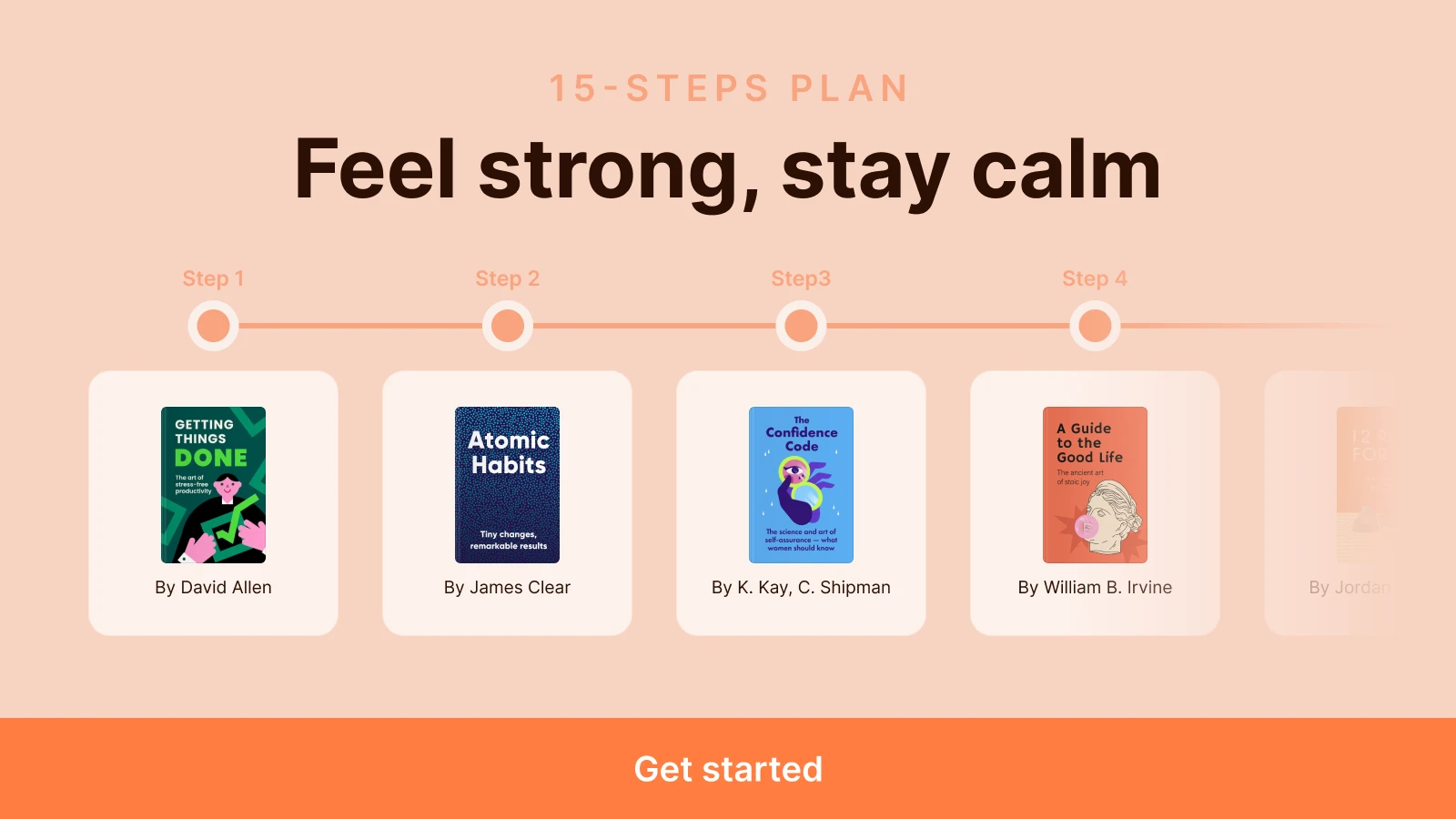
In the Headway app, you can receive the best advice from world-class public speakers and psychology experts in 15-minute audio and text summaries. It's the easiest way to sharpen your communication skills while you're grabbing coffee or driving to work. Think of this approach as an actionable "how-to" guide without having to read over 300 pages.
📘 Download Headway here to start building your self-confidence today!
Quick answer: How to speak in public confidently
Knowing how to speak in public confidently isn't about getting rid of butterflies; it's about making them fly in formation. It means delivering your message clearly while keeping the audience's attention from start to finish. You do this by over-preparing, reframing your nerves as "performance energy," and practicing in low-stakes environments before you hit the big stage.
Preparation: Script your main points and know your audience so you aren't guessing what they care about.
Mindset: Use positive affirmations and visualization to see a successful outcome before you even walk out the door.
Practice: Start small by speaking to a small group of people to work out your nervous habits.
Delivery: Master your body language, keep steady eye contact, and remember to take a deep breath when you feel rushed.
What public speaking confidence is
What does confidence actually look like? It's definitely not about never making a mistake or having a perfectly polished voice. In public speaking, real confidence is more about the connection you make with the room. When you stand in front of people, they are constantly scanning your body language to see if they should trust what you're saying. If you're standing tall and look comfortable, they'll feel relaxed too.
That connection is a core part of your communication skills. Building confidence is a slow process that happens when you stop trying to be a perfect confident public speaker and start trying to be a helpful one. Your public speaking skills aren't just about the words you choose; they're about the presence you bring.
If you can stay in the moment and look at your audience like they're just people, you'll find that the "performance" part feels a lot less heavy. It's the difference between reciting a dry script and having a real conversation.
Why people fear public speaking
The fear of public speaking is a weirdly universal thing. For most of us, it triggers that caveman fight-or-flight response. Your heart starts racing, your mouth gets dry, and your mental health takes a hit because you're convinced everyone is waiting for you to fail. It's physically exhausting. But here's the thing: that adrenaline is actually there to help you.
People who know how to handle stage fright don't try to kill the butterflies; they just teach them to fly in formation. Use positive affirmations to tell yourself you're excited rather than terrified. Take a deep breath to calm your nervous system.
Legends like Dale Carnegie taught that nervousness is just misplaced energy. If you don't fight it, you can actually use it to make your talk more engaging and passionate. Instead of viewing the crowd as a threat, see the audience as a group of people who are just there to hear what you have to say.
📘 Done with all the "umms" and "ahhs"? Get Headway and master your communication skills in just 15 minutes a day.
Confidence-building framework: The PREPARE system
Instead of just grabbing a few random "hacks," you need a system that actually sticks when your hands start shaking. Many people use this simple loop: Prepare, Practice, Perform, and Reflect.
First, you have to prepare: Preparation isn't just about throwing some text onto a PowerPoint. You need to know your audience inside and out. What do they actually need from you? If you can't nail down your main points in two sentences, you aren't ready to stand in front of people.
Next, you need to practice: And no, talking to your reflection in the bathroom mirror doesn't count. You need to start small. Find a small group of people, friends, family, or even a Toastmasters group, and run through your talk. Practice is where you catch those annoying nervous habits, like jiggling your keys or saying "like" every three seconds.
When it's time to perform, focus on the basics: Take a deep breath before you start. Use your body language to take up space; don't try to shrink into the floor. Keep your eye contact steady and don't just stare at the back wall or your shoes.
Finally, reflect: Most people finish a talk and immediately rush to hide in their car. Don't do that; ask for constructive feedback and review how you did. Did you lose your train of thought at some point? Were your visual aids actually helpful? Use that info to make the next one better.



Five practical techniques and tips to nail the delivery
If you want to look like you're giving a TED Talk even when you're just in a boring Tuesday morning meeting, you need a few go-to tactics.
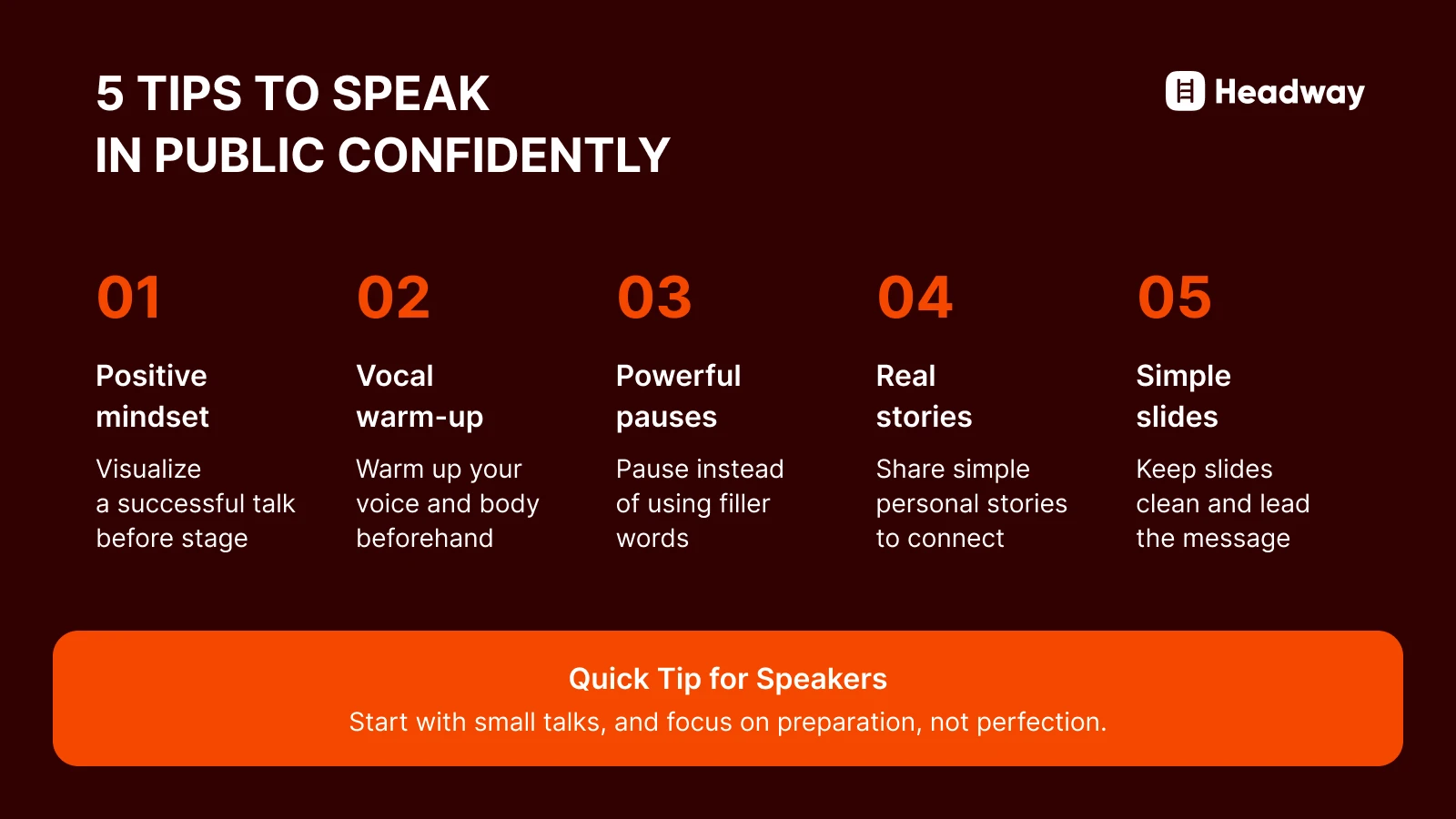
The mindset shift: Use visualization. Before you walk out, close your eyes and literally "see" yourself nailing the key points. It sounds a bit "woo-woo," but top-tier public speakers do this for a reason. Combine it with some positive affirmations like "I have something worth saying" to drown out that inner critic.
Vocal and physical presence: Your voice is like a muscle, so warm it up. When you're on stage, remember that your body language tells the audience more than your words do. Stand firm, use your hands to emphasize key tips, and don't be afraid of silence. A pause is better than a "um."
Audience engagement: To keep the audience's attention, you have to tell stories. Nobody wants a lecture, but everyone loves a narrative. Don't be afraid to show a little vulnerability. If you admit you're a bit nervous or share a mistake you made, people will actually root for you.
Mastering the tech: If you're using visual aids, keep them simple. Your slides shouldn't be a script. If your PowerPoint is too busy, people will stop listening to you and start reading.
Handling the "brain fart": If you lose your train of thought, don't panic. Take a sip of water. It gives you five seconds to find your place without the audience realizing you've forgotten everything. Just find your next key points and keep rolling. Your self-confidence comes from knowing you can handle a mistake, not from being perfect.
📘 Your next big presentation doesn't have to be scary. Try Headway and learn how to keep any audience's attention without the stress.
Three real practice scenarios: Putting it into play
We aren't all aiming for a TEDx stage right away. Most of the time, you just want to get through a work meeting without your voice cracking. Here's how you handle the different "arenas" of public speaking.
In the work meeting
Even if you're just sitting around a table with a small group of people, you're still being evaluated.
The trick: Don't wait for a lull to speak. If you wait too long, your anxiety builds up. Jump in early with a brief comment to break the ice.
Eye contact: Don't just stare at your laptop. Look at the person speaking, and when it's your turn, scan the room. It makes you look like you know what you're doing, even if you're internally panicking.
Mini script: "I've been looking at the numbers, and I think the main points we need to focus on are X and Y. Does that align with what you're seeing?"
The high-stakes presentation
High-stakes presentations are where the PowerPoint comes out, and the pressure hits.
The prep: Know your first two minutes by heart. If you can get through the intro without losing your train of thought, the rest usually flows much easier.
Movement: If you're in front of a large group, don't stand like a statue. Use the space. It helps burn off that nervous energy that usually turns into nervous habits like tapping your foot or clicking a pen.
Online and video calls
Speaking to a lens is weirdly harder than speaking to humans.
The lens is the person: Stop looking at your own little box on the screen. Look at the camera. That's how you maintain eye contact in a digital world.
Social skills: Because you can't feel the room's energy, you have to over-communicate. Use your body language and hands more than usual so people can actually "feel" your enthusiasm through the screen.
Become a confident speaker with Headway!
At the end of the day, you aren't going to magically wake up and be a pro. You have to keep feeding your brain the right strategies. You could spend years at Toastmasters, or you could start by soaking up the best advice from people who have already mastered the fear of public speaking.
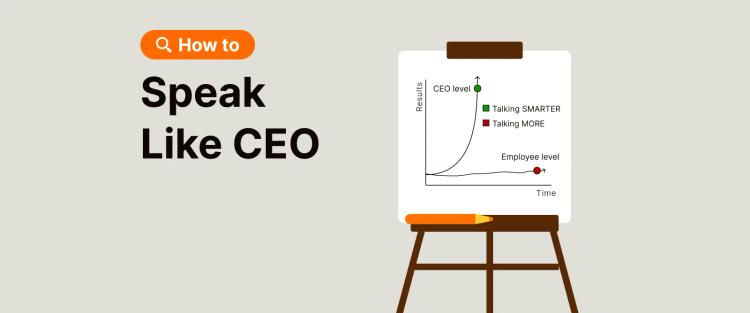
That's why the Headway app is such a game-changer: it offers 15-minute summaries of the most iconic books on communication skills, building confidence, and growth plans like "Speak confidently" and "Speak like a CEO."
You'll find insights from the industry experts who know exactly how to settle those nerves and keep your audience's attention. It's the fastest way to work on your self-confidence without it feeling like a second job.
📘 Download the Headway app and start turning those public speaking jitters into your greatest strength!
FAQs about how to speak confidently in public
How do I gain confidence to speak in public?
You don't just wake up feeling brave. Confidence is really just a side effect of doing the thing you're scared of until it feels normal. Start with a small group of people where the stakes are zero. Focus on your key points, not your heart rate. Eventually, your brain realizes the audience isn't a predator.
How do I stop being afraid of public speaking?
You don't actually stop being afraid; you just learn to use that adrenaline. Reframe that shaky feeling as excitement rather than dread. Take a deep breath and remember the audience actually wants you to succeed. They aren't there to judge your every move; they just want the information you're holding. Focus on helping them, and the fear fades.
What are the 5 tips for public speaking?
First, know your audience so you aren't talking to a brick wall. Second, prepare your main points, but don't memorize a script. Third, keep steady eye contact to build trust. Fourth, tell stories to keep people awake. Finally, grab constructive feedback afterward so you can fix the nervous habits you didn't even know you had.
What body language helps public speaking?
Your body language should show you're taking up space. Stand with your feet planted and keep your hands visible; no pockets or crossed arms. It makes you look like a confident public speaker even if you're sweating. Move around a little to burn off nervous energy. If you look comfortable, the room will usually start to feel comfortable too.
What are common public speaking mistakes?
The biggest mistake is treating a PowerPoint like a teleprompter. If you're just reading slides, you've already lost the audience's attention. Other killers include rushing through your speech without pausing or ignoring the room's energy. Don't try to be a perfect robot; just be a human who has something valuable to say. Vulnerability actually builds a better connection.