Self-growth
 Apps & Digital Tools
 Business & Career
 Success
 Growth Tools
 Psychology
 Communication
 Relationships

Are you scrolling through your reading list again, and feeling guilty about those unread books? You're not alone. Between work deadlines and everything else that life throws at you, finding hours to read feels impossible. That's where Blinkist comes in — a book summary app with nonfiction book insights.
This Blinkist review breaks down everything that you need to know: What you actually get, how much it costs, and whether it delivers on its promise. We'll look at the features, pricing, and user experience to see if Blinkist fits your lifestyle.
But here's the thing: If you've downloaded app after app, hoping that something would finally stick with your self-growth goals, this cycle can feel exhausting. Headway helps you break out of that pattern. With its bite-sized insights from the top bestselling nonfiction books, Headway gives you a daily growth guide that turns learning into a lifelong habit.
Reading. Listening. Goal-setting. Try Headway and get the app that has it all!
Quick summary: What you need to know about Blinkist
Library size: 9,000+ nonfiction summaries covering topics like business, self-help, psychology, and science.
Time commitment: Each summary (called a "blink") takes roughly 15 minutes to read or listen to.
Pricing: A free account gives you one daily summary; a premium subscription unlocks the full library for around $16/month or $100/year.
Formats: Both text and audio versions are available, with offline access on the mobile app.
Best for: Time-strapped professionals and learners who want the main points fast. It's not ideal if you need full depth or love immersive reading.
Keep reading for more details!
What is Blinkist app and how does it work?
Founded in 2012 in Berlin, Blinkist started with a simple question: What if busy people could absorb the key insights from bestsellers without spending hours reading? The company has grown into one of the most popular book summary services, with millions of users worldwide.
What you actually get: The Blinkist app gives you access to thousands of condensed nonfiction books. Each summary distills a whole book into key ideas that you can read in about 15 minutes.
The Blinkist library covers topics from business books and personal development to science and self-improvement. You'll find popular books like 'Atomic Habits,' 'Thinking, Fast and Slow,' and new titles that are added regularly.
Using Blinkist is straightforward: Download the app on iOS or Android. Browse by category, search for specific books, or check out curated collections. Pick a summary. Read the text version or listen to the audio format.
The app syncs across devices, so you can start on your phone, and finish on your tablet.
You can highlight passages, save summaries to your reading list, and access everything offline — which is handy for commutes or flights. The user experience focuses on simplicity: Clean design, easy navigation, and minimal friction between you and the content.
📘Want something different? Try Headway for daily growth!
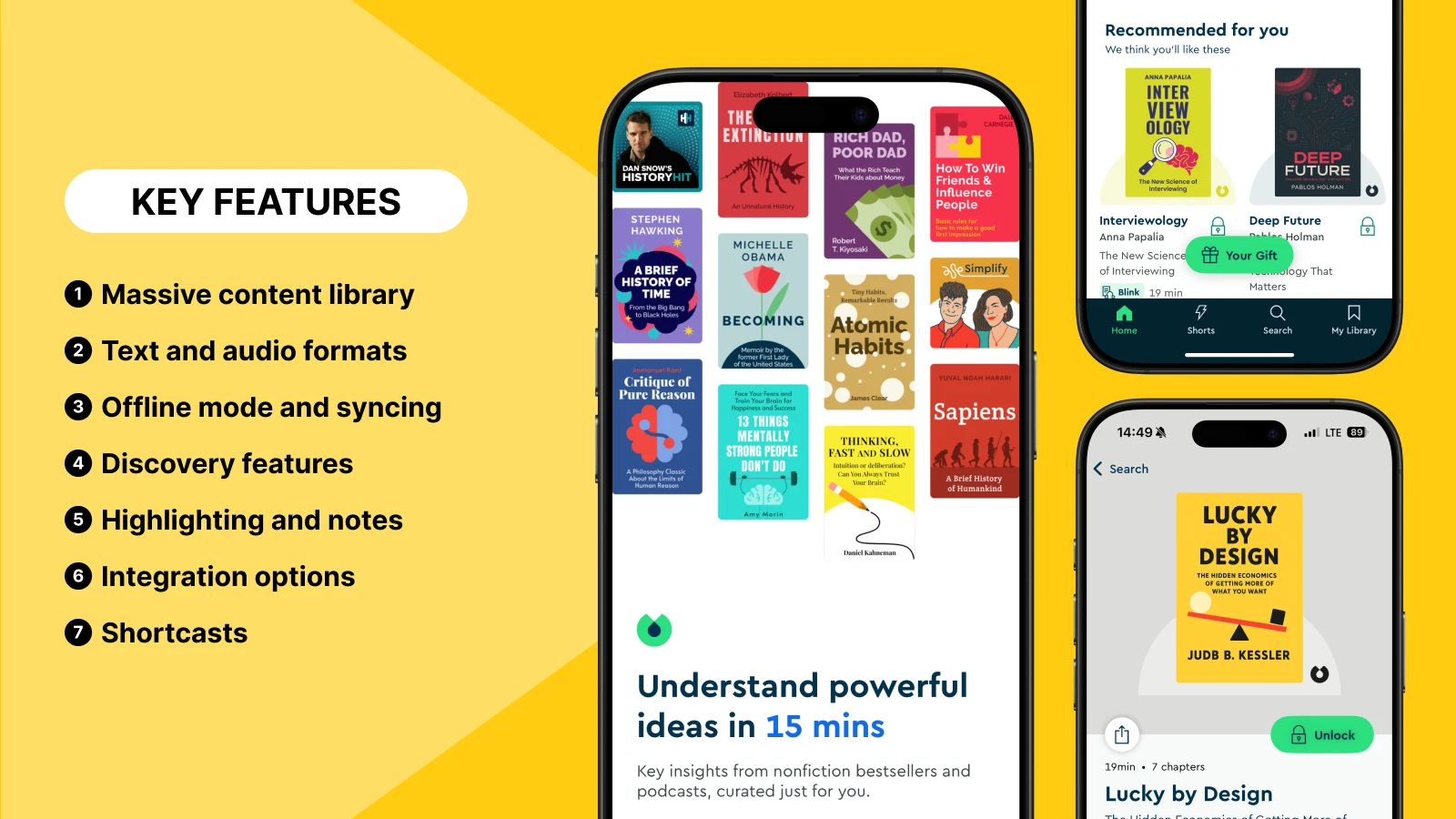
Seven key features that make Blinkist work
Here's what actually makes the app useful for book fans.
1. Massive content library
With 9,000+ summaries, Blinkist offers a solid range of nonfiction books. Business books dominate, but you'll also find psychology, health, science, and personal growth titles. New books get added to the library weekly, keeping the content fresh.
2. Text and audio formats
Every summary comes in both written and audio versions. The audio format uses professional narrators who make listening pleasant during workouts, commutes, or household chores. This flexibility matters when your eyes are tired but your mind's still hungry for learning.
3. Offline mode and syncing
You can download summaries for offline reading. Your progress syncs across devices automatically. Start listening on your morning walk, pick up reading on your lunch break, and finish on your laptop at home.
4. Discovery features
Blinkist offers curated collections, personalized recommendations, and "spaces" where you can organize summaries by topic. The book app highlights trending topics and new titles. These features help when you're not sure what to read next.
5. Highlighting and notes
You can mark important passages and add notes. Later, you can review your highlights or export them. This feature helps with retention and makes Blinkist work better as a learning tool rather than just entertainment.
6. Integration options
Blinkist connects with Kindle and other platforms, though these integrations are somewhat limited. You can send highlights to note-taking apps like Evernote or Notion, although some workarounds might be needed.
7. Shortcasts
Beyond book summaries, Blinkist offers shortcasts — audio-only deep dives into specific topics, interviews, or ideas. These 15-minute summaries feel like focused podcasts and add variety to the content.
But what's the real value here? Simply put, time efficiency. The microlearning approach shows that focused, short sessions can improve retention when done right.
📘Test-drive Headway to build your daily growth habit!
Blinkist pricing: How much does Blinkist app cost?
So, is Blinkist free? Well, not exactly. Let's talk numbers now. Here's what you'll pay and what you get at each level.
| Plan type | Cost | What you get |
|---|
Free plan | $0 | One free summary per day, limited access to premium features |
Monthly plan | ~$15.99/month | Unlimited access to full library, offline mode, audio versions |
Yearly subscription | ~$99.99/year | Same as monthly, but about 40% cheaper annually |
The free version lets you test the waters with one daily summary. It's enough to understand how Blinkist works and whether the format fits your style. But it's limited, so you can't choose which summary you get each day, and you miss out on the audio format and offline access.
The premium subscription removes those limits. Unlimited access means browsing the entire Blinkist library, downloading for offline use, and switching between text and audio whenever you want. The premium plan makes sense if you plan to use Blinkist regularly.
Blinkist cost comparison: A single audiobook on Audible runs $15–20. A Kindle book costs $10–15. For roughly the same price as one full book per month, you get access to thousands of summaries. If you prioritize breadth over depth, the value adds up.
Is Blinkist worth it financially? That depends on your reading habits. If you'd normally buy three books per month but only finish one, Blinkist saves you money. If you prefer libraries and already use Kindle Unlimited or similar services, the extra cost might not make sense.
📘Start making change with Headway!
Pros and cons of using Blinkist
Here's the honest breakdown of Blinkist's strong sides and drawbacks. Test the app for yourself and see if it meets your needs.
What works: Time-saving features and flexible learning
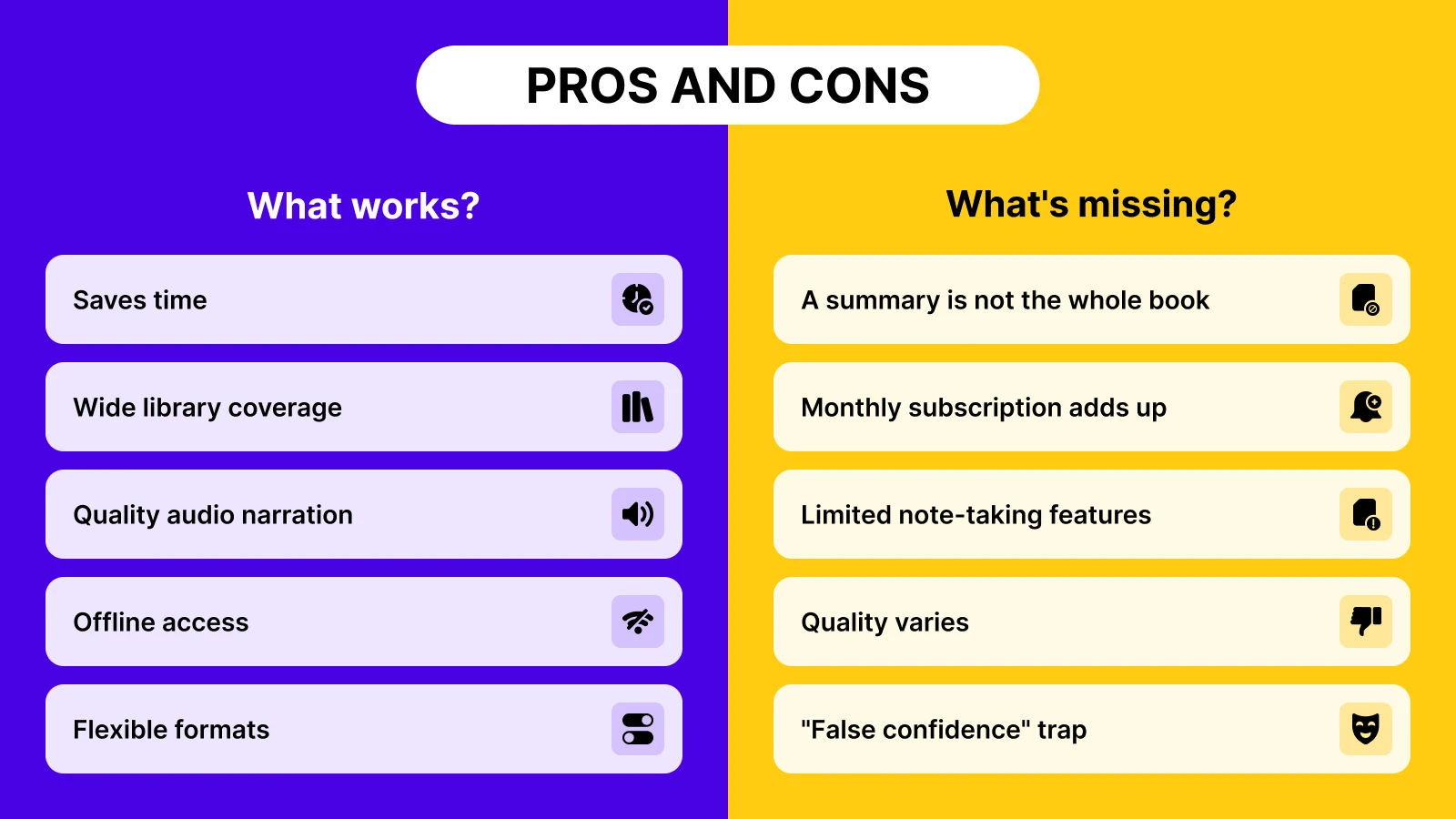
1. Saves time: This element is the most significant advantage. You get key insights from an entire book in 15 minutes.
2. Wide library coverage: Over 9,000 summaries cover the most popular books in business, self-help, psychology, and science. You'll find bestsellers, classics, and new titles regularly added.
3. Quality audio narration: Professional narrators make the audio versions of book summaries enjoyable. Compared to computer-generated voices, they sound more natural and keep your attention.
4. Offline access: The mobile app handles offline mode smoothly, so you can download summaries ahead of time and listen to them from wherever you are.
5. Flexible formats: You can switch between reading and listening based on your situation. Walking the dog? Audio. Waiting at the dentist's? Text. This flexibility fits real life better than audiobook-only or text-only options.
What's missing: Depth, cost concerns, and limitations
1. A summary is not the whole book: You miss out on the examples, nuances, all the storytelling experiences, and depth of the subject, while all shorter summaries lose some of their intended impact.
2. Monthly subscription adds up: At $15.99 monthly, Blinkist costs more than many streaming services. If you don't use it consistently, you're wasting money.
3. Limited note-taking features: Even though you can highlight and add notes, the functions are too basic, so you might need external tools for more detailed note-taking.
4. Quality varies: Some summaries capture the main idea just right. Others feel rushed or miss important context. The quality depends on the structure of the original book and on how well the ideas translate to a condensed format.
5. "False confidence" trap: Reading a summary might make you feel like you "know" a book when you've only scratched the surface. This feeling can be misleading in professional or academic contexts.
📘Get insights without the reading guilt, download the Headway app!


User experience: What people actually say about Blinkist
The Blinkist app earns solid ratings — typically 4.5 to 4.7 stars — on both iOS and Android app stores. The interface gets consistent praise: Clean design, intuitive navigation, minimal bugs. Users appreciate that you can jump in and start learning immediately without a complicated setup.
At the same time, many users mention that while they love the service, the Blinkist subscription feels expensive compared to alternatives or library access.
And unlike free microlearning apps that emphasize community, Blinkist keeps the experience individual. The platform doesn't offer discussion forums, book clubs, or social sharing options.
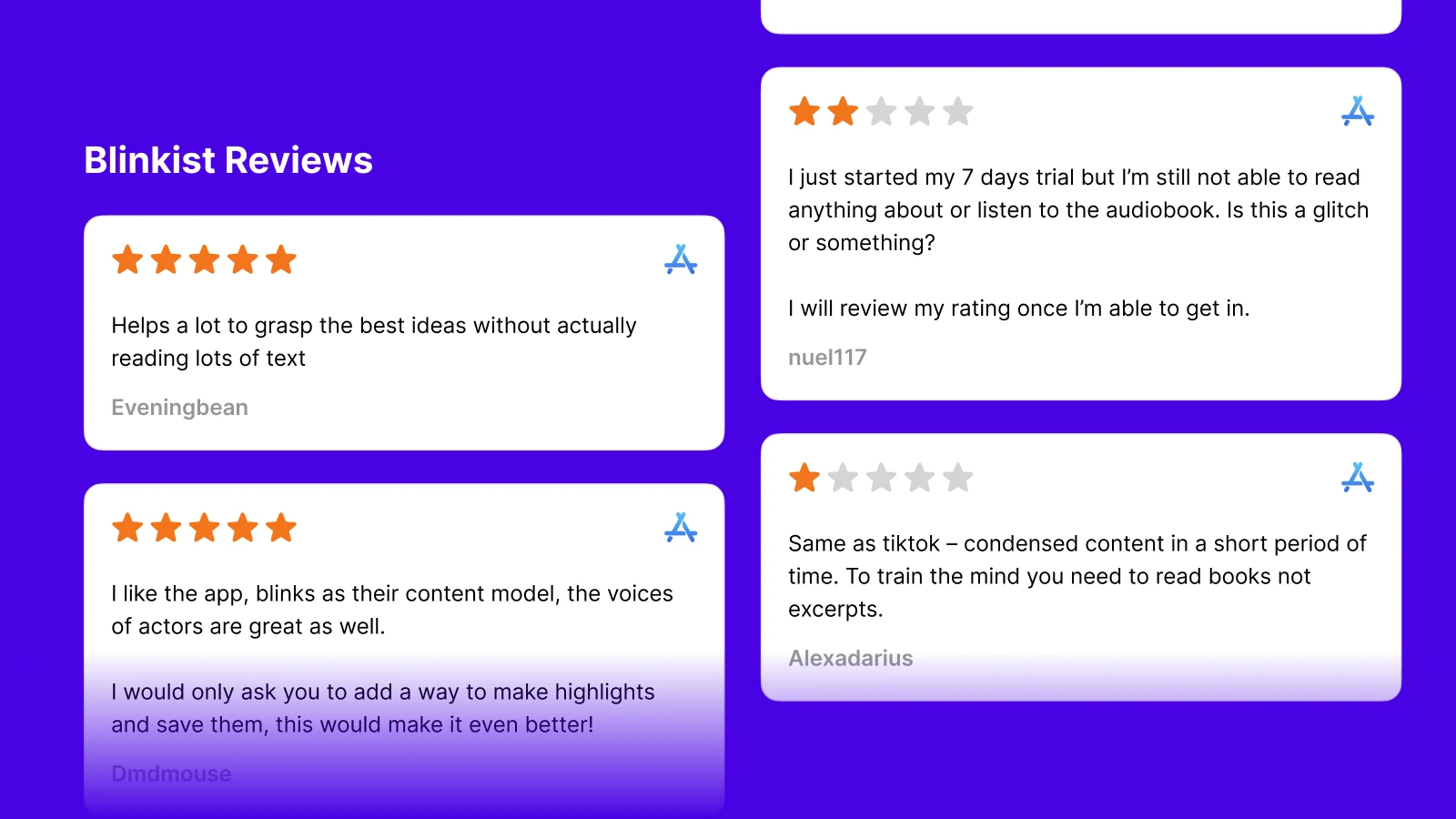
So what's the honest review consensus? Blinkist brings fast, quality summaries. But it's not a magic solution. Success depends on matching your learning style, accepting the limitations, and using it as part of a broader learning strategy.
📘Stop scrolling, start growing with the Headway app!
Educational effectiveness: Does Blinkist actually help you learn?
A 15-minute summary gives you the main points — the central thesis, key insights, and takeaways. You get the "what" but often miss the "why" and "how." For books heavy on storytelling, nuanced arguments, or detailed case studies, summaries frequently feel incomplete.
What you gain: Efficiency and breadth. You can expose yourself to ideas from dozens of books in the time that it takes to read one cover-to-cover.
This breadth helps you identify which topics interest you most, discover new perspectives, and make connections across different fields.
What you lose: Depth, nuance, and retention. Research shows that deeper processing — spending more time with material, engaging with it actively, and connecting it to prior knowledge — improves long-term memory.
According to cognitive psychologist Hermann Ebbinghaus's research on the forgetting curve, people forget approximately 70% of new information within 24 hours without active review or repetition.
Reading a 15-minute summary creates weaker memory traces than reading a full book over several days.
Who benefits most: Professionals staying current with business trends. Entrepreneurs seeking inspiration and frameworks. Students exploring topics before deep research. Anyone building a foundation of knowledge across multiple subjects.
Who should skip it: Academic researchers needing citation-level understanding. People preparing for exams or professional certifications. Avid readers seeking entertainment or emotional connection. Individuals who genuinely enjoy the reading process and don't feel time-pressured.
Critics argue that summary culture contributes to shortened attention spans and surface-level thinking.
There's legitimate concern about treating books as mere data to be extracted rather than experiences to be savored. Bite-sized learning has benefits, but it shouldn't completely replace deeper engagement.
So, what's the smart approach? It's simple. Use Blinkist summaries as a supplement to your reading, not as a replacement. Read them to triage your reading list. When a summary resonates, invest time in the full version of the book.
📘Add the Headway app to your productivity checklist!
Blinkist vs paid alternatives vs free book summary apps: How it stacks up
You've got options beyond Blinkist. Each book summary service has different strengths, pricing, and target audiences. Here's how Blinkist compares to its main competitors, so you can choose the one that best fits your learning style and budget.
| Feature | Blinkist | Headway | getAbstract | Shortform |
|---|
Library size | 9,000+ summaries | 2,000+ summaries | 20,000+ summaries | 1,000+ in-depth guides |
Summary length | ~15 minutes | ~15 minutes | ~5–10 minutes | 20–30 minutes |
Audio format | Yes | Yes | Yes | Yes |
Pricing | ~$100/year | ~$90/year | ~$300/year | ~$180/year |
Unique feature | Shortcasts | Gamification & daily insights | Business focus | Extended analysis |
Strengths of Blinkist: The app hits a sweet spot between brevity and comprehensiveness. It offers a strong mobile app experience, along with a large library that has a good variety. Blinkist is an established brand with consistent quality. Shortcasts add unique content beyond standard summaries.
Weaknesses compared to competitors: Headway offers better motivation and habit-building features. getAbstract provides broader business coverage. Shortform gives you a more detailed analysis. Blinkist sits in the middle — it's good at everything, but exceptional at nothing.
📘Try Headway and turn reading into a self-growth habit!
How can you decide if the app is right for you?
Ask yourself three questions before subscribing:
1. What's your actual goal?
Want to stay broadly informed about popular books? Blinkist fits.
Need a deep understanding for work or study? Full books or Shortform work better.
Building a daily learning habit? Headway vs AI shows how gamification and motivation matter more than library size.
Deciding which books to buy? Blinkist Premium works as an excellent filter.
2. How do you prefer to learn?
Short bursts during commutes? Perfect match.
Long, immersive reading sessions? Stick with full books.
Audio while doing other activities? Blinkist audio versions excel here.
Deep focus with notes and highlights? Full books or academic resources fit better.
3. Does your budget and time make sense?
Will you use it at least 2–3 times per week? The yearly subscription pays off.
Already spending on Audible or Kindle Unlimited? Calculate total costs.
Tight on money? Try the free plan first or look at free alternatives.
Value time over money? The premium subscription offers excellent time savings.
Is Blinkist worth it? Quick decision guide:
If you're a marketing manager keeping up with trends, Blinkist works great.
If you're a student writing research papers, full books are required.
If you're a parent with 20-minute windows, Blinkist or Headway both fit.
If you're retired and love reading for pleasure, traditional books feel more satisfying.
If you're prepping for a career change, Blinkist helps you explore new fields quickly.
The real question isn't whether Blinkist is objectively good — it clearly provides value. The question is whether it matches your specific situation, learning style, and goals. But what's the best way to know? Essentially, start small and build consistent learning habits.
Start small, build consistent learning habits with the Headway app
Following these Blinkist reviews, the app delivers on its core promise: Quick, quality summaries that save time. It works smoothly, covers major bestsellers and popular books, and fits busy lifestyles.
But here's the reality: Tools only work if they match how you actually live. If your problem is finding time, Blinkist helps. If your problem is motivation, finishing summaries might not feel more satisfying than finishing full books. Maybe what you actually need isn't faster learning — it's learning that feels sustainable.
Small daily progress instead of ambitious goals that fizzle out. That's where Headway shines. It's built around the idea that consistency beats intensity. Personalized recommendations keep content relevant. Progress tracking shows your growth without putting pressure on you. The experience focuses on building a habit that sticks, not just consuming information.
Download Headway and turn idle moments into daily progress toward becoming who you want to be. No pressure, no guilt. Just steady growth, one insight at a time.
Frequently asked questions about Blinkist app
What is included in the Blinkist free plan?
The free plan provides one randomly selected summary each day. You get text-only access without offline downloads or audio versions. It's enough to test the format and see if Blinkist fits your style, but you can't choose which books to read or access premium features like the full library or shortcasts.
How to use Blinkist?
Download the Blinkist app from iOS or Android. Browse 9,000+ book summaries by category or search for specific titles. Choose a "Blink" and read or listen to it in about 15 minutes. You can save summaries to your library, download them offline, and sync across devices. The free version gives you one daily summary.
How many summaries are available on Blinkist?
Blinkist offers over 9,000 summaries covering nonfiction books across business, self-help, science, psychology, and personal development. The Blinkist library adds new titles weekly, focusing on bestsellers and popular books. Fiction books aren't included — the service focuses entirely on nonfiction content that delivers actionable insights.
Can I share my Blinkist subscription with my family?
Technically, Blinkist's terms limit accounts to individual use. Some users share login credentials with family members via theor Blinkist Google Play or Apple App Store accounts, but this violates the service agreement. Blinkist doesn't offer official family plans like some streaming services do. If multiple people want access, each person needs their own premium subscription or should use the free version.
Does Blinkist have full books or just summaries?
Blinkist only provides summaries, not entire books. Each summary condenses the entire book into 15-minute summaries covering key ideas and main points. If you want to read the whole book after enjoying the summary, you'll need to purchase it separately through retailers like Amazon, Kindle, or Audible.
Can I access Blinkist content offline?
Yes, but only with a premium subscription. The free plan requires an internet connection. Blinkist Premium lets you download unlimited summaries for offline reading or listening. This feature works great for flights, commutes through areas with poor cell service, or anywhere you want to save mobile data while using the Blinkist app.
Does regularly using book summary apps like Blinkist negatively affect your ability to read full-length books?
Research suggests heavy summary app usage can reduce sustained attention capacity, making full books feel tedious. However, many users report the opposite — summaries spark curiosity, leading them to read more complete books than before. The key is intentional use: treat summaries as complements, not replacements. Alternate between summaries and full reads to maintain deep reading skills while benefiting from efficient knowledge sampling.
Is Blinkist Pro worth it?
If you plan to use Blinkist Pro (the premium version) at least a couple of times each week, it is probably worth trying. At about $100/year, you will get unlimited access to the entire library, the audio versions, and offline downloads. If you struggle to finish books consistently or are just looking for quick highlights, it pays for itself.
Deepstash vs Headway vs Blinkist: Which app should I choose?
Blinkist offers 9,000+ summaries with professional narration. Deepstash has a social media feel, with user-generated content. Headway combines book summaries with daily habits, streaks, and spaced repetition to help you actually remember what you learn. All three cost $80-$100 yearly, but Headway's science-backed retention tools set it apart.
How much is Blinkist?
As of March 2026, Blinkist costs $14.99-$15.99 per month or $79.99-$99.99 per year. The annual plan often gets discounted to around $140 on the first purchase. There's also a Pro plan at $139.99-$166.72/year with AI summarization tools. The free version gives you one pre-selected summary daily.
What are free Blinkist alternatives?
StoryShots offers free summaries with ads. Deepstash gives you 200,000+ ideas with a social feed. Bookey lets you access summaries by watching ads. Headway also offers a free book summary daily, plus science-backed spaced repetition to help you retain what you learn. All works well if you don't mind ads.