Self-growth
 Business & Career
 Success
 Communication
 Healing
 Relationships
 Psychology
 Happiness
Looking for a career that pays well, has job security, and doesn't trap you in one narrow specialty?
The US Bureau of Labor Statistics shows strong demand for project management roles through 2034, with companies in healthcare, tech, construction, and nonprofit sectors hiring. Starting salaries land around $60,000 for entry-level roles and climb past $120,000 with experience, and your earning potential jumps higher when you get certifications.
The career works in 2026 because project management adapts to any industry, such as software launches, construction projects, and healthcare implementations. Successful project managers need both technical knowledge and soft skills, like stakeholder management, problem-solving, and time management.
Become a project manager (PM) and get the key skills that employers look for! Upgrade your knowledge with Headway's 15-minute book summaries on leadership, communication, and project management strategies.
📘 Download Headway and start building what you need for a project management career.
Quick answer: How to become a project manager and why?
The numbers explain why people want this career:
Job outlook: The US Bureau of Labor Statistics projects 6% growth for project management roles through 2034, creating roughly 65,000 new positions yearly. Demand is strongest in tech, healthcare, and construction.
Salary potential: Entry-level roles, such as project coordinator, typically range from $55,000 to $65,000. Mid-level jobs require around 3 to 5 years of experience and pay $75,000 to $95,000. Senior positions with over 7 years of experience can pay $110,000 to $140,000 or more.
Certifications increase pay: A PMP (Project Management Professional) certification from PMI adds an average of 20% to your salary. CAPM (Certified Associate in Project Management) bumps earning potential by 10 to 15%. Both prove you understand project management methodologies.
Soft skills with Headway's book summaries: Our app includes key project management skills and concepts in a quick audio and text format, without spending months reading full books or complicated certification guides.
What is a project manager?
A project manager coordinates teams, processes, and resources to deliver successful projects, requiring a mix of leadership skills, certifications, and hands-on experience.
You define the project scope, build a project team, set deadlines, manage the budget, and deliver results on time. Stakeholders come to you for updates, and team members look to you when things go wrong.
Daily work includes:
Running meetings and tracking progress against timelines.
Communicating with stakeholders and removing obstacles for your team.
Adjusting project planning when problems come up.
Managing deliverables across the project lifecycle.
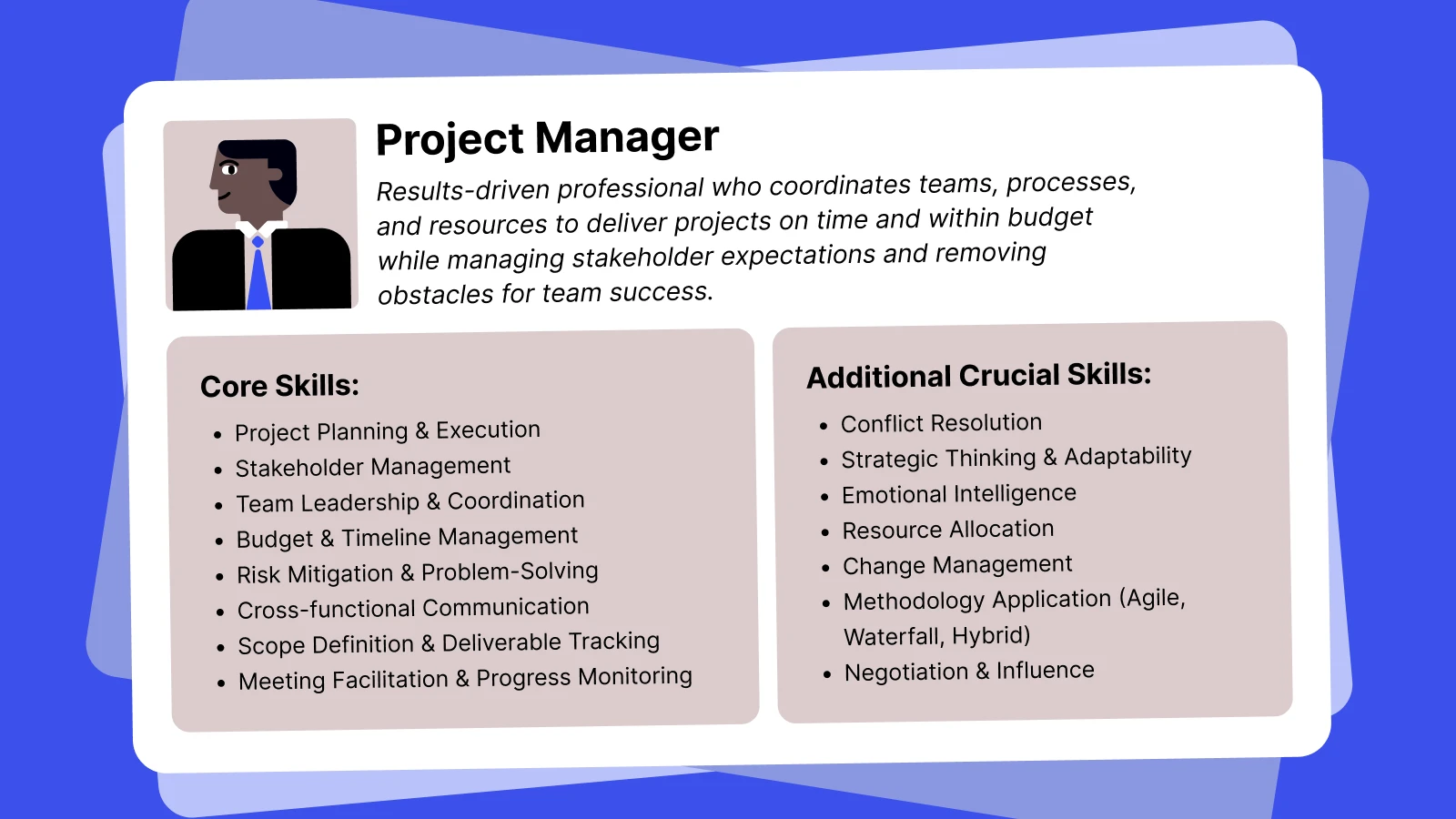
You don't do the technical work yourself. You coordinate the people who do. Your job is stakeholder management, keeping the initiative moving forward, and making sure everyone knows what they're supposed to be doing.
The project management role transfers across industries because the core responsibilities stay the same. You're still planning, executing, and monitoring projects using established methodologies.
But what makes a good project manager? Leadership skills and soft skills matter more than technical skills. Understanding what your team does helps, but your ability to communicate, handle conflict, and think ahead determines whether projects actually finish on time and on budget.
How to become a project manager: Step-by-step roadmap (2026)
Step 1: Choose your path
You don't need a specific bachelor's degree for project management. People come from various backgrounds, like business, engineering, and communications. Some get a master's degree in project management or an MBA. Yet, gaining project management experience and proving you can handle responsibility matters more than your degree.
Pick an industry that matches your interests or current work experience. Tech means technical project manager roles. Construction uses different methodologies and tools. Healthcare project management focuses on compliance and patient systems. The career path works the same across industries, but the context changes.
📘 A quick insight: About 70% of projects fail because of poor communication, not technical problems. Headway's 15-minute summaries cover the leadership skills certifications don't teach — download it now.
Step 2: Develop core skills
Employers look for these skills:
Leadership: Guide team members without being their direct manager. Motivate people, make decisions when things are unclear, and take initiative when projects stall.
Communication: Translate between technical teams, executives, and stakeholders. Clear communication prevents most failures.
Risk management and problem-solving: Projects go wrong. Successful project managers spot risks early and have backup plans.
Time management: You're juggling multiple deadlines and competing priorities. Missing deadlines kills project success.
Step 3: Education and certifications
A project management certificate proves you understand methodologies. Here are the main options:
| Education solution | What is needed | Time and cost | Target role |
|---|
CAPM | 23 hours of education OR 1,500 hours of experience | About $300 and study time | Entry-level |
PMP | Bachelor's and 3 years OR high school and 5 years | About $555 and 35 hours of education | Mid to senior |
Scrum or Agile | Varies | $200 to $1,000 | Tech or software |
Headway app | Motivation and craving to become a PM | $89.99 a year | Position of any level |
PMI administers CAPM and PMP. PMP is what most employers recognize. CAPM works if you're starting with no years of experience. Professional certificate programs through universities also exist, but they cost more and take longer than these focused certifications.
Step 4: Gain experience
You need hands-on project management experience before anyone gives you an actual project management role:
Volunteer to coordinate projects at your current job.
Take more responsibility in team projects and document what you managed.
Apply for entry-level roles like project coordinator or business analyst.
Look for internships in project management.
Most people need 2 to 3 years of coordinating smaller projects before landing a full project manager job with responsibility for a new project from start to finish.
Step 5: Build your network and portfolio
Join PMI local chapters. Connect with project managers on LinkedIn. Engage in online PM communities that share job leads.
Build a portfolio showing projects you've managed:
Project scope and objectives.
Your role and what you delivered.
Outcomes and metrics.
Project management tools you used (like Excel, Jira, and Asana).
Document even small projects. Employers want proof that you can run a project team and finish on time.
📘 A quick insight: New project managers say their biggest regret is skipping soft skills training. Headway gives you career change summaries and growth plans like 'Lead like a CEO.' You can start today — get the app and skip the expensive mistakes.
Tools and AI for project managers in 2026
Project management tools are non-negotiable. Employers expect you to know the main platforms and use them without training.
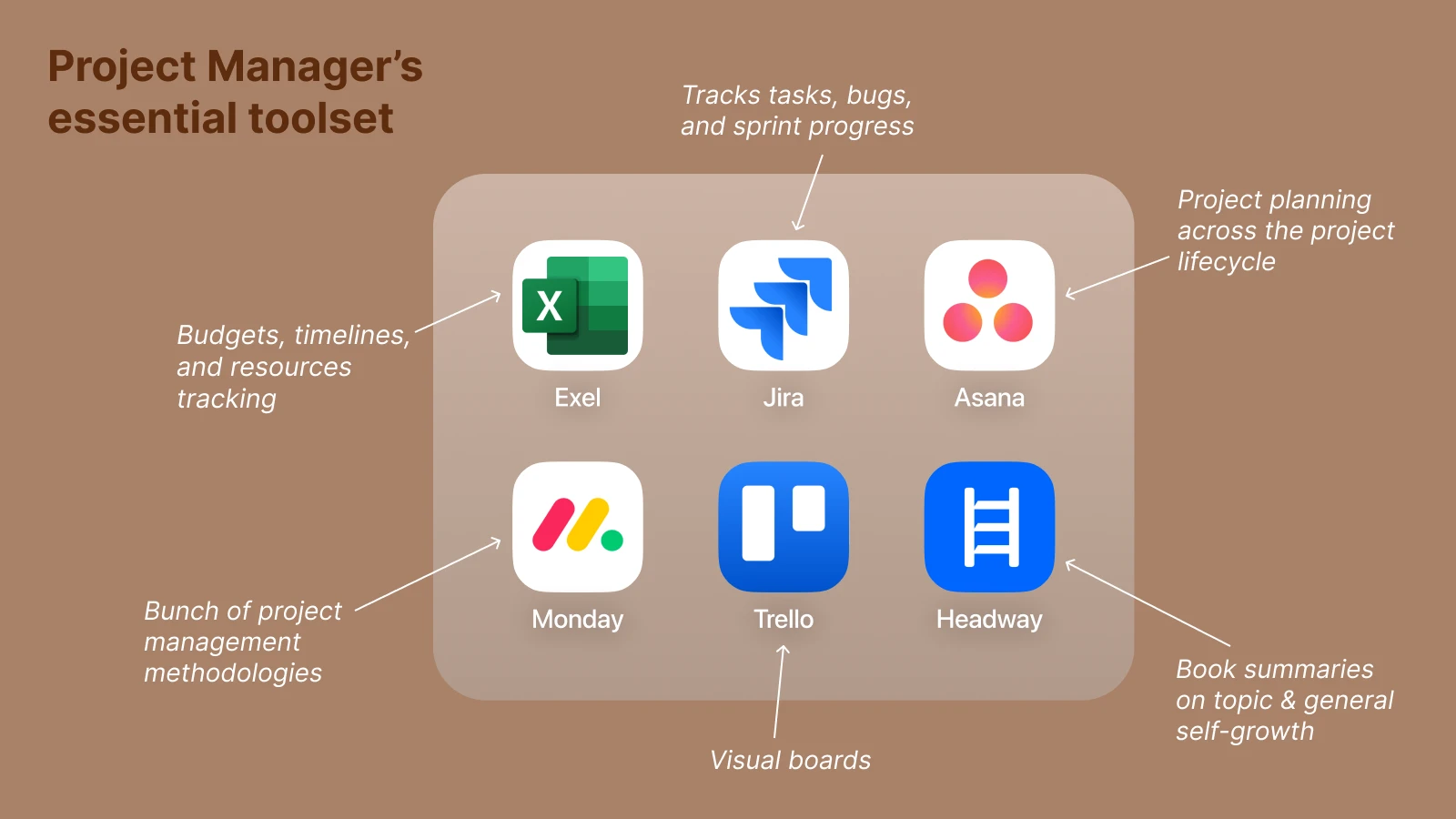
Six essential tools
Excel — Still the baseline for tracking budgets, timelines, and resources.
Jira — Standard for tech teams using Agile. Tracks tasks, bugs, and sprint progress. Technical project managers use this daily.
Asana — Works for marketing, creative, and general project planning across the project lifecycle.
Trello — Visual boards for smaller teams and straightforward projects.
Monday.com — A flexible platform that handles different project management methodologies.
Microsoft Project — For complex builds with detailed timelines and resource allocation.
AI is changing the work
AI tools now predict project risks from historical data, automatically update timelines when tasks run late, and flag bottlenecks before they occur. Chatbots handle routine updates to stakeholders. Time tracking runs in the background. Budget forecasting catches overruns early.
You still need project managers — the skill set just shifts. You spend less time updating spreadsheets and more time on problem-solving, stakeholder management, and keeping team members aligned during project planning.
| Tool type | What it does | PM benefit |
|---|
Task management | Assigns and tracks work | Keeps deliverables on schedule |
Communication platforms | Centralizes team discussion | Cuts down email mess |
AI predictive tools | Forecasts risks and delays | Spots problems early |
Time trackers | Monitors hours automatically | Improves budget accuracy |
Companies hiring for project management jobs want people who already know these platforms. List them on your resume. Practice with free versions. Knowing the right project management tools makes you hireable.



How to get your first project manager role
Landing your first project management job when you lack years of experience means understanding what companies actually want and which titles to apply for.
Resume tips
When crafting your resume, place your project management experience right at the top, even if it involves coordinating smaller tasks in your current role. Don't forget to list your project management certifications (like CAPM, PMP, or Scrum) close to your name. Showcase your achievements. Think about the budget you managed, the deadlines you met, and the size of your team. Numbers really make a difference!
Illustrate your skills with concrete examples: for instance, "Led an 8-person team through a software migration, completing it two weeks ahead of schedule." This not only highlights your leadership abilities but also demonstrates your time management skills without resorting to vague buzzwords.
LinkedIn profile
Recruiters search LinkedIn for entry-level roles using specific terms. Your headline should read "Project Coordinator | CAPM Certified" or "Aspiring Project Manager | 3 Years Project Experience." List project management tools you know (like Jira, Asana, and Excel). Describe hands-on projects you've run with real outcomes in your summary.
Job titles to search
Don't limit yourself to "Project Manager," try:
Project Coordinator
Associate Project Manager
Business Analyst
Program Coordinator
Implementation Specialist
These entry-level roles build work experience and usually lead to promotion to full PM positions within 1 to 2 years. Many require only 1 to 3 years of experience, rather than over 5.
Interview preparation
Expect questions testing how you handle stakeholders, team members, and problems:
"Describe a time you managed a difficult project." Walk through what went wrong, how you fixed it, and what happened.
"How do you prioritize when everything is urgent?" Explain your process for time management and keeping deliverables on track.
"Tell me about a project that failed." Say what happened and what you'd do differently. They want to see you learn from mistakes.
Use real examples from any project work you've done — internships, volunteer projects, or coordinating initiatives at your current job all count as project management experience.
📘 A quick insight: Most PM rejections happen in the first 15 minutes when candidates can't articulate well enough. Headway's summaries and growth plans, like 'Develop your career,' cover how to frame your experience and answer tough interview questions. Try the app before your next interview.
Career progression: From junior to senior project manager
The career path has clear stages based on years of experience and the complexity of your projects.
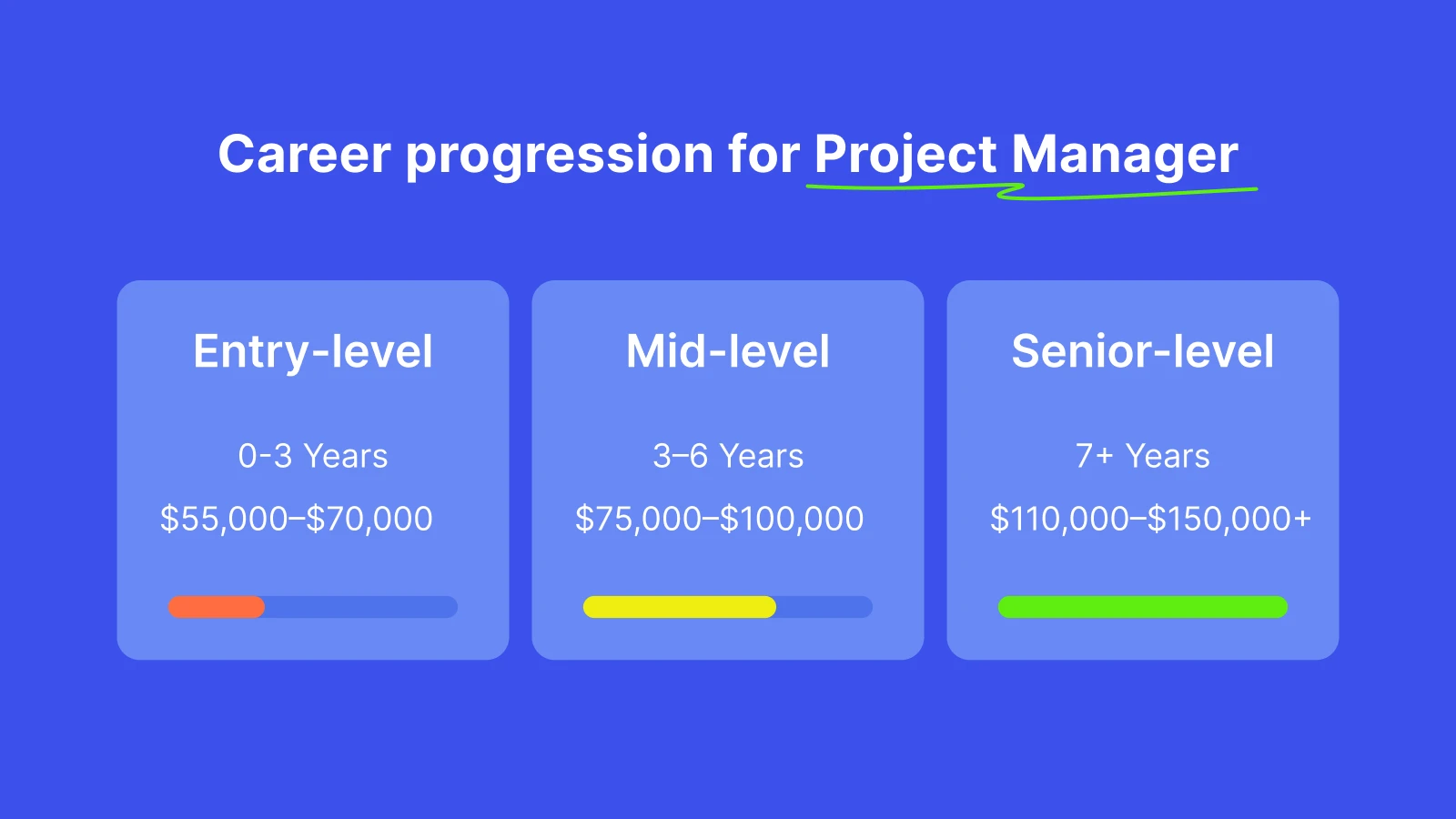
Entry-level (Years 0 to 3)
You start as a Project Coordinator or Associate Project Manager supporting senior PMs. You track schedules, update stakeholders, and handle smaller pieces of bigger projects. The project scope you manage is narrow — one workstream or a basic internal project. Salary ranges from $55,000 to $70,000.
What to focus on: Learn project management methodologies, get comfortable with project management tools, watch how experienced PMs run project planning, and keep team members working together.
Mid-level (Years 3 to 6)
In the mid-level stage, you're now in charge of full projects. Larger budgets, more team members, and real consequences if things don't go as planned. You might find yourself juggling several projects at once or diving deep into one intricate project with many moving parts.
Companies are counting on you to manage risks, tackle problems head-on, and meet deadlines. Salaries in this range typically range from $75,000 to $100,000. At this point, leadership skills take precedence over technical know-how. You'll be working closely with executives and need to coordinate your project team effectively, all while minimizing conflicts.
Senior-level (Years 7 or more):
Senior Project Manager, Program Manager, or Director positions. You oversee multiple PMs, set strategy for how the organization runs projects, and deal with C-suite executives. Your project scope covers enterprise initiatives affecting entire departments. Earning potential can reach $110,000 to $150,000 or higher.
Successful project managers at this level get hired for judgment. Companies want someone who's seen projects go wrong and knows how to prevent them.
Start your project management career with Headway!
Becoming a project manager doesn't require one specific path. You need project management skills — leadership, communication, time management, and problem-solving — alongside hands-on experience managing deliverables through the full project lifecycle, and usually a certificate program like CAPM or PMP from PMI.
Pick your industry, develop your skill set, get certified, gain project management experience through entry-level roles, and build connections. Most people need 2 to 3 years before landing their first full project manager position.
Building the leadership and soft skills that set successful project managers apart from average ones takes time and initiative.
Headway's 15-minute book summaries cover career planning, stakeholder management, communication, and project management methodologies. You get knowledge from experts who've managed complex projects for years.
📘 Download Headway and start learning what you need to run projects, not just work on them.
FAQs about how to become a project manager
What qualifications do you need to be a project manager?
If you want to break into project management, most jobs typically require a bachelor's degree in any field, along with 2 to 5 years of relevant experience. Having a PMP or CAPM certification from PMI can really speed up your hiring process. For entry-level positions like project coordinator, the bar is a bit lower. If you aim for a technical project management role, expect to need a degree in engineering or computer science, plus familiarity with methodologies such as Agile or Scrum.
Is a project manager well paid?
When it comes to salary, entry-level roles generally pay between $55,000 and $65,000. However, if you have over 7 years of experience, you can earn $110,000 to $140,000 or more in senior positions. Plus, getting your PMP certification can boost your salary by about 20%. It's worth noting that the healthcare and tech sectors tend to offer higher pay than the nonprofit sector.
Can I become a project manager without a degree?
Absolutely, but you'll need solid project management experience and certifications like CAPM or PMP. A good starting point is to take on more responsibilities as a project coordinator and keep track of what you manage. Many companies prioritize your ability to deliver projects on time and manage stakeholders over your degree. In this field, work experience can often outweigh formal education.
Is a project manager a stressful job?
It really depends on your industry and how well you handle pressure. You're constantly balancing deadlines, managing stakeholders with varying expectations, dealing with team members who might miss deadlines, and navigating shrinking budgets mid-project. Strong time management and problem-solving skills are essential. Some people thrive on variety and pressure, while others may burn out quickly under constant demands and challenging stakeholders.