Self-growth
 Business & Career
 Success
 Communication
 Healing
 Relationships
 Psychology
 Happiness

Did you know that top executives spend most of their time listening to others? It's one of those secret ingredients of success. And with the right approach, you can learn how to be a better listener yourself!
To top it off, you don't have to build this crucial skill completely on your own. Authors like Peter Drucker, Leil Lowndes, and Douglas Stone share solid advice on forming true human connections.
Their book summaries feature short lessons, guidance on self-improvement, and clear steps to improve your everyday social situations.
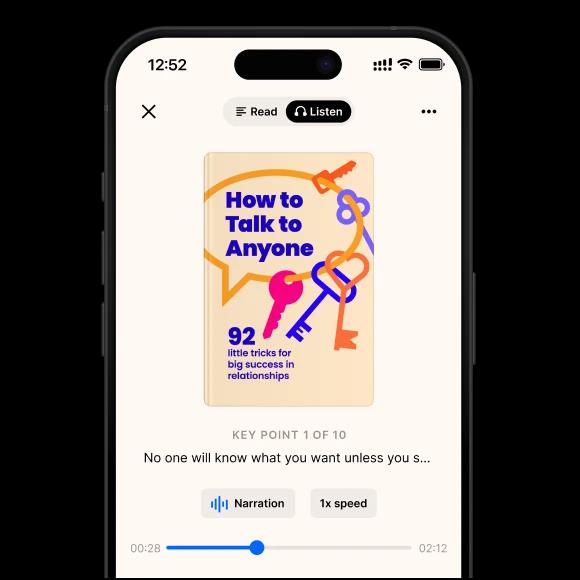
The best part is that you can easily start building these skills today with the Headway app. It offers quick access to book summaries focused on listening skills, daily reminders, and interactive exercises designed to help you apply what you've learned.
Get the Headway app and track your progress over time!
Quick list: Five simple hacks to listen better starting today
You can start improving your listening skills right now.
Focus fully on the speaker's words and nonverbal cues.
Pause your inner dialogue.
Ask thoughtful, open-ended questions to show genuine interest.
Reflect back and validate what you hear.
Build habits for sustained growth.
Keep reading to unlock powerful tips you can act on today! Take your listening skills to the next level.
Am I a good listener? Take this quick quiz to find out
You might also wonder about your current abilities. Answer the following questions honestly to evaluate your habits.
This quick assessment shows your baseline. You'll improve your score over time with consistent effort.
📘 Build crucial communication skills in minutes with Headway!
How to be a better listener: Six steps to build the skill
Once you know your starting point, a solid playbook makes practicing new skills much easier. These quick ideas from popular book summaries give you clear, actionable steps to improve your chats right away.
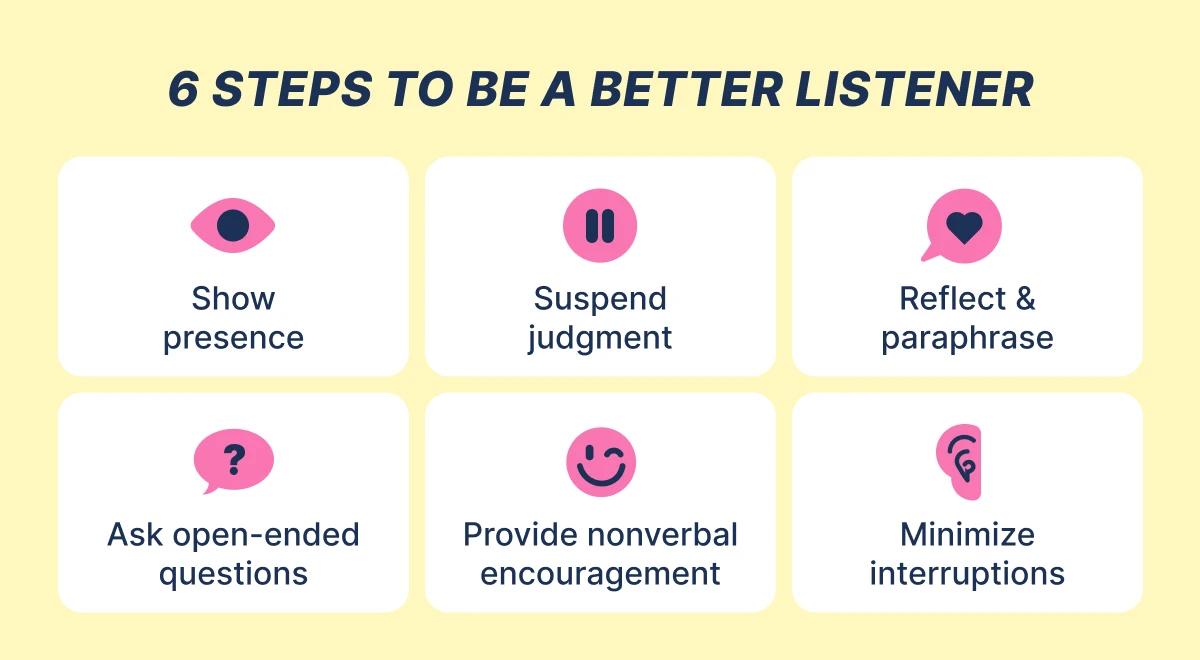
Master these six listening steps and get practical insights.
1. Show presence
Try to remove distractions, maintain eye contact, and face the speaker. That physical presence signals to the other person that they have your full attention, which improves the overall conversation.
2. Suspend judgment
Hold off on forming an opinion until you've heard their full point of view. Evaluating too early means you stop listening and start reacting, often before the other person has made their actual point.
If you're wondering how to stop thinking about your response while listening, this is the root cause: your brain switches to compose mode before the speaker has finished. Committing to the full thought — even when you already have a reply ready — is what separates hearing from listening.
📘 Get all these expert books in 15 minutes on Headway!
3. Reflect and paraphrase
Repeat back what you heard to confirm you understood it correctly. Paraphrasing is one of the most reliable ways to make someone feel heard — it shows you were tracking their meaning, not just waiting for a gap to speak. It also catches any misreads early, before they drift into a bigger problem.



4. Ask open-ended questions
Invite your conversational partner to expand on their thoughts. Questions like "Can you tell me more?" encourage detailed and honest responses.
📘 Focus tools that actually work are on Headway!
5. Provide nonverbal encouragement
Nodding, making eye contact, and positive facial expressions keep the other person talking. Short affirmations like "right" or "I hear you" signal you're with them, not just waiting for your turn.
6. Minimize interruptions
The urge to jump in is normal. Resist it. Knowing how to listen without interrupting is less about self-control and more about training yourself to trust that the full thought is worth more than your half-heard reaction. Let the person complete what they're saying — a great listener always waits for a natural pause before speaking.
📘 Learn to give advice less, listen more with Headway!
Five practical tips from top books: Build your muscle daily
You can acquire powerful habits by studying experts. Read these actionable ideas to improve your daily interactions.
1. Active listening techniques: Focus tools
Tip: Schedule two conversations per day where you only need to listen. Give no advice during these chats. Learning how to listen without giving advice is one of the quickest ways to show someone you trust them to figure things out — and it's harder than it sounds. This practice shows you exactly how to be a better listener in your daily routine.
2. The effective executive: Managing attention
Check out The Effective Executive summary to better manage your time and focus.
Tip: Schedule listening blocks. Set aside purposeful time to focus on your team, your family, or whoever needs your attention. Protected time ensures you can offer undivided attention when needed.
📘 Practice daily exercises straight from Headway!
3. How to talk to anyone: Confidence in connection
Look through the key tips from the 'How to Talk to Anyone' summary to build social confidence quickly.
Tip: Use conversational mirrors. Subtle shifts in phrasing, like reflecting the other person's language back to them, make the speaker feel respected, heard, and important without you having to say much at all.
4. Difficult conversations: Managing emotions
Tip: Use emotion labeling. When you can name what someone seems to be feeling, like "It sounds like you're frustrated," you give them a sense of vital validation during important conversations.
📘 Manage your attention like top executives on Headway!
5. How to make people like you in 90 seconds or less
Find helpful tips on quick rapport building in the summary of 'How to Make People Like You in 90 Seconds or Less.'
Tip: Use micro-affirmations to signal effective listening. If you're saying "I'm listening" while checking your phone, other people won't believe you based on your body language alone.
Why listening is your core strength (and how to use it)
There's a big difference between hearing sounds and actually understanding someone. Hearing is biological. The art of listening requires intention, focus, and empathy.
When you give someone your full attention, you build trust faster than almost any other action. People notice. It's one of those things that's obvious in its absence and quietly powerful when it's there.
Science shows that listening is a learnable skill. Anyone can learn to be a better listener through consistent practice and dedication. This matters just as much in personal life as it does at work — if you're looking at how to improve listening skills in a relationship, the same techniques apply: presence, patience, and paraphrasing before reacting.
Read more tips on how to become a well-spoken person to pair your speaking with excellent attention.
📘 Schedule listening blocks using wisdom from Headway!
Daily routine: Turn listening into a habit every day
A solid plan makes all the difference when you're building a new habit. You can turn your communication goals into a reality with a few simple, structured steps throughout your day. Let's look at a schedule that actually works.
Morning reflection
Before you step out the door, set one intention for your conversations today. It doesn't have to be elaborate. Something like "I'll let people finish before I respond" is enough to practice effective communication and change the course of an entire day of interactions.
During the day
Find five to ten minutes for focused listening moments. Put your phone away, turn off social media and notifications, and give whoever you're talking to your undivided attention during those short windows. You'll be surprised by how much more you hear.
Evening review
Look back at your conversations. Where did you listen well? Where did your mind wander, or your mouth jump in too soon? You can use the quiz criteria from earlier as a guide. Adjust your approach accordingly for tomorrow.
📘 Protected time for better focus starts with Headway!
Mistakes to avoid when practicing (and how to fix them)
We all slip up sometimes while building new skills. You can avoid common pitfalls by recognizing them early and applying simple corrections.
| Mistake | Why it backfires | How to fix it |
|---|---|---|
Preparing your response while the other person is still speaking | The moment your brain shifts to composing a reply, you stop absorbing what they're actually saying | Put your reply on hold until they finish — you can only respond well to what you've fully heard |
Interrupting the speaker | It signals that your point matters more than theirs, even when that's not the intent | Wait for a natural pause, even an awkward one — the silence is almost always worth it |
Offering unsolicited advice | People who need to vent often feel dismissed when you jump straight to solutions | Ask first: "Do you want my take, or do you just need to talk it through?" |
Distracted multitasking | Split attention is obvious — people can tell when you're half-listening, and trust erodes fast | Phone face-down, laptop closed, full presence for the window of the conversation |
Find more guidance on improving communication skills to avoid these common pitfalls.
📘 Build social confidence quickly with Headway!
How Headway users applied these steps in real conversations
How Headway users applied these steps in real conversations
Reading about these techniques is a starting point. Seeing how others have put them to work makes them stick.
Deyvis Bebicaci, an ICF-accredited executive coach and founder of Synergy Consulting with 30 years of experience, came across a Headway summary on non-verbal cues during his morning reading routine. The framework helped one of his clients recognize that their silence in team meetings was being interpreted as disengagement — not thoughtfulness. Small shifts in body language and timing led to an immediate improvement in team trust. The insight wasn't complicated, but it required someone to point out the gap between what the leader intended and what the room was actually receiving. Read Deyvis's full story.
Abdelrahman Mohamed Soliman, a cost control manager at NMDC Energy, describes a specific turning point during a high-stakes budget meeting. He was about to push back defensively — then caught himself. Instead of reacting, he paused, reframed the issue, and asked questions focused on root causes rather than blame. The conversation moved faster, and the outcome was cleaner. His colleagues noticed the shift: "You don't rush decisions anymore — you frame them." That pause, built through consistent learning with Headway, became his edge in high-pressure rooms. Read Abdelrahman's full story.
📘 Build the listening habit that changed how they lead — start with Headway!
Real-world examples: Attention that transformed conversations
History and modern business offer many stories of leaders who excelled at giving attention. You can look at the top executives of major companies to see the real impact of empathy and focus. Here are two notable figures who rely on these vital traits.
Richard Branson on gathering information
Richard Branson consistently emphasizes the value of hearing others. He believes that the greatest asset of any organization is its people. In his view, gathering information from employees is the best way to move business forward.
He even stated in an interview that leaders who are great listeners uncover strategies with a huge impact. This approach is a great example of how to be a better listener in high-stakes environments. You can apply the same principle to your own life, your family meetings, and your community gatherings.
Satya Nadella and the importance of empathy
Satya Nadella, the CEO of Microsoft, transformed his company's culture by prioritizing empathy and emotional intelligence. He argues that high IQ is useless without high EQ. He actively encourages his team to focus on the human element of technology.
In a recent podcast, Nadella explained that empathy requires us to better understand the context. This approach is exactly how top executives prioritize strategic patience.
Professionals on LinkedIn often share how active listening helped them close big deals. They ask follow-up questions to show genuine interest in their clients.
For a modern take on digital networking, review our guide on how to win friends and influence people in the digital age.
📘 Make people feel important using tips from Headway!
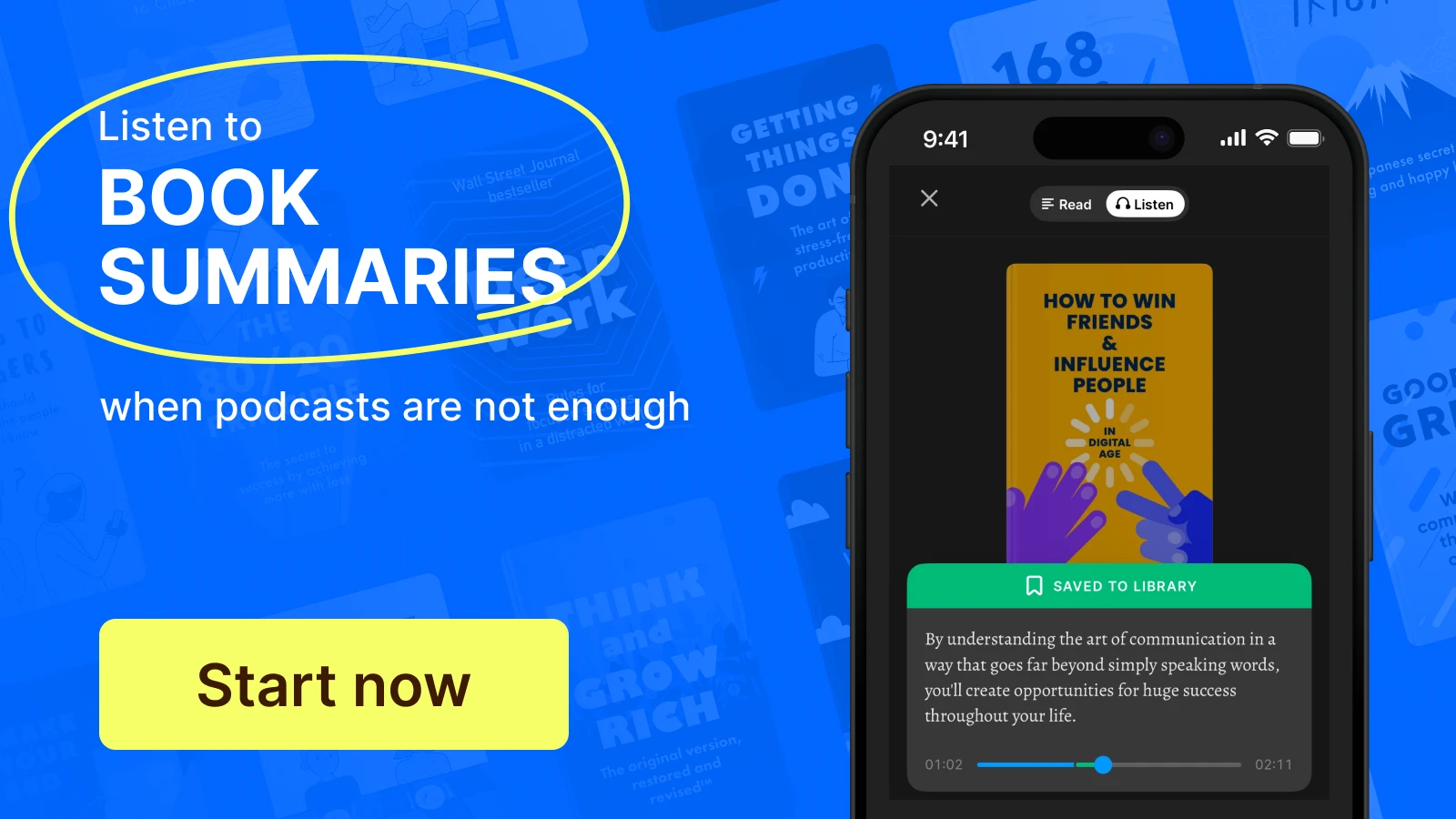
Become a better listener with the Headway app
Now that you know how to be a better listener, you can improve your interactions, build trust, and communicate more effectively. Following these actionable steps daily will transform your relationships. The Headway app is the perfect tool to help you stay on track with your personal growth.
The microlearning platform offers bite-sized book summaries, audio guides, and daily insights. You can consume top-tier knowledge in just fifteen minutes a day. This way makes it incredibly easy to fit self-improvement into a busy schedule, a long commute, or a quiet morning routine.
Take charge of your personal development today.
Download the Headway app to access hundreds of summaries on communication, psychology, and success. Start building the kind of listening skills that actually change how people feel around you today.
FAQs on active listening
What does it mean to really listen?
It means giving your undivided attention to the speaker without planning your reply. Knowing how to be a better listener involves focusing on verbal and nonverbal communication. You must validate the speaker's emotions, maintain steady eye contact, and avoid checking notifications. This practice creates a safe space for meaningful dialogue.
Can listening skills be learned?
Yes, anyone can develop this ability through consistent practice and firm intention. You learn how to be a better listener by studying active techniques, taking notes, and practicing daily. Reading expert summaries provides the exact framework needed to improve your focus, your empathy, and your social interactions.
How long does it take to become a better listener?
You can see immediate improvements in your very next conversation by simply pausing. Even so, cementing the habit of being a better listener takes several weeks. Regular practice, mindful reflection, and using tools like book summaries will significantly speed up your progress.
Are there daily habits that help me listen better?
Yes, implementing micro-moments of focus throughout your day works exceptionally well. Practicing being a better listener includes setting morning intentions, turning off your phone, and asking open-ended questions. Reviewing your progress every evening ensures you stay committed to your personal growth goals.
Why is listening important for productivity?
Clear communication prevents costly mistakes, reduces workplace conflict, and streamlines teamwork. When you know how to be a better listener, you capture essential instructions the first time. This method eliminates frustrating rework, builds strong team morale, and helps everyone achieve their daily targets much faster.