Self-growth
 Business & Career
 Success
 Communication
 Healing
 Relationships
 Psychology
 Happiness
Let me guess. You started the New Year with some bold resolutions. Maybe to work out every morning, meditate, or commit to a daily journaling habit. You probably felt motivated and started out strong too.
But the second Friday in January is called 'Quitter's Day' for a reason. That's when most people throw in the towel. By mid-February, 80% of people who set New Year's resolutions abandon them, according to psychology professor Alison Phillips from Iowa State University. So if your motivation is waning, you're not alone.
And no, it doesn't mean you failed. Most New Year's resolutions collapse because they rely on motivation instead of structure.
Real behavior change takes time, and it rarely fits perfectly into daily life. Instead of asking for unrealistic amounts of time or energy, sustainable habit-forming systems focus on consistency over intensity.
With Headway, you can turn personal growth into a 15-minute habit with quick book summaries and practical ideas that keep your goals alive even on low-energy days. It's not about doing more.
How long does it take to build a habit?
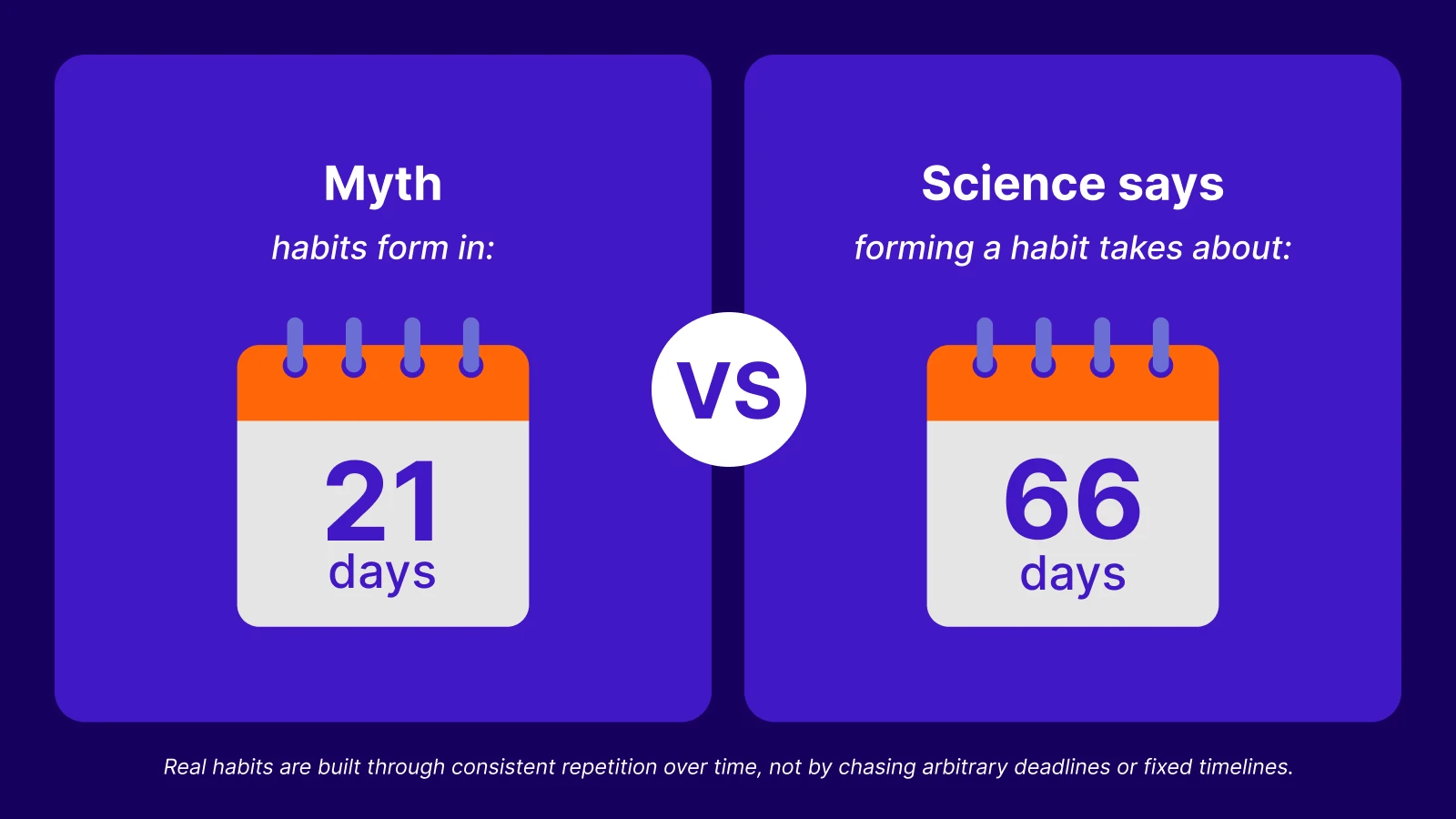
On average, it takes 66 days for a new behavior to become automatic, according to Phillippa Lally at University College London. However, the timeframe varies widely, from 18 to 254 days, depending on the habit's complexity and your level of consistency.
This wide range highlights an important truth about the habit formation process: there is no universal magic number that works for everyone.

The 21-day myth and why you should ignore it
You may have heard the commonly cited statistic that it takes 21 days to form a new habit. Turns out, this is a myth. That observation was made by Dr. Maxwell Maltz, a plastic surgeon, who realized that his patients took about 21 days to adjust to their changes in appearance following surgery.
In his 1960 book Psycho-Cybernetics, he noted that it took a "minimum of 21 days for an old mental image to dissolve and a new one to jell." Notice he said minimum! In the decades that followed, this nuanced statement was boiled down to "it takes 21 days to form a new habit," and this was the origin of the 21-day myth.
This oversimplification became deeply rooted in self-help culture, but it doesn't reflect how real habit formation works. Letting go of the 21-day myth can actually improve your wellness, because it replaces unrealistic expectations with patience.
📘 Build habits that actually stick — get Headway.
The real science: The 66-day average
On average, it takes 66 days for a new behavior to become automatic, according to Phillippa Lally at University College London in their 2009 research paper. However, the timeline varies widely, from 18 to 254 days, depending on the habit's complexity and your level of consistency. Newer research is consistent with this finding; a 2024 systematic review of 20 habit-formation studies concluded that the median time to create a new habit is 59 to 66 days, with individual ranges from 4 to 335 days.
Why is the range so wide?
The time it takes to build a habit depends heavily on what the habit is. Simple actions like drinking water with lunch are low-effort, have a clear cue, and are often considered easy-to-adopt good habits.
More complex behaviors, like exercise habits, maintaining a writing routine, or cooking healthy meals, involve multiple steps and more opportunities for disruption. These different habits take longer to automate, especially when they replace existing bad habits.
What is a habit?
Habits like eating a piece of fruit with lunch or drinking a glass of water with lunch are straightforward, require little effort, and have a clear trigger. These can become automatic in as little as 18 days. More complex habits, like going to the gym, sticking to a writing routine, or preparing healthy meals daily, involve multiple steps, greater mental or physical energy, and more opportunity for disruption. These often take far longer.
Research also shows that the timing of the habit can play a role; habits performed in the morning are generally easier to stick with than those performed in the evening.
Individual agency
Habits that the individual chooses for themselves lead to stronger habit formation than those assigned by others, such as a doctor or family member. Autonomy is vital for sustaining behavior change and for mental health support. That's why external intervention often fails if the person does not personally value the habit.
Consistency and repetition
Repeating the habit in a consistent context (same time, same place, same trigger) eventually leads to automatic execution, and increased practice frequency can speed up habit formation. Over time, the behavior becomes part of your daily routine, requiring less conscious effort.
That said, missing one day won't kill the habit (phew!). What matters is the overall pattern of consistency over the weeks and months rather than perfect streaks.
The latest research: Why it might take 6 months
A 2023 machine learning study led by neuroscientist Colin Camerer at Caltech found that complex, identity-driven habits, like going to the gym, meditating, or eating plant-based foods, may take closer to 180 days to solidify.
The researchers used massive, real-world datasets: badge swipe data from over 30,000 gym members spanning several years and RFID-tracked hand-washing data from thousands of hospital workers.
With this data, they built a model to predict whether each person would perform the behavior on a given occasion using variables such as day of the week, past streaks, etc. For gym attendance, the median time to habit formation was 4 to 7 months, whereas for hand-washing, the habit formed more quickly. Typically, it took 9 to 10 shifts.
These findings suggest that successful habit formation, especially for identity-based habits, may require a much longer amount of time than we typically expect.
📘 Master long-term habit formation — download Headway.



What makes a habit stick?
What transforms a repeated action into a lasting habit isn't just willpower or repetition. It's automaticity. In psychology, automaticity refers to the moment when a behavior is so ingrained that you perform it without consciously thinking about it. Examples might be putting your seatbelt on in the car or locking the door behind you when you leave your house. I always pat my jacket pocket when I leave my house to make sure I have my keys before I pull the door shut behind me!
The foundation of this process is built on what Charles Duhigg coined the 'habit loop' in his book 'The Power of Habit,' and it goes cue, routine, then reward. When this loop is repeated often enough, your brain starts to form new neural pathways that make the behavior easier to perform, and eventually it requires less conscious effort. For a long time, it was believed that the brain was fixed in adulthood. But modern neuroscience has proven otherwise. Thanks to neuroplasticity, the brain's ability to rewire and adapt, repeated behaviors can literally reshape how your brain functions over time. Repetition is critical, but meaningful repetition is even more powerful. When habits are linked to a clear reward (like the satisfaction of ticking off a habit tracker or the dopamine hit from learning something new), the brain learns to associate the behavior with a positive outcome.
The three phases of habit building
Building habits isn't just about repetition. It's about understanding the emotional and neurological journey behind behavior change. These three phases can help you anticipate the highs, dips, and turning points.
The honeymoon phase (1–7 days)
You're feeling inspired and motivated, and it's relatively easy to stick to your new habit in these initial days. This period is a great time to leverage your excitement and set up visible cues to keep the momentum going. Print your free daily habit tracker, and put it somewhere visible as a daily reminder.
The messy middle (8–30 days)
The initial excitement has faded, results feel slow, and resistance starts to creep in. James Clear refers to this as the "Valley of Disappointment," where you feel you're putting in effort but not seeing any progress. It's helpful to understand that progress is often exponential, not linear. The early days are spent laying the foundations (retraining your brain, building consistency, and creating cues), and results come later, through the compound effect.
Emotionally, this messy middle is the hardest phase, and it's where most people give up their new habit, mainly because it's not working fast enough. This is also the phase where self-doubt, perfectionism, or old narratives can rear their heads: "Why bother? This isn't working." Recognizing that this discomfort is part of the process can help you stay the course.
In this phase, distractions like social media, work stress, or fatigue can easily derail a new routine. This stage is where external support, such as a short podcast or a Headway summary, can help reinforce consistency without being too overwhelming.
Second nature (31–66+ days)
Things are starting to click. The behavior becomes more automatic, you feel less resistance, and you don't need as much willpower to show up. You may still hit occasional dips, but your identity is shifting. You're no longer someone "trying" to build a habit. You're becoming the kind of person who does it.
Why habits fail
Here are 5 common reasons habits fail:
1. All-or-nothing thinking: When we miss a day, it's tempting to think we've failed entirely. This black-and-white mindset fuels guilt and often leads to giving up altogether, but research shows that missing a day is okay. It's consistency overall that matters, not just the perfect streaks. Never miss twice is a better rule of thumb.
2. Setting goals instead of systems: Goals are great, and we do need direction. But it's the system around the goal that helps it stick. Instead of "I want to meditate daily" (goal), try setting a trigger, time, and place like "After brushing my teeth, I will meditate for 2 minutes" (system).
3. Lack of visual cues: We so easily forget what we don't see. If it's out of sight, then it's usually out of mind.
4. Trying to change too much at once: Overhauling your whole life is unsustainable. Focus on one habit at a time and make this habit achievable by starting with super small steps.
5. Relying on motivation: Motivation comes and goes; it's unreliable. If your habit relies on you "feeling like it," you're vulnerable to life's chaos and energy dips. Instead, make it as easy as possible to do the thing.
Seven strategies to build habits that stick
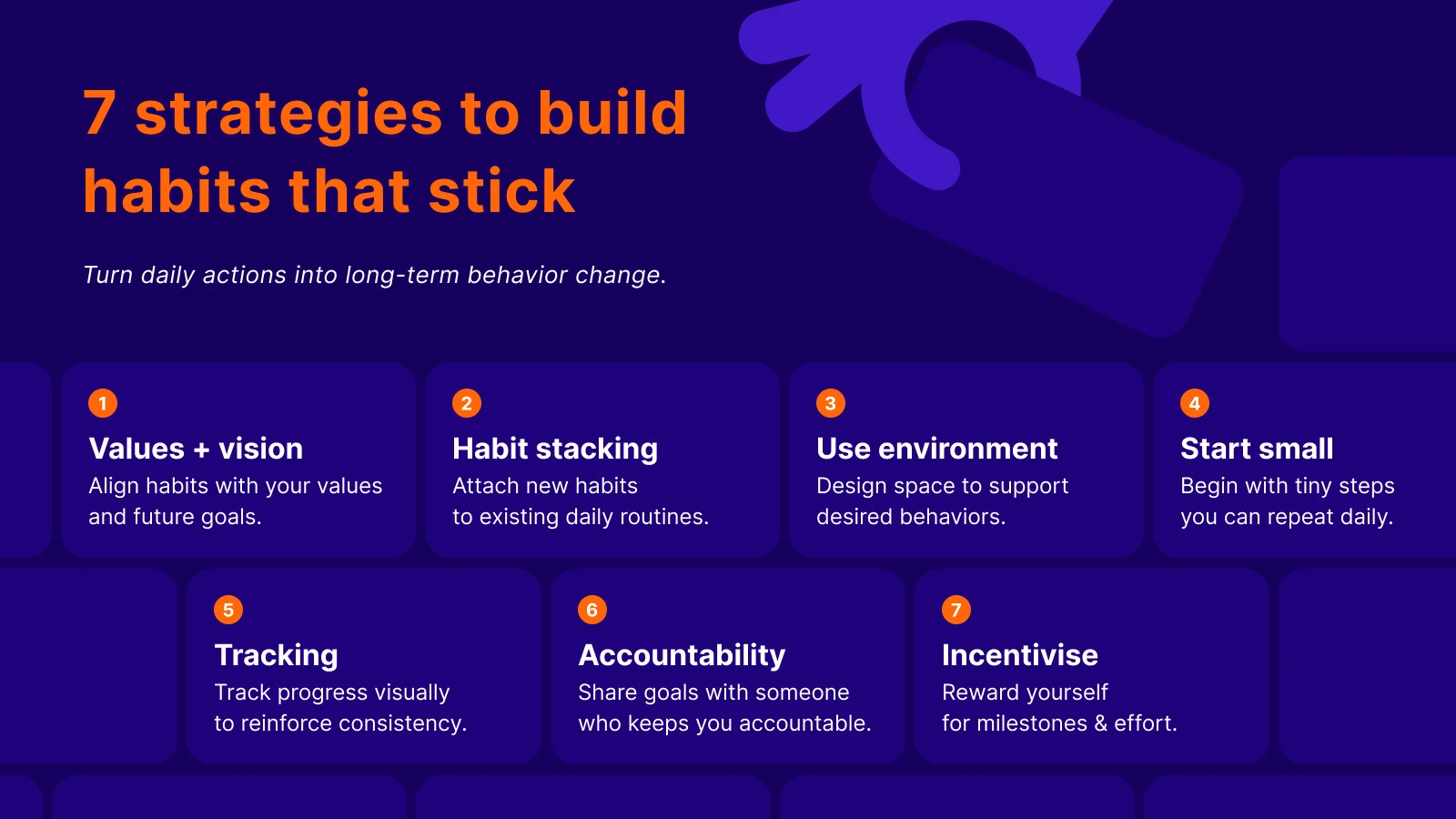
1. Values and vision: Make sure the habit you're trying to create is in alignment with your values and future vision; this will make it feel more meaningful. Taking some time to think about your goals is a powerful exercise too; this free goal-setting worksheet is useful to structure your thoughts.
2. Habit stacking: Attach a new habit to a habit you already do, for example, "After I make my coffee, I'll meditate for 2 minutes", or "When I'm driving to work, I will listen to Headway."
3. Leverage your environment: Set up your space to make your habit easier, for example, lay out your gym clothes before you go to bed, or have your supplements on your bedside table, put your Headway app on your phone's home screen, set yourself some reminders in your calendar. I've found that if something is out of sight, then it's out of mind, and it doesn't happen.
4. Start small: It's preferable to start with a baby step, something little that you can commit to that is realistic for you to achieve.
5. Tracking: Use a habit tracker to monitor your progress. I have a wipeable board in my kitchen that I use, and it's very helpful as I see it often throughout the day. It's an adult version of a reward chart!
6. Accountability: Get yourself an accountability partner; maybe there's someone you know who also wants to work on the same habit as you.
7. Incentivize: Decide in advance how you will celebrate when you successfully do the thing. Give yourself a reason to celebrate! For example, add a celebration milestone on day 7, 14, 21, or 66.
Your next step: build better habits with Headway
Building a habit is a combination of systems, consistency, and supportive experiences, not willpower.
If you're looking to create a routine that fits your daily life, whether through healthy habits or breaking bad habits, or simply developing new routines for yourself, Headway keeps you motivated with small, achievable steps, podcast-style insights, and reminders that help you practice in a consistent context.
It's like having a personal growth coach in your pocket, guiding you through the habit formation process, celebrating your wins, and helping you turn good habits into lasting behaviors.
📘Start building habits that last, one small step at a time, with Headway.
FAQ on How Long It Takes to Build a Habit
How long does it take to build a habit?
The average time to develop a habit is 66 days; however, it may take anywhere from four to 335 days, depending on the degree of complexity and similarity between the actions: simple habits (for example, drinking water) typically take less time to form, while those that require more effort and planning take a longer period of time.
What is the 21/90 rule?
Some common theories state that by simply completing an action consistently for 21 days, you will have developed a habit, and by continuing this for a period of 90 days, you will have fully integrated that habit into your lifestyle. This theory is based on the idea that it takes less time to adjust to a new activity than to create a routine, and that more time is needed to make good habits a part of your daily routine and, therefore, create a lifetime of positive behaviors.
Does it take 3 months to form a habit?
Often, yes, especially for habits that are tied to identity, like exercise habits, meditation, or a new daily routine. In fact, depending on the complexity and regularity, habit formation can take anywhere from a few weeks to 6 months.
How long does it take to build a habit with ADHD?
A person with ADHD may need more time to form a habit due to difficulties with concentration and consistency. Establishing a habit can take 2 to 3 months, or even 6 months or more. Tools like visual tracking aids, reminders, and accountability measures can help.
How long does it take to build a habit of working out?
Forming a working-out habit typically takes 4 to 7 months, depending on the complexity of the exercises, regularity, and personal motivation. Creating an exercise, or activity-based, routine is much easier than creating an exercise-related routine, as exercise-related activities require more time and effort for successful habit formation and for developing a consistent context within which to exercise regularly.
How long does it take to build a habit of waking up early?
Waking up early typically takes between 30 to 60 days of continuous practice to truly develop this habit creator. It is important to maintain a consistent context: go to bed and get up at the same time, use small rituals, and gradually change your daily routine for stable results.
What is the golden rule of habits?
Cue, routine, then reward. This habit loop, popularized by Charles Duhigg, is a foundation of behavioral change and describes how a cue triggers an action (routine), which then produces a reward. Repeating this sequence makes the behavior automatic and reinforces good habits.
What helps you stay motivated?
Using a combination of tracking, rewards, and inspiration from the bite-sized summaries inside the Headway app to stay on track. These small, consistent steps make it easier to stick to your new routine and gradually turn actions into good habits.