Self-growth
 Business & Career
 Success
 Communication
 Healing
 Relationships
 Psychology
 Happiness
Are you constantly tired, feeling like your mind is running a marathon you never signed up for? You're definitely not the only person dealing with daily stress. In this Headspace app review, we take a close look at how this tool compares to other mental health apps and whether guided meditations actually bring relief.
Taking a few minutes to pause sounds easy, but research shows that consistent mindfulness practices physically change how our brains handle pressure. One study confirms that brief daily meditation sessions lower cortisol levels and improve overall well-being. We'll see if Headspace actually delivers.
And if you've been meaning to learn and grow, but never found the right moment, Headway can help you start now. It's a great self-growth companion that turns book insights into quick lessons you can easily integrate into your meditation routine.
📘Get the Headway app and commit to real change!
Quick summary: Headspace review at a glance
If you are short on time, here's what you need to know about Headspace.
What it is: A beginner-friendly meditation app focused on stress relief, better sleep, and mental wellness.
Core features: Hundreds of guided sessions, sleepcasts, breathing exercises, and focus music.
Pricing: $12.99 per month or $69.99 for an annual subscription, with a 7-day to 14-day trial period.
Pros and cons: Great for beginners and well-organized, but most features require a paid subscription.
Alternative option: If you prefer learning actionable skills over quiet meditation, Headway might be a better fit for your daily routine.
What is the Headspace app?
Headspace is a mindfulness and meditation app that offers personalized support through AI-powered guidance, meditation, mindfulness, coaching, and therapy.
Headspace launched in 2010 when Andy Puddicombe, a former Buddhist monk, teamed up with Richard Pierson. Their goal was simple: make meditation accessible to everyday people without confusing terminology. They wanted to take mindfulness out of the ashram and put it on your phone.
The app grew from offering simple audio files into a comprehensive mental health coach. It now covers everything from mindful eating to managing burnout. The creators worked hard to ensure their methods actually work in real life, not just in theory.
Headspace relies heavily on scientific evidence to support its claims, partnering with researchers to test its mindfulness exercises. Because of this, many users trust it as their first introduction to mental health care.
📘 Calm your mind with meditation, then feed it with knowledge on Headway!
Why mindfulness and technology work together
We usually blame our phones for our daily stress and anxiety. So, it may sound strange to use a screen to calm your mind, but turning your device into a mental health coach actually makes practical sense.
Phones are built to grab your attention. When you install a meditation app, you flip that design in your favor. Instead of getting an alert about a stressful work email, you receive a reminder to take a deep breath.
Technology also makes it incredibly simple to track your habits. Seeing a visual streak of your daily meditation practice gives you a quick hit of dopamine, which encourages you to open the app again the next day.
Most importantly, apps make mental wellness available to anyone with a smartphone. You don't need to drive to an expensive clinic or schedule an appointment. The tools for better sleep and reduced anxiety are right in your pocket.
When you pair that easy access with structured learning, you create a strong support system. You learn how your brain works through reading, and you immediately practice what you learn through guided audio.
📘 Meditation clears your head — Headway fills it with winning ideas!
How Headspace works: Four features you'll actually use
Headspace packs a lot into its menus. Here's a breakdown of the tools you get when you open the app and how they fit into a normal day.
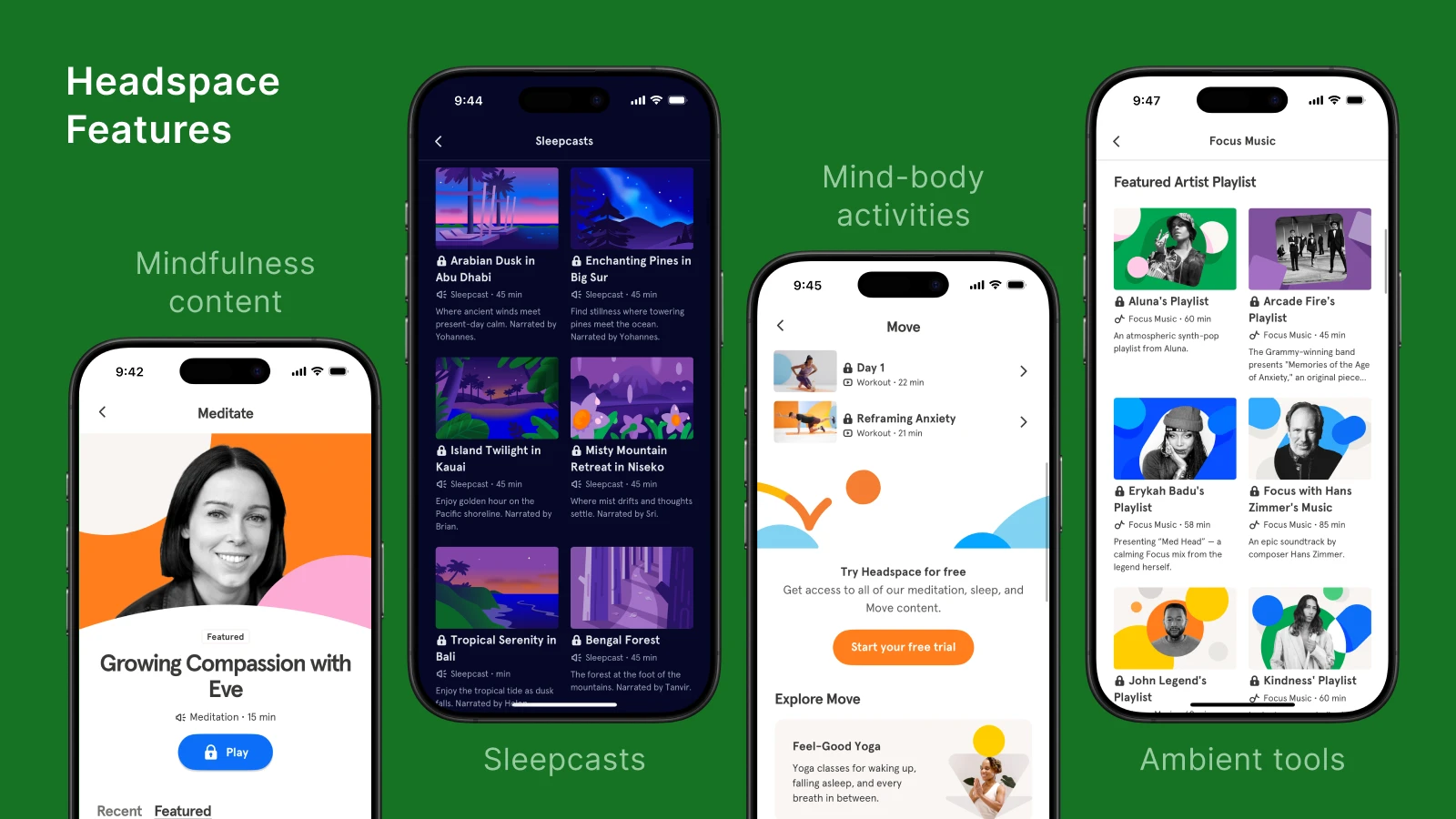
1. Meditations and mindfulness content
The core of the Headspace meditation program is its library. You can choose from structured meditation courses that last several weeks or pick single sessions for a quick reset. The app organizes these by topic, so you can find help for anxiety, grief, or frustration without much searching.
If you're new to this, the basics course teaches you the foundation of breathwork and body scanning. The guided meditations use a friendly voice to keep your mind from wandering. Over time, these daily routines become easier to stick with.
2. Sleep tools and sleepcasts
Struggling to fall asleep is a common problem, and Headspace tackles it with a dedicated sleep tab. Sleepcasts are essentially bedtime stories for adults. They use soothing voices and shifting soundscapes that give your busy brain somewhere gentle to land.
These sleep tools differ from other apps because they're not just white noise. The stories slowly decrease in volume and energy, guiding you toward better sleep. They also offer wind-down exercises to help you physically relax before bed.
3. Move and mind-body activities
Sitting still isn't the only way to practice mindfulness. Headspace includes a "Move" section that connects your mind and body through light exercise. These are not intense workouts, but rather gentle stretches and mindful walking guides.
You can listen to guided sessions while doing yoga or taking a walk around your neighborhood. It's a great option if you feel too restless for sitting meditation, and it proves that self-care doesn't require complete silence.
4. Focus music and ambient tools
When you need to work or study, Headspace offers a variety of focus music. You'll find playlists curated by musicians like John Legend, as well as ambient noise and lo-fi beats to block out office chatter or household noise.
It's an audio-first approach to concentration that's similar in some ways to listening to audiobooks while you work, though strictly focused on helping you think rather than learn. If you're curious how that compares to dedicated listening apps, it's worth checking out if Audible is worth it for your needs.
📘 A calm mind absorbs faster — start learning smarter with Headway!
How much does Headspace cost? Pricing, plans, and value
Headspace operates on a subscription model. You can choose to pay month-to-month or commit to a yearly subscription. If you opt for the annual plan, the overall price drops significantly compared to the monthly rate.
There's almost always a trial period available. Usually, you get 7 days free on the monthly plan and 14 days free on the annual plan. Just remember to watch out for auto-renewal if you decide the app is not for you.
| Plan Type | Price | Free trial |
|---|
Monthly | $12.99 / month | 7 days |
Annual | $69.99 / year | 14 days |
Student | $9.99 / year | Valid with student ID |
📘 Skip the subscription — start learning from more than 2,000 books on Headway today!


Pros and cons of the Headspace app
Every app has its strengths and weaknesses.
Pros of using Headspace:
Very beginner-friendly, with clear instructions for starting meditation.
Wide variety of content, including sleep music and podcasts.
Backed by science and tested for effectiveness.
Clean, colorful interface that's easy to navigate on iOS and Android.
Cons of using Headspace:
The price may be too high for some budgets.
Limited personalization compared to working with a real therapist.
The free version has very little content.
📘 Get more value than any meditation app — discover Headway!
Headspace alternatives: Same functions, different vision
There are plenty of choices in the app store. Here's how Headspace compares to other popular tools before you decide which one fits your routine. We'll look at Calm, Insight Timer, Mindvalley, Happier, and Waking Up below.
| App name | Best for | Core vibe | Annual subscription |
|---|
Headspace | Beginners, structured courses | Playful, educational | $69.99 |
Calm | Sleep stories, nature sounds | Soothing, atmospheric | $69.99 |
Insight Timer | Budget users, huge variety | Community-driven, diverse | Free (Premium $59.99) |
Mindvalley | Life coaching, spiritual growth | Intense, community-focused | $399.00 |
Happier | Skeptics, realistic approach | Practical, interview-style | $99.99 |
Waking Up | Deep philosophy, neuroscience | Academic, thought-based | $119.99 |
Calm and Insight Timer are the most direct competitors. Calm focuses heavily on unguided relaxation and celebrity narrators. Insight Timer offers a massive library of free meditations from thousands of teachers, which is worth exploring if you're on a tight budget.
If you want to focus on holistic life coaching and personal transformation, reading a Mindvalley review will show you how it differs from a standard meditation app. Mindvalley acts more like a virtual university for self-improvement, offering long video courses rather than short breathing exercises.
Happier is excellent for people who feel skeptical about meditation. It uses plain language and features interviews with scientists.
Waking Up, created by Sam Harris, is best for users who want to understand the neuroscience behind their thoughts and prefer a serious, academic tone.
📘 Done breathing? Learn something new with Headway!
Meditation apps vs habit-building apps: Which one is better?
Sometimes, breathing exercises aren't enough to fix what's stressing you out. If your anxiety comes from procrastination or feeling stuck in your career, a learning app might serve you better than a meditation app.
| App name | Core functionality | Best used for | Format |
|---|
Headway | Bite-sized book summaries | Daily self-growth and habit building | Audio and text summaries |
Blinkist | Nonfiction book summaries | Broad topic exploration | Audio and text summaries |
Wiser | Content curation and saving | Organizing articles and podcasts | Digital bookmarking |
Imprint | Visual interactive learning | Retaining complex subjects visually | Interactive graphics |
StoryShots | Animated book summaries | Budget-friendly learning | Video, audio, and text |
Here's where you can explore platforms focused on knowledge. For example, reading a Headway vs Blinkist comparison shows how absorbing book summaries can actively solve problems. When you learn how to manage time through a 15-minute summary, you directly reduce your stress.
While Headspace calms the mind, learning apps give you the tools to change your circumstances. If you're deciding whether a summary app fits your budget, you might ask, "Is Blinkist worth it?" or "Should I just stick to Headway?" For many, combining brief meditation with actionable microlearning creates the best results.
If you're a visual learner, reading an Imprint app review might point you toward a platform that uses interactive graphics.
And if you want to organize what you read to feel less overwhelmed, checking a Wiser app review can help you decide if a digital bookmarking tool will clear your mental clutter.
📘Pair your calm mind with actionable book insights from Headway!
Headspace meditation app review: User experience
Looking at app store reviews gives you a good idea of how the app performs day to day. We checked what actual users think about their time spent on Headspace across different platforms.
On the Apple App Store, Headspace maintains a solid 4.8-star rating. Users frequently mention how Andy Puddicombe's voice feels calming and familiar. Many long-term Headspace users credit the app for helping them handle panic attacks before big work presentations.
Over on Reddit's Headspace community, the feedback is a bit more detailed. Regular users often praise the sleepcasts, noting that the changing soundscapes prevent their brains from memorizing the stories and tuning them out.
Some Reddit users do express frustration when the app updates its interface, occasionally making older, favorite courses harder to find.
On the Google Play Store, Android users generally report a positive experience with the daily meditation tools, though a few reviews mention occasional audio glitches when the screen locks.
Despite minor bugs, positive feedback heavily outweighs the negative, particularly around the variety of mindfulness exercises available for beginners.
📘 Turn your relaxed focus into learning time with Headway!
Scientific evidence: Does it truly help?
Headspace is one of the few mindfulness apps that actively researches mental health and mindfulness. Its 2024 Workforce State of Mind report found that nearly half of employees attribute most of their stress to work. In response, the app offers specific, expert-backed guidelines for addressing workplace burnout.
A peer-reviewed study also indicated that using a mindfulness app for just 10 days can reduce daily stress by up to 14%. The researchers noted that these brief interventions are highly effective for people who can't afford traditional therapy.
These results happen because mindfulness meditation trains your brain to notice distractions without reacting to them. Over time, this practice lowers the physical symptoms of anxiety.
It isn't a replacement for cognitive behavioral therapy (CBT) administered by a professional, but the scientific consensus suggests it works well as a daily support tool.
📘 Build your best routine yet: meditation and microlearning with Headway!
Who should use Headspace to feel better
Headspace isn't perfect for everyone. Here's a breakdown of who will get the most value from a subscription:
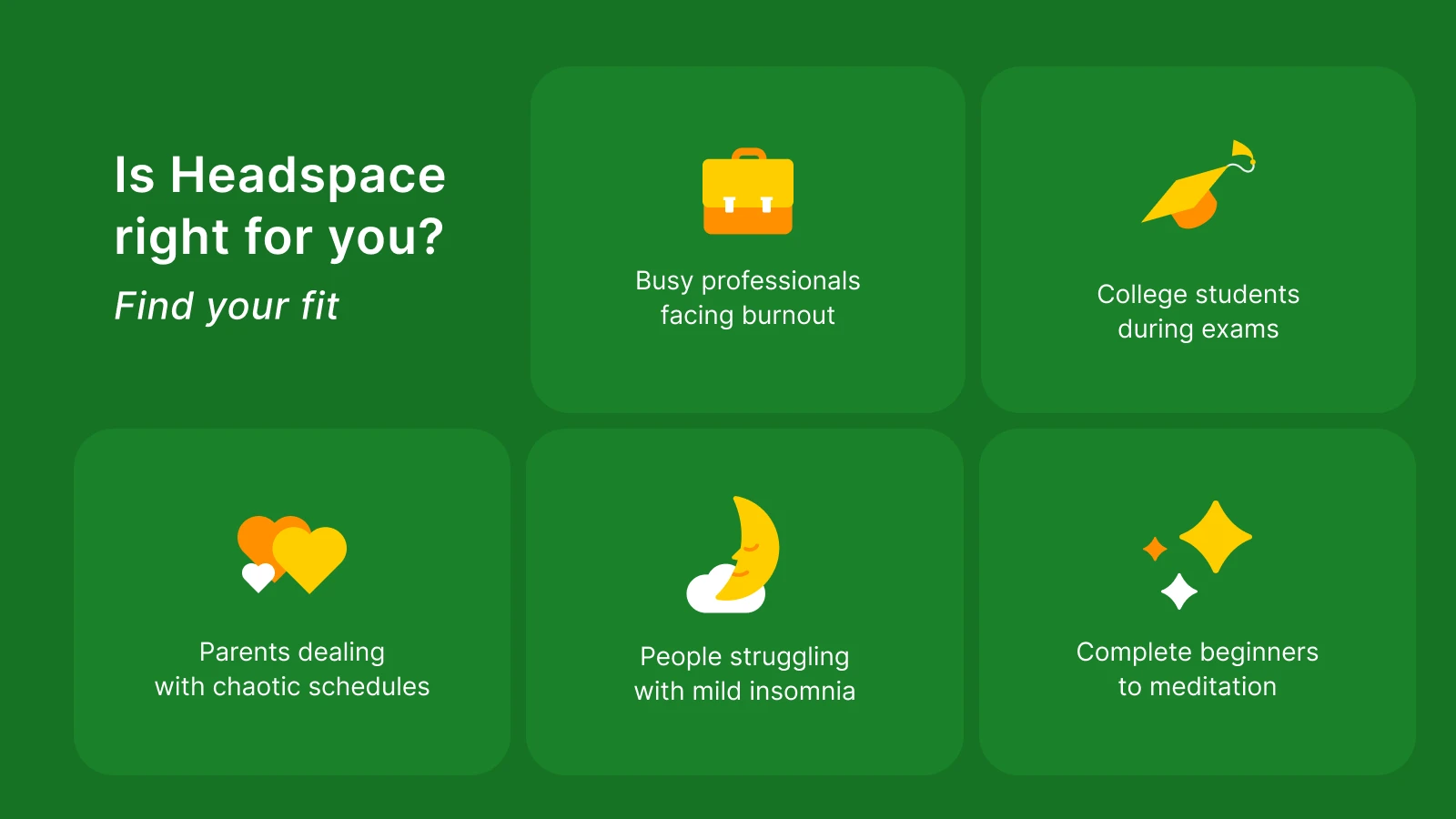
1. Busy professionals facing burnout: If you work long hours and feel your chest tighten before checking emails, the three-minute SOS sessions offer immediate relief. The app teaches you how to reset your nervous system at your desk.
2. College students during exams: Students dealing with heavy workloads often struggle to concentrate. Headspace offers focused music and study-break meditations to help clear mental fog between classes.
3. Parents dealing with chaotic schedules: Finding quiet time is hard when you have kids. The "Move" section allows parents to practice mindfulness while walking the dog or doing light stretching, proving that self-care doesn't require complete silence.
4. People struggling with mild insomnia: If your brain starts listing your mistakes the moment your head hits the pillow, sleepcasts are worth trying. They distract your mind just enough for physical exhaustion to take over
5. Complete beginners to meditation: If you feel intimidated by the idea of meditation, you'll appreciate the animations and simple explanations. The practice feels approachable rather than overwhelming.
📘 Don't just calm your mind, transform it with Headway!
How to get the most out of Headspace: Ten expert tips
Downloading the app is only the first step. Here are ten specific ways you can actually make the subscription worth your money:
1. Anchor to an existing habit: Don't try to carve out a new time slot. Listen to a five-minute session while your morning coffee brews. Attaching the app to something you already do makes it far easier to stick with.
2. Use the SOS sessions for immediate panic: Headspace has a section specifically for high-stress moments. If you feel panic rising before a meeting, the SOS tab offers a guided breathing exercise to bring your heart rate down quickly.
3. Start sleepcasts before you are tired: Don't wait until you're tossing and turning. Turn a sleepcast on 20 minutes before you want to fall asleep and let the story play while you brush your teeth and get into bed.
4. Download offline sessions for your commute: Download a few of your favorite guided meditations to your phone so you can listen to them even when you're underground or in airplane mode.
5. Don't skip the basic course: Even if you've meditated before, start with Basics 1. It introduces the specific language Headspace uses, such as "noting" and "body scanning," making the advanced courses much easier to follow.
6. Try the mindful eating exercises: Most people eat lunch while staring at a screen. Headspace offers short audio guides for mindful eating. Try one during your lunch break to give your eyes a rest.
7. Experiment with different voices: Andy Puddicombe is the original narrator, but Headspace now offers sessions led by other teachers like Eve Lewis Prieto. If Andy's voice doesn't work for you, switch your teacher in your settings.
8. Keep your streak, but do not obsess: The app tracks how many consecutive days you meditate. This feature is great for motivation, but if you miss a day, don't feel guilty about it. Guilt defeats the purpose of a mental health app.
9. Use the focus music for admin tasks: When you have to reply to boring emails or pay bills, turn on the focus music tab. The lo-fi beats help block out household noise and make tedious tasks feel shorter.
10. Pair your session with active learning: Meditation clears your brain and makes it ready to absorb new information. Right after a Headspace session, open an app like Headway to read a book summary while your focus is at its peak.
📘 Ready for real progress? Combine mindfulness with growth on Headway!
Fitting Headspace app into your daily routine: A step-by-step guide
A new habit takes planning. Try this simple routine to start your day without stress!
Morning: Start with a three-minute "Wake Up" video while drinking your coffee. It sets a calm tone before you check your emails.
Afternoon: Use a five-minute breathing exercise when you feel the mid-day slump. It resets your focus better than a second cup of coffee ever could.
Night: Turn on a sleepcast 20 minutes before you want to fall asleep and let the story play while you close your eyes.
If you struggle to stick to routines, you might be researching apps like Wiser or Headway to help you stay accountable. The key is to pick one tool and open it at the same time every single day.
📘 Your calm mind deserves big ideas — find them on Headway!
Mindfulness and habit formation: Is one app enough?
Meditation clears your mind, but what do you do with that clarity?
When you practice meditation, you improve your attention span and reduce procrastination. A calm brain is much better at absorbing new information.
Once you lower your stress with Headspace, you have the mental energy to read, learn, and make progress on the things that actually matter.
Relying on just one app might limit that progress. Using Headway right after a Headspace session ensures your relaxed mind immediately gets something useful to work with, namely, actionable knowledge from nonfiction books like 'Atomic Habits.'
📘 No time for long books? Get the best ideas in 15 minutes on Headway!
Your five-day mindful habit plan with Headway and Headspace
Here's a straightforward schedule to help you test both platforms together. This plan pairs short breathing exercises with actionable book summaries to help you build a solid routine from Monday to Friday.
Day 1: Start your morning with the 3-minute "Wake Up" video on Headspace. On your commute, listen to the Headway summary of 'Atomic Habits' to learn exactly how to make this new morning routine stick.
Day 2: Try a five-minute focused breathing session before you open your laptop. During your lunch break, check out the summary of 'Deep Work' on Headway. This combination helps block out office noise and increases your concentration.
Day 3: Use a mid-day SOS meditation practice on Headspace when you feel overwhelmed by your inbox. Follow it up with the 'Essentialism' summary on Headway to learn how to say no to low-priority tasks and protect your time.
Day 4: Take a ten-minute mindful walk using the Headspace "Move" section. While you walk, listen to the audio summary of 'Thinking, Fast and Slow.' Moving your body while learning keeps your brain alert and helps you remember facts.
Day 5: End your workweek with a Headspace sleepcast to quiet your racing mind. Earlier in the evening, check out the summary of 'Why We Sleep' on Headway. Understanding the science of rest makes those sleep tools feel even more worth using.
📘 Follow the five-day plan and grow faster with Headway!
Don't choose between personal growth and mindfulness — achieve both with Headway
To wrap up this Headspace app review, it's clear that it's a good tool for beginners seeking guided meditations and sleep meditation support. It teaches you how to breathe, relax, and manage daily anxiety. But a calm mind is just the foundation; filling that mind with good ideas is the next logical step.
That's where Headway fits in. While Headspace handles your stress, Headway handles your personal development. It offers bite-sized insights from more than 2,000 bestselling nonfiction books, letting you read or listen to key concepts in just 15 minutes. You get personalized recommendations, progress tracking, and no pressure.
If you're ready to combine a calm mind with continuous learning, Headway gives you the gentle motivation you need to actually finish the books you keep meaning to read.
📘Download the Headway app and start making real progress on your goals!
FAQs
Does Headspace work for sleep?
Yes, Headspace works very well for sleep. The sleepcasts are calming stories that fade out gradually and, combined with dark-screen modes and relaxing soundscapes, help quiet a racing mind and make falling asleep much easier for most users.
How much does Headspace cost?
Headspace currently costs $12.99 per month on the monthly plan. The annual subscription is $69.99, bringing the monthly cost down significantly. A student plan is available for $9.99 per year, and free trials are frequently offered to new users.
Is Headspace worth it in 2026?
Yes, particularly for beginners who want structured guidance. The app regularly updates its library with new content, like podcasts, music, and mindfulness tools. If you struggle with daily stress or poor sleep, the science-backed exercises justify the annual subscription price.
What are the downsides of Headspace?
The main downside is the cost, as the free version offers limited functionality. Some users find the colorful, cartoonish interface a bit too playful for serious mental health work. Additionally, experienced meditators might find the guided sessions too talkative and prefer an app with silent, unstructured timers.
Which is better, Calm or Headspace?
Choosing between Calm and Headspace depends entirely on your needs. Headspace is better for beginners who want step-by-step courses and educational animations. Calm is usually preferred by people looking for less structured relaxation, atmospheric nature sounds, and celebrity-narrated bedtime stories.
What is the #1 app for meditation and sleep?
Headspace and Calm consistently compete for the top spot in app stores. Headspace is often ranked number one for educational mindfulness and beginner meditation courses. Calm is frequently the go-to for sleep stories and unguided relaxation music. Millions of users highly rate both.
Is it easy to cancel Headspace?
Generally, yes. If you subscribed through the Apple App Store or Google Play, you can cancel your subscription in your phone's subscription settings. If you signed up directly on headspace.com, you can cancel in your account settings on their website.
Is Headspace good for overthinking?
Yes, Headspace is excellent for overthinking. The app teaches you how to observe your racing thoughts without getting caught up in them. Specific courses target anxiety and focus, using breathing exercises to ground your attention in the present moment, which naturally interrupts the cycle of continuous overthinking.