Self-growth
 Business & Career
 Success
 Communication
 Healing
 Relationships
 Psychology
 Happiness
Female leadership qualities are the traits and skills that help women lead confidently, communicate clearly, make bold decisions, and inspire teams. These aren't mystery abilities. They're learnable, backed by decades of research showing women leaders often outperform their peers in emotional intelligence, team cohesion, and strategic thinking.
These qualities show up across leadership roles, from nonprofit organizations to the business world, where female leaders increasingly shape cultures, strategies, and results.
With the Headway app, the #1 book summary microlearning app offering audio summaries from top nonfiction books and daily self-growth challenges, you can explore these leadership qualities in bite-sized insights every day. Whether you're stepping into your first management role or growing as a seasoned executive, understanding these qualities empowers you to lead with authenticity.
You'll discover eight core female leadership qualities with real CEO examples, practical tips you can use this week, and book recommendations in 15-minute reads.
Quick summary: Female leadership qualities at a glance
Here are some basic skills a modern female leader cannot survive without. They enable her to make important decisions, influence others, and remain confident in chaos:
Empathy and emotional intelligence: Understanding team needs before problems arise
Vision and purpose: Seeing three moves ahead while keeping values intact
Inclusive decision-making: Building rooms where everyone speaks up
Resilience and problem-solving: Turning roadblocks into reroutes
Confidence and authenticity: Leading without pretending to be someone else
Collaboration and mentorship: Growing leaders, not just followers
Strategic thinking and decisiveness: Cutting through noise to make calls that stick
Self-awareness and growth mindset: Knowing your blind spots and fixing them
📘 Develop powerful leadership skills with insights from top books on Headway.
What are female leadership qualities?
1. Empathy and emotional intelligence
Women leaders read rooms like GPS systems read traffic. Jane Fraser, CEO of Citigroup, didn't climb to the top by ignoring how her teams felt. She listens first, decides second. Research from Regent University shows that women leaders often score higher on emotional intelligence tests. Why? They're better at reading relationships.
When we empathize with others, we aren't simply "being nice." We observe others' underlying stress and help prevent it from becoming an explosive situation. When Julie Sweet became CEO of Accenture in 2019, she established feedback loops that enabled junior consultants to send direct feedback to senior partners. That system lets client insights flow much faster than top-down memos ever could.
Practical tip: Begin weekly conversations with team members by asking: "What's been draining your energy this week?" rather than "How is your project going?" That question draws out authentic answers.
Book connection: 'Leadership in Turbulent Times' by Doris Kearns Goodwin shows how Lincoln used empathy to hold his cabinet together. Headway's summary gives you the framework in 15 minutes.
2. Vision and purpose-driven decision-making
Vision separates managers who react from leaders who steer. Rosalind Brewer, CEO of Walgreens Boots Alliance, didn't just manage operations. She redesigned employee equity programs because she saw burnout patterns three years before they'd crater retention rates.
Women leaders connect the dots between today's decisions and next year's culture. Research from the Society of Women Engineers shows women executives prioritize long-term sustainability over short-term wins, a pattern that correlates with better employee retention.
Purpose-driven leadership means your "why" shows up in budget meetings, not just posters. Indra Nooyi cared about global wellness while serving as CEO of PepsiCo. She pushed for healthier options because she believed a corporation could contribute positively to society as a whole. That belief inspired her program Performance with Purpose.
Practical tip: Write your leadership "why" in one sentence and display it at your workstation. Before making any significant decision, ask if it aligns with your purpose.
Book connection: 'The 5 Levels of Leadership' by John C. Maxwell walks through vision-building at every career stage. Level 4 leaders develop people. Level 5 leaders develop leaders who develop people.
3. Inclusive leadership and mentorship
Inviting everyone to the table is different from ensuring everyone gets heard. Mary Barra, CEO of General Motors, has changed the way GM operates by eliminating barriers to decision-making, so fewer layers prevent prompt responses. She replaced the notion of "gatekeeper" with being "accountable."
Inclusiveness isn't soft leadership. It's a teamwork multiplier. Inclusive female leaders build teams where diverse voices improve decisions, not slow them down.
Research shows that inclusive leaders create psychological safety, the foundation for innovation. Harvard Business Review found that inclusive teams make better business decisions up to 87% of the time.
Practical tip: Pick one person on your team who stays quiet in meetings. Before the next one, ask them privately, "What's one idea you've been sitting on?" Then call on them during the meeting to share it.
Book connection: 'Invisible Women' by Caroline Criado Perez shows how overlooked perspectives lead to product failures. Inclusion isn't feel-good; it's profit-smart.
4. Resilience and problem-solving
Resilience is the difference between leaders who freeze and leaders who pivot. Sara Blakely, who created Spanx, faced rejection from every hosiery manufacturer. Instead of quitting, she learned how to manufacture hosiery herself. Her persistence wasn't simply stubbornness; it was strategic iteration.
Ginni Rometty, former CEO of IBM, steered the company through cloud computing transitions. She reframed the challenge: "We're not protecting the past. We're building what comes next."
Research shows that companies with women in executive roles demonstrate higher resilience during economic downturns because women leaders prioritize relationship capital and adaptive strategies.
Practical tip: After any significant project fails, complete a "failure debrief" within 48 hours. Ask two questions: "What surprised us?" and "If we did this again, what would we do differently?" Extract lessons, not blame.
Book connection: 'A woman of No Importance' by Sonia Purnell tells the story of Virginia Hall, a spy who lost her leg and still ran intelligence operations across Nazi-occupied France.
5. Authenticity and self-awareness
Authenticity means you don't rehearse being yourself. Oprah Winfrey built an empire by refusing to fit TV executive molds. She cried on camera, talked about weight, trauma, and failures. Audiences trusted her because she wasn't performing; she was present.
Self-awareness drives authenticity. Melinda French Gates wrote in 'The Moment of Lift' about learning to step back when her Microsoft background pushed her to be overly prescriptive in philanthropy work.
Inauthentic leaders eventually fail. Real leaders build teams that cover the leader's weaknesses, but leaders must embrace those weaknesses first.
Practical tip: Ask 3 people you trust: "What's one way I undermine my message?" Listen without defending yourself. Work on it for 90 days.
Book connection: 'Dare to Lead' by Brené Brown describes vulnerability as a strength in leadership. Brené's research shows authentic leaders create braver teams.
6. Collaborative and team-focused leadership
Teamwork is more effective than rivalry when you're building something that lasts. Susan Wojcicki built multiple cross-functional teams at YouTube, with roles ranging from engineers to policy experts to creators working together. Those teams helped YouTube become the second-largest search engine globally.
Another example of team collaboration is Angela Ahrendts, who created Apple Store's customer service processes by giving employees authority and freedom. That approach helped Apple Stores achieve higher sales and better employee retention.
Practical tip: Before your next big decision, run a "pre-mortem." Ask the team: "If this fails, what went wrong?" Collaboration surfaces risks you'd miss alone.
Book connection: 'The Culture Code' by Daniel Coyle shows how the best teams are built on belonging and purpose. Collaboration isn't soft. It's strategic.
7. Strategic thinking and decisiveness
Strategic leadership balances collaboration with decisiveness. Input matters, but clarity wins.
Strategic thinking means seeing patterns others miss. Ursula Burns, former CEO of Xerox, saw the printing industry dying before competitors admitted it. Instead of clinging to copiers, she pivoted Xerox toward business process outsourcing.
Marillyn Hewson, former CEO of Lockheed Martin, made billion-dollar defense contract calls without endless committee loops. She gathered data, consulted experts, and then made a decision. Speed matters.
Practical tip: Set a decision deadline for every primary choice. Gather input until the deadline, then decide. No extensions. Setting deadlines trains your decision-making muscle.
Book connection: 'Thinking, Fast and Slow' by Daniel Kahneman explains cognitive biases that sabotage strategic thinking. Knowing your mental shortcuts helps you override them.
8. Self-awareness and growth mindset
Growth mindset leaders view errors as data points instead of catastrophic failures. The term was first used by Dr. Carol Dweck, who studied how humans interact with failure throughout her career. When strategies fail, women leaders who carry a growth mindset don't fall apart. Instead, they develop new strategies through an iterative process.
Satya Nadella has changed Microsoft's culture from "know-it-alls" to "learn-it-alls." By changing his mindset, he reactivated Microsoft's innovation engine.
Self-awareness creates the opportunity for continued growth. When leaders take the time to keep a journal and reflect on their decisions, they increase their ability to recognize patterns in their decision-making over time.
Practical tip: Keep a "leadership log." Every Friday, write three things: one win, one mistake, and one adjustment for next week. Review monthly.
Book connection: 'Mindset: The New Psychology of Success' by Carol Dweck is the definitive guide to building a growth mindset.
Real-world examples: Women leaders in action
Jane Fraser, Citigroup's first female CEO, was not an overnight success. She spent the majority of her career in emerging markets, developing personal relationships in places most executives chose to ignore and learning to speak both Spanish and Portuguese. That long-term leadership development shaped her global perspective. When she took the helm in 2021, she already understood global banking from the ground up.
Julie Sweet turned around Accenture's diversity numbers not with slogans but with accountability. She tied executive bonuses to diversity targets, treating inclusiveness as a business metric, not a PR line. Within two years, women made up 47% of Accenture's workforce, nearly double the tech industry average. That approach mirrors how many entrepreneurs operate: clear goals, measurable outcomes, and zero tolerance for performative leadership.
Mary Barra killed bureaucracy at General Motors by asking one question in every meeting: "Does this decision make us faster or slower?" If it made GM slower, it got cut. That ruthless efficiency turned a legacy automaker into an electric vehicle contender and positioned Barra among the most respected female executives in a historically male-dominated industry.
These leaders created their own playbooks from empathy and decisiveness, from vision and practicality, and from teamwork and accountability, rather than relying on existing templates. That's what female leadership qualities look like in practice: not perfection, but progress with purpose.
How to build these qualities
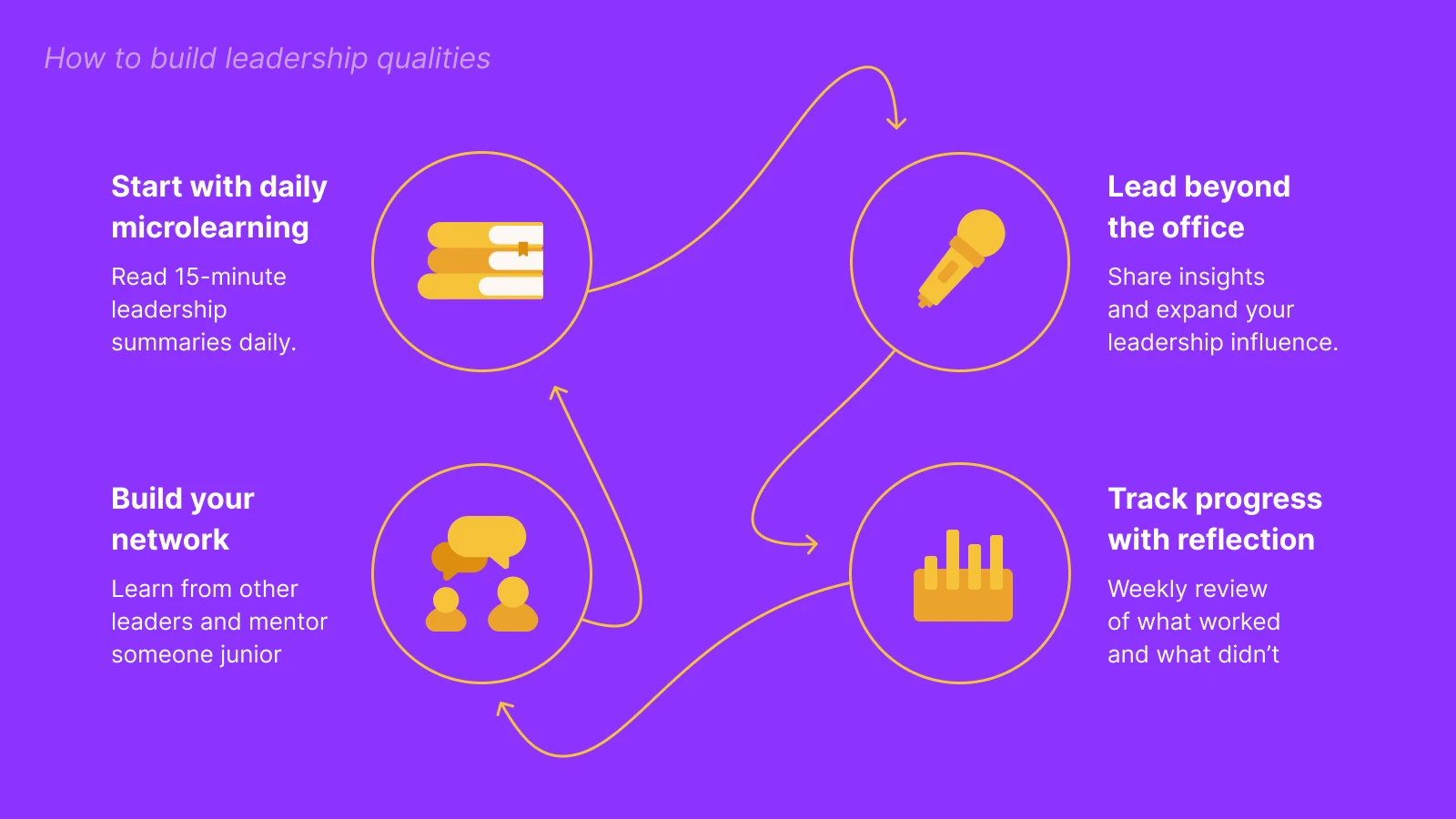
Start with daily microlearning
You don't need an MBA to build leadership skills. Start with 15-minute summaries of the greatest leadership books. Read one summary during your commute, and you'll complete 24 leadership books each year.
Pick an area of development that interests you and find a great book to read this month. For example, if you want to build your empathy skills, read 'Emotional Intelligence 2.0' and 'Dare to Lead.' If you are developing strategic thinking, start with 'Thinking Fast and Slow.'
Build your mentorship network
Finding mentors isn't about cold emails to famous CEOs. Identify three leaders in your industry whose careers you admire. Follow their LinkedIn posts, comment thoughtfully. After three months, ask for a 20-minute coffee chat about one specific challenge.
Being a mentor matters just as much. Pick one person earlier in their career. Meet monthly. Share what you're learning, not just what you've achieved.
Lead beyond the office: Using social media as a leadership tool
Many female leaders use social media intentionally, not for self-promotion, but to lead beyond their formal leadership roles. Networks like LinkedIn and podcasts now offer opportunities to network, mentor others, and influence thought leadership on a larger scale.
Track progress with reflection
Every Friday, spend 10 minutes answering: What went well this week? What flopped? What will I adjust next week? Monthly, review your answers to spot patterns.
Build female leadership qualities with Headway
The most effective female leaders don't simply copy male leadership models. They succeed because they develop qualities that make them effective leaders in complex, fast-moving environments.
Effective female leadership combines vision, empathy, resilience, authenticity, collaboration, strategic thinking, and self-awareness.
These traits don't develop at birth. They're cultivated through intentional learning and continual self-reflection. With Headway, you can study how Lincoln built empathy, how Sheryl Sandberg navigated corporate culture, and how Carol Dweck developed a growth mindset — all in 15-minute reads.
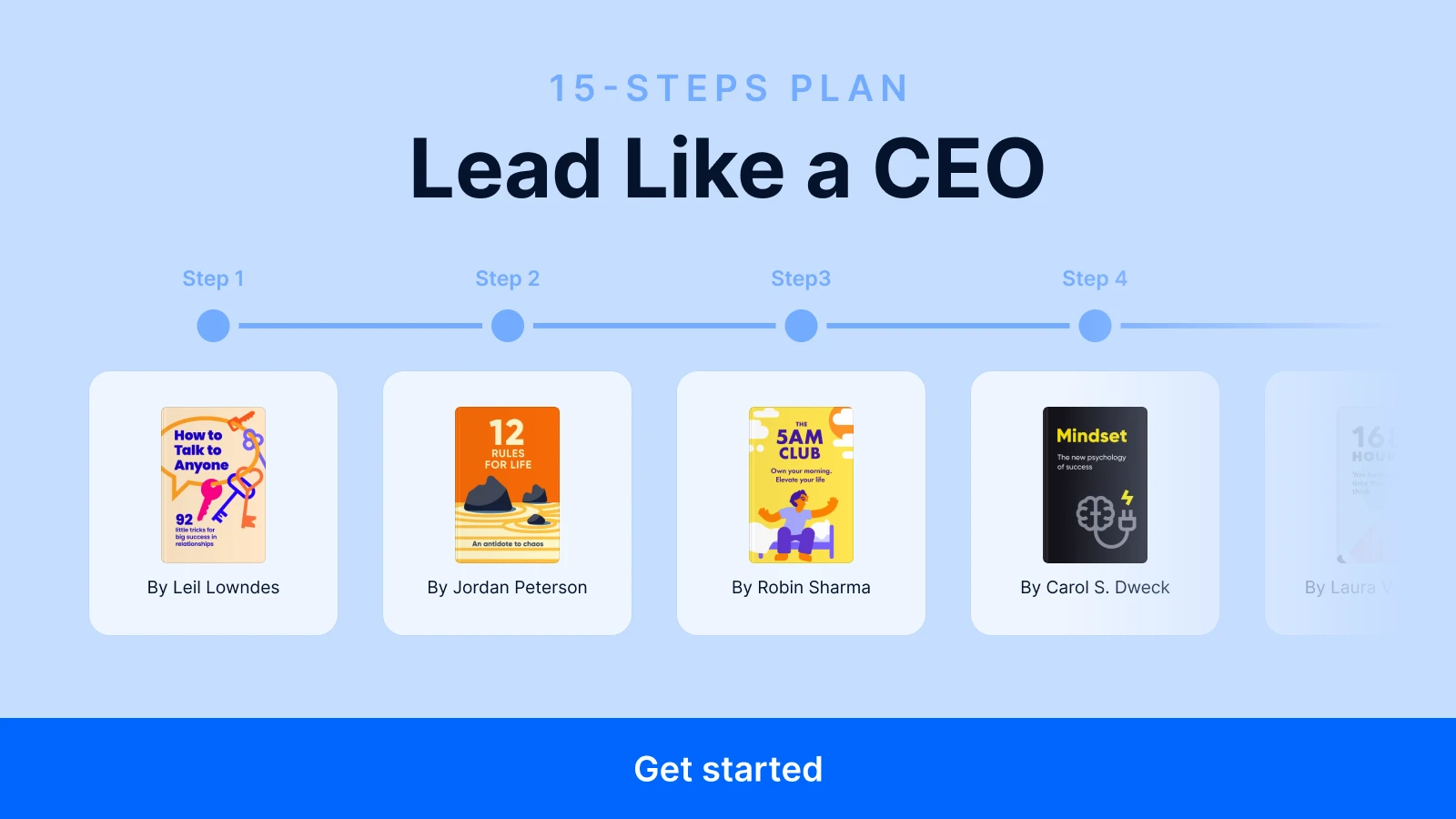
Start your leadership growth with daily insights from Headway. From emotional intelligence to strategic decision-making, the app turns world-class leadership wisdom into bite-sized reads you'll actually finish.
📘 Download Headway today and become the leader you'd want to follow.



Build female leadership qualities with Headway
The most effective female leaders don't simply copy male leadership models. They succeed because they develop qualities that make them effective leaders in complex, fast-moving environments.
Effective female leadership combines vision, empathy, resilience, authenticity, collaboration, strategic thinking, and self-awareness.
These traits don't develop at birth. They're cultivated through intentional learning and continual self-reflection. With Headway, you can study how Lincoln built empathy, how Sheryl Sandberg navigated corporate culture, and how Carol Dweck developed a growth mindset — all in 15-minute reads.
Start your leadership growth with daily insights from Headway. From emotional intelligence to strategic decision-making, the app turns world-class leadership wisdom into bite-sized reads you'll actually finish.
📘 Download Headway today and become the leader you'd want to follow.
FAQs about female leadership qualities
What are the top female leadership qualities?
The top female leadership qualities include empathy and emotional intelligence, vision with purpose, inclusive decision-making, resilience and problem-solving, authenticity paired with self-awareness, collaboration and mentorship, strategic thinking with decisiveness, and a growth mindset.
How do women leaders differ from male leaders?
Women in leadership roles typically focus on empathy, teamwork, planning for the future, and building strong relationships through collaboration. On average, women also score higher than men when assessed on relationship-based management and inclusive decision-making. Regardless of whether leaders are men or women, effective leaders can show empathy and make quick decisions.
Can anyone develop female leadership traits?
Yes. Leadership qualities aren't tied to gender or genetics. Anyone can build empathy, strategic thinking, resilience, and collaboration through deliberate practice and learning. Start by reading leadership books (Headway offers 15-minute summaries of classics like 'Dare to Lead' and 'Thinking, Fast and Slow'), finding mentors who model these traits, and reflecting weekly on your decisions and growth areas.
Which books help build leadership qualities?
Key books for building leadership qualities include 'Dare to Lead' by Brené Brown (authenticity and vulnerability), 'Emotional Intelligence 2.0' by Travis Bradberry (empathy and self-awareness), 'Thinking, Fast and Slow' by Daniel Kahneman (strategic thinking), 'Leadership in Turbulent Times' by Doris Kearns Goodwin (resilience and vision), 'The 5 Levels of Leadership' by John C. Maxwell (mentorship and growth), and 'Mindset' by Carol Dweck (growth mindset). Headway offers summaries of all these titles, turning hours of reading into 15-minute insights you can apply immediately.
Is emotional intelligence a key quality in women's leadership?
Yes. Emotional intelligence is one of the most researched and validated leadership qualities. Women leaders often score higher on EQ assessments, particularly in relationship management and social awareness. High emotional intelligence helps leaders read team dynamics, resolve conflicts before they escalate, and build psychological safety where innovation happens.