Self-growth
 Business & Career
 Success
 Communication
 Healing
 Relationships
 Psychology
 Happiness
A recent University of California study highlights a harsh reality for many families: Female cortisol ruins more bonds with children than parents think. So, instead of patience and connection, the caregiver feels overwhelmed and reactive.
Experts like Daniel J. Siegel and Janet Lansbury explain how to restore the mother-child connection with proven problem-solving strategies available on the Headway app. The app offers 15-minute summaries of bestsellers in psychiatry, parenting, and human development, teaching you how to reduce stress and enhance your mental well-being.
Download the Headway app to start your journey toward a stress-free home and better parenting today.
Quick summary: How to lower stress and bond better
Here's how you can lower your stress for your child's sake:
Understand the chemical barrier
Break the cycle
Create calm routines
Connect before you correct
Manage your reactions
Ready to become the calm parent you want to be? Keep reading for the complete list of exercises!
What is cortisol? The science behind stress
Cortisol is often called the body's main stress hormone. It's produced by the adrenal glands and controlled by the hypothalamic-pituitary-adrenal (HPA) axis.
While it helps us wake up and react to danger, prolonged exposure at higher levels can harm our mental and physical health. High cortisol keeps you in "survival mode," making it hard to relax or connect emotionally with others.
How female cortisol affects your bond with your child
When you are stressed, your body floods with cortisol. This flood puts your nervous system on high alert. For a mother, this state makes it very hard to read a child's cues.
A new study published in PubMed suggests that higher levels of cortisol in mothers predict less responsiveness to their children.
Instead of seeing a crying toddler as sad, a stressed brain sees them as a stressor or a threat. This reaction is why female cortisol ruins more bonds with children — it physically prevents empathy.
The impact goes beyond just a bad day. Longitudinal study data show that children raised by highly stressed parents often have higher levels of salivary cortisol themselves.
This pattern means your stress can become their stress. It affects child development, leading to anxiety or behavioral issues.
Neuroscience tells us that children need a calm "baseline" at home to develop properly. When the caregiver is always stressed, the child's safety system never turns off.
This dynamic creates a cycle. The child acts out because they feel unsafe, which raises the parent's stress levels even more.
Social interactions become battles instead of bonding moments. Understanding that this is a biological issue, not a moral one, is the first step to fixing it.



Top five expert tips to lower cortisol levels (from top parenting experts)
To fix toxic parenting behaviors, you need practical tools. The following exercises come from top-rated books on Headway. They are designed to lower your stress reactivity and help you rebuild that bond.
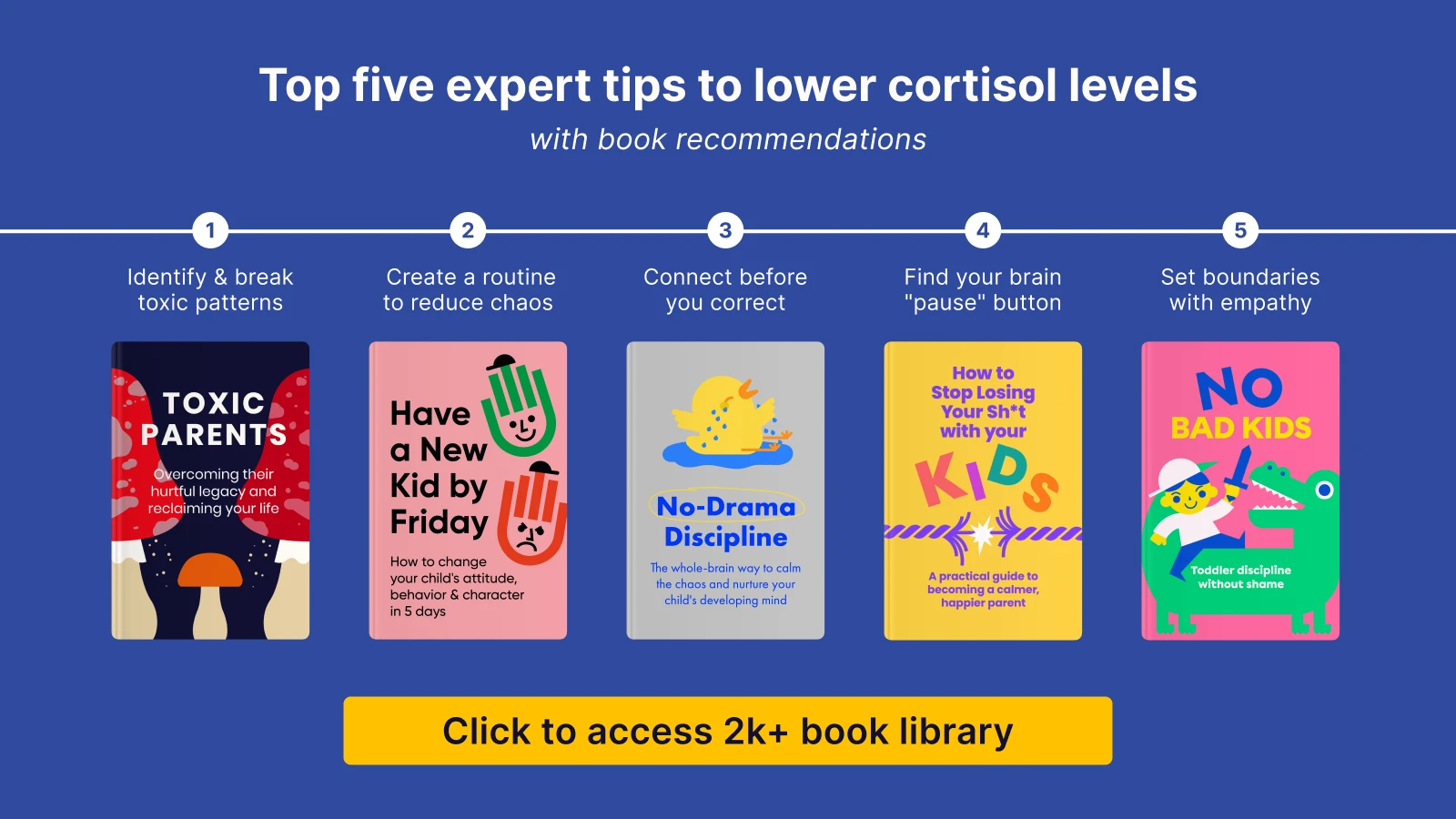
1. Identify and break toxic patterns
Book recommendation: 'Toxic Parents' by Susan Forward
Many of us carry stress from our own childhoods. Susan Forward explains that higher levels of family stress often repeat themselves. If your parents were reactive, you might be too.
Write down three things your parents did that made you feel small or scared. Now, write down how you handle similar situations with your child. Seeing the pattern helps you stop it.
Why it works: This exercise moves you from reacting to thinking. It lowers the emotional stress response and engages your brain's problem-solving areas.
2. Create a routine to reduce chaos
Book recommendation: 'Have a New Kid by Friday' by Kevin Leman
Unpredictability is a major stressor. When you and your child don't know what to expect, levels of cortisol rise. Leman suggests that a lack of structure leads to constant negotiation, which exhausts parents.
Implement a strict "Monday to Friday" routine for one week. Set clear times for meals, homework, and bed. When the child asks, "Why," simply say, "That is the schedule."
Why it works: Routine creates a predictable environment. This structure lowers the baseline anxiety and anger when your child misbehaves.
3. Connect before you correct
Book recommendation: 'No-Drama Discipline' by Daniel J. Siegel and Tina Payne Bryson
This book uses neuroscience to explain that a shouting parent appears to be a threat to a child's brain. High cortisol in the parent triggers fear in the child.
The next time your child misbehaves, physically lower yourself to their eye level. Touch their arm gently. Say, "I see you are having a hard time," before you mention the bad behavior.
Why it works: This physical connection releases oxytocin, which counters cortisol. It instantly calms both of your nervous systems.
Read the summary: 'No-Drama Discipline'
4. Find the "pause" button for your brain
Book recommendation: 'How to Stop Losing Your Shit with Your Kids' by Carla Naumburg
We often react before we think. Naumburg explains that this is the fight-or-flight response.
When you feel the heat rise in your chest, stop. Do not speak. Take three deep breaths. Count the colors in the room.
Why it works: This short pause allows your frontal cortex (the thinking brain) to catch up with your emotional brain. It prevents a cortisol response from ruining the moment.
5. Set boundaries with empathy
Book recommendation: 'No Bad Kids' by Janet Lansbury
A lack of boundaries causes stress because parents feel walked all over. Lansbury teaches that you can be firm without being mean.
State the limit clearly, but acknowledge the feeling. "I cannot let you hit me. I know you are mad, but I will not let you hurt me." Gently hold their hands if necessary to stop the hitting.
Why it works: This approach protects your physical safety, mental health, and overall well-being while validating the child's emotions. It builds trust.
Read the summary: 'No Bad Kids'
Make this your best parenting year yet with the Headway app
Managing your body's chemistry is a huge part of being a good parent. You know now that female cortisol ruins more bonds with children because it creates a biological wall between you and the people you love. But you are not helpless.
Headway is the perfect tool to help you on this path with the key lessons from top parenting books. It allows you to focus on your personal development every day, even if you only have a few moments while the kids are asleep. This daily growth helps you stay calm, present, and happy.
Download the Headway app now to access over 2000 summaries that will support your journey!
FAQs
What is the fastest way to lower cortisol right away?
Deep breathing is very effective. It signals the nervous system that you are safe. Physical touch, like a hug, also releases oxytocin. This hormone counters the stress hormone cortisol and helps you feel connected again quickly.
How can I improve my bond with my teenager?
Adolescents are very sensitive to parental stress. Questionnaires and current study results from adolescents show they pull away when parents are tense. Using active listening and staying calm also helps. The summary of the book 'The Self-Driven Child' on Headway offers great advice for this age group.
Is it too late to fix the bond with my child?
It's never too late. The brain is like plastic and can change. By lowering your stress levels now, you create a sense of safety. Young children and even older kids respond quickly to a calmer caregiver. Start small today.
What role does oxytocin play in parenting?
Oxytocin is the "love hormone." It builds trust and safety. High cortisol blocks it. Activities like hugging, laughing, or reading together boost oxytocin. This hormone acts as a moderator against stress and repairs the bond.
Does the Headway app have books on parenting stress?
Yes! Headway has summaries of top books like 'No-Drama Discipline' and 'Toxic Parents.' These cover stress reactivity, child development, and emotional regulation. You can learn problem-solving tips in just 15 minutes a day.