Self-growth
 Business & Career
 Success
 Communication
 Healing
 Relationships
 Psychology
 Happiness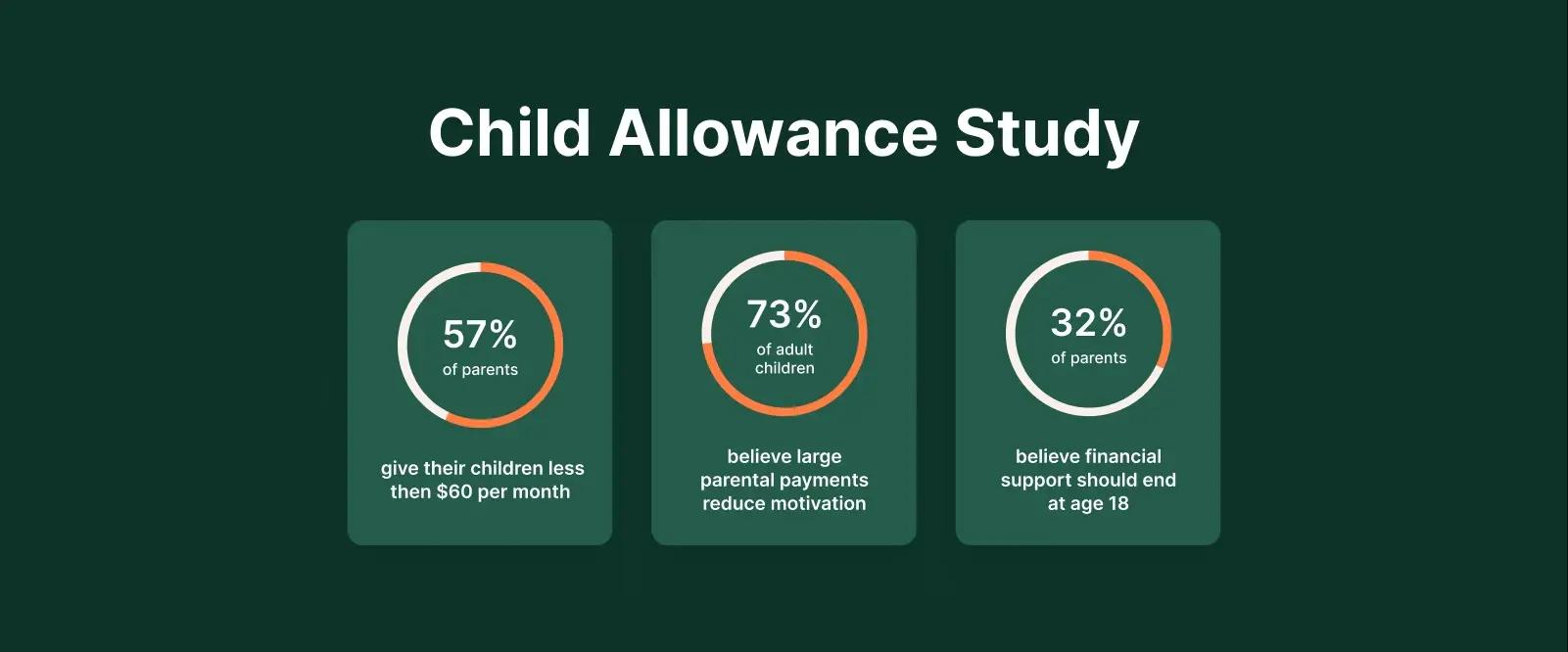
Growing up no longer corresponds to becoming financially independent. When we see that the housing, education, and necessities costs continue to rise, while the opportunities might go down, a logical question arises: when is the right time to let our children fly the nest?
In addition to that, parents start to doubt themselves. Should we help, risking a decline in motivation? Or should we refuse support, knowing that the starting point today is more difficult than it used to be?
Parents find themselves torn between the desire to make life easier for their children and the fear of making them dependent.
Allowance with a deadline
Financial support for children is generally more low-key than it may seem at first glance. According to the survey, more than half of parents (57%) give their children less than $60 per month, and one in five (20%) believe that regular pocket money is unnecessary and give none.
Given that, it seems that allowance is used as a tool for teaching basic financial management, rather than a substitute for income.
When it comes to age, the line remains well-defined. One in three parents (32%) believes that financial support should end at age 18, and about a quarter (25%) believe it should end earlier, at age 16.
Only a small percentage (9%) are willing to continue providing support until the age of 21 or older, and even less (2%) after the age of 30.
Getting a driver’s license is often the first step toward autonomy. It can be perceived as a breaking point for reconsidering a monthly allowance support.
Despite the rising cost of living and the longer path to independence, most parents still stick to their reasoning that growing up must be accompanied by financial independence.
57% of parents give their children under $60 a month, while 20% say kids shouldn't receive a regular allowance at all
$0 – kids shouldn’t get a regular allowance | 20% |
Under $30 | 32% |
$30–$60 | 25% |
$60–$100 | 11% |
$100–$150 | 6% |
More than $150 | 6% |
32% of parents believe regular allowances should be cut off at age 18
14 | 11% |
16 | 25% |
18 | 32% |
21 | 9% |
30 | 2% |
After they graduate | 15% |
Never | 6% |
When playing it safe is risking to become the new norm
When children become young adults, care doesn’t disappear, but financial support becomes socially conditional. Almost one in three parents (28%) believes that once their children reach adulthood, they should be able to provide for themselves without financial help.
Even among those who receive help, it is usually more of an icing on the cake rather than the cake itself. 20% consider up to $50 acceptable, especially on some holidays here and there, while another 27% consider up to $100 acceptable.
Only 12% allow payments of up to $1,000, and even a smaller number supports larger amounts.
Parents are experiencing some ambivalence. On one hand, parents see how challenging it is to become financially independent today, while on the other hand, they fear that long-term support will hinder responsibility.
Therefore, assistance to older children often acts as a temporary measure, not as a long-term solution.
1 in 3 parents believe adult children should receive no allowance and earn their own money
$0 – adults should earn their own money | 28% |
Under $50 | 20% |
Under $100 | 27% |
Under $1,000 | 12% |
Under $3,000 | 3% |
More than $3,000 | 1% |
There should be no limit if parents can afford it | 9% |
When help starts to hurt
Society's attitude toward long-term financial support for adult children remains harsh. 73% believe that large parental payments reduce motivation to succeed, while only 27% see no problem with it. In addition, 62% are convinced that financial pressure from parents is necessary to keep them driven.
Skepticism also extends to success stories linked to family money. 61% do not believe that "nepo babies" could have achieved success without financial support from their families. This supports and reinforces the idea of independence even more, with constant aid being frowned upon the most.
73% of people believe large parental allowances make adult children less motivated to achieve success
Yes | 73% |
No | 27% |
62% believe financial pressure from parents is necessary to stay ambitious
Yes | 62% |
No | 38% |
61% do not believe "nepo babies" would succeed without family money
Yes | 39% |
No | 61% |
Independence is preached – dependence is quietly funded.
Practice what you don’t preach is a motto for some families. 31% of adults admit that they rely on their parents financially, with 9% to a large extent, and 22% from time to time, while another 13% admit that they needed such support at certain periods of their lives.
At the same time, financial dependence remains a taboo subject – 54% of adults say they would never admit to their friends that they receive money from their parents.
This discrepancy between actions and beliefs creates a double standard, where ongoing financial support is possible, but only if it is kept behind the scenes.
The decision around helping often mirrors the parents' own experience, even if that experience contradicts their stated values.
1 in 3 adults rely on their parents financially, with 13% having needed support in the past
Yes, heavily | 9% |
Sometimes | 22% |
No | 56% |
Not now, but I’ve had moments of need | 13% |
54% of adults say they would never tell friends they still receive money from their parents
Yes | 46% |
No | 54% |
The idea of financial independence remains an ideal, while real life gets in the way and requires compromises. Support can be a source of strength only when we can set clear boundaries.
The ability to draw the line between those boundaries and care is becoming a new form of providing our children with independence.
Methodology: To find out what families’ take on financial support for their children at different stages of maturity, Headway app surveyed 2,000 parents about allowance amounts, age expectations, and which type of support is seen as helpful rather than harmful.
About the Headway app
With over 50 million users in 170+ countries, the Headway app is the world's most downloaded book summary app. It offers 15-minute audio and text summaries of nonfiction bestsellers, as well as daily microlearning sessions and gamified challenges. The app is designed to help people achieve their self-development goals. Headway received the Editor's Choice award from the US App Store and constantly hits the App Store home screen as App of the Day.