Self-growth
 Business & Career
 Success
 Communication
 Healing
 Relationships
 Psychology
 Happiness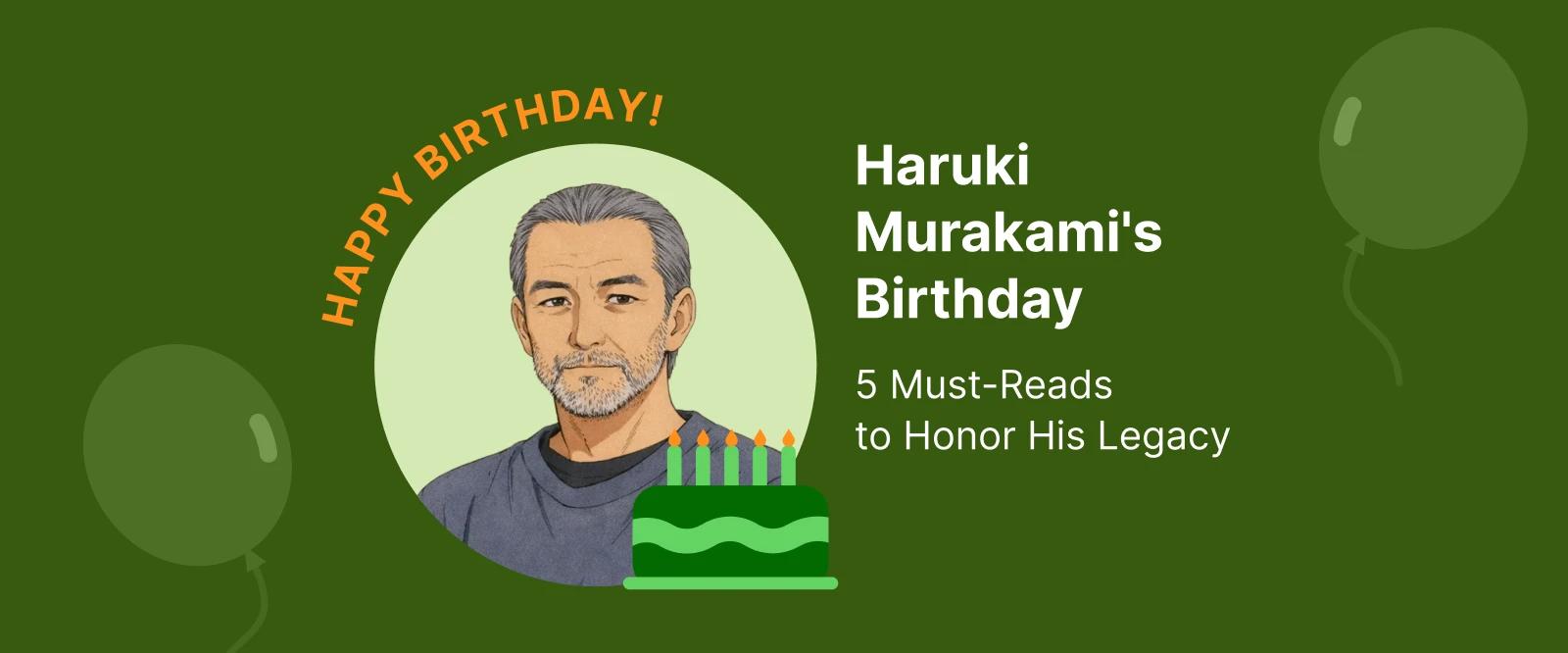
Why do we still read books by someone who ran a jazz bar in Tokyo?
At age 31, having written his first book while still working at a bar, Haruki Murakami was able to leave his job to devote himself entirely to writing. For the next 40 years, he has written novels about loneliness, mysteriously missing cats, and alternate realities that often seem more "real" than our own.
Murakami is now a worldwide phenomenon with millions of copies in approximately 50 different languages, and his works receive numerous international award nominations.
Unlike many authors, Murakami has never taken a class in creative writing or interned with a publishing company. However, these five titles by Murakami (originally published in Japanese but now available in English) capture the bizarre yet compelling way his imagination continues to inspire many readers.
Quick answer: What are Haruki Murakami's must-read books?
'The Wind-Up Bird Chronicle' (1994–95) — A man looks for his missing wife and cat, and then discovers war crimes and parallel realities.
'Hard-Boiled Wonderland and the End of the World' (1985) — A man splits between dystopian Tokyo and a dreamlike walled town.
'Norwegian Wood' (1987) — Love, loss, and living with grief in 1960s Tokyo.
'Kafka on the Shore' (2002) — A classic story of unexpected fates: a teenage runaway and an old man searching for lost memories.
'1Q84' (2009–10) — A woman and a man navigate parallel Tokyo where two moons hang in the sky.
Five best books by Haruki Murakami to read in 2026
What separated Murakami from other Japanese novelists writing in the 1980s and beyond?
Book 1: 'The Wind-Up Bird Chronicle'
Toru Okada quits his job at the law firm, spends his mornings making spaghetti, and tries to find his wife's missing cat. The cat disappears, then his wife disappears, then a stranger calls asking about his desires, while a teenage neighbor climbs over his fence, and a dry well in an abandoned house becomes a portal to somewhere else.
Murakami braids three storylines across 600 pages:
Toru's search through suburban Tokyo,
Soldier's memories of wartime Manchuria, where men got skinned alive
Journeys into parallel spaces accessed through meditation and that well.
The book asks whether you can understand your present without excavating the violence everyone agreed to forget.
Published between 1994–95 in Japan, translated into English in 1997. Toru Okada is Murakami's most passive protagonist — he cooks, he waits, things happen to him — and that paralysis makes the book more unsettling than if he fought back. You watch someone's ordinary life crack open to reveal historical trauma, suppressed sexuality, and the possibility that consensus reality is negotiable.
'The Wind-Up Bird Chronicle' is peak Murakami: jazz references, empty houses, mysterious women, cats, wells, and the suspicion that Tokyo hides a second Tokyo underneath.
📘 This Murakami book is available as a Headway summary — 17 minutes gets you the parallel worlds, war history, and the philosophy Murakami spent 600 pages building!
Book 2: 'Hard-Boiled Wonderland and the End of the World'
The alternating chapters tell two stories that ultimately merge into one. In 'Hard-Boiled Wonderland,' a data processor in near-future Tokyo is caught between warring information cartels after his brain gets encrypted, while in 'End of the World,' a man arrives in a walled town where residents lose their shadows and memories, spending quiet days reading old dreams.
The two narratives are the same person — the Town is his subconscious, the encryption is killing him, and he needs to choose which world to inhabit as his mind splits permanently.
Murakami wrote this in 1985, before anyone outside Japan knew his name. It's his first book with the split-reality thing he kept using later. Characters who let things happen to them instead of making choices.
Book 3: 'Norwegian Wood'
Murakami's only realistic novel strips away all magical elements. Toru Watanabe is a college student in 1960s Tokyo grieving his best friend's unaliving when he falls for Naoko, his deceased friend's girlfriend, who disappears into a sanatorium in the mountains. Then he meets Midori, who is alive and present and everything Naoko isn't.



The book splits Watanabe between two women representing different responses to loss — withdrawal versus engagement with the messy world. Murakami wrote this as a detour from his surreal work, and it became his biggest bestseller, selling millions in Japan and making him too famous to walk Tokyo streets comfortably.
Published in 1987, named after the Beatles song. Loving someone doesn't cure their depression or yours, and choosing to stay alive matters more than understanding why.
Book 4: 'Kafka on the Shore'
Fifteen-year-old Kafka Tamura runs away from his father's Oedipal prophecy and hides in a library while Nakata — an older man who talks to cats but can't read after a childhood accident — follows instructions from supernatural forces he doesn't understand. Their stories move toward collision across alternating chapters.
Kafka's literary bildungsroman runs parallel to Nakata's surreal road trip, where fish rain from the sky and a pimp shaped like Colonel Sanders quotes Hegel. Murakami meditates on fate, responsibility, metaphor made literal, and whether you can escape prophecies or only fulfill them differently than expected.
Published 2002. Murakami called it his most violent book, though the violence often happens offstage while characters discuss Schubert and Greek tragedy.
Book 5: '1Q84'
Aomame climbs down a highway emergency staircase in 1984 Tokyo, notices two moons in the sky, and realizes she's somewhere else now — '1Q84,' where history bent differently. Tengo, a math teacher and ghostwriter, rewrites a teenage girl's strange manuscript about Little People emerging from a dead goat, as their narratives alternate for 900 pages. At the same time, they search for each other across parallel timelines.
Murakami wrote this as his most ambitious project, published in three volumes in Japan between 2009–2010. It's a love story stretched across alternate realities, a critique of religious cults, and an examination of how stories create worlds as real as the one outside your window.
Start with Murakami's ideas, then read his masterwork on Headway!
Haruki Murakami was born on January 12, a date worth remembering. His books keep asking: What happens when you can't reach the person you love? Running away doesn't work if the problem is you. And trauma — can you fix it, or just get better at living with it?
'Norwegian Wood,' 'Kafka on the Shore,' '1Q84' — his characters are lonely, isolated even around other people. Sometimes reality splits into parallel worlds. And sometimes you realize the person you thought you were doesn't match what you actually do.
In the Headway app, you can find a 17-minute summary of 'The Wind-Up Bird Chronicle,' covering Toru's search, the Manchurian war crimes, and the parallel reality structure Murakami spent his career refining. Read the summary to understand what Murakami explores, then decide which full books are worth your time.
📘 Try Headway and see why this author still matters decades later!
Frequently asked questions about Haruki Murakami
When is Haruki Murakami's birthday?
Haruki Murakami's birthday is January 12. He is going to be 77 this year and shows no signs of stopping his writing and publishing activities. Fun fact: Murakami shares his birthday with Jack London, which is appropriate given his obsession with jazz and American literature.
How will different countries celebrate Haruki Murakami's birthday in 2026?
Even though Murakami is Japanese, and in Japan they host book clubs and reading events, he is still more celebrated abroad. Bookstores worldwide (both online and physical) stock his most famous novels like 'Norwegian Wood' and 'Kafka on the Shore' on display. Taiwan and South Korea, where he's massively popular, hold larger events than most Western countries.
What should I read first by Haruki Murakami?
'Norwegian Wood' if you want grief without weird stuff. 'Kafka on the Shore' if you want the full Murakami experience — talking cats, reality splitting, metaphysical confusion, all that. 'Norwegian Wood' is just people being sad and sleeping with each other. 'Kafka on the Shore' has a fifteen-year-old runaway and an older man who talks to cats and fish fall from the sky. Both demonstrate why millions read him obsessively despite critics calling his work repetitive.
Why is Haruki Murakami still relevant today?
Murakami wrote about loneliness before phones made it worse, disconnection before social media named it, and parallel realities before everyone lived half-online. His protagonists cook pasta, listen to jazz, and drift through cities feeling separate from everyone around them — that emotional isolation predates modern technology but describes it perfectly. His refusal to explain surreal elements still reads more honest than tidy resolutions.
What makes Haruki Murakami's writing different from other authors?
Murakami translated Raymond Carver and Fitzgerald for many years before he wrote his own book. Funny how his characters don't do much; they just drift, observe, cook pasta, or listen to jazz. Surreal things happen, and nobody acts surprised. For example, a talking cat might show up, but the conversation continues. Also, his books don't explain these weird parts or tie up endings neatly. That's why some readers dislike that, but many other of them reread his books obsessively.