Self-growth
 Business & Career
 Success
 Communication
 Healing
 Relationships
 Psychology
 Happiness
In 2026, access to AI is no longer a competitive advantage — everyone has the same tools. The real edge lies in what AI still can't do: think strategically about persuasion, read human psychology, and craft messages that stay with people long after they've scrolled on.
These six books won't help you write faster. They'll train you to think deeper. And that depth — judgment, intuition, mental models — is the gap no language model can close.
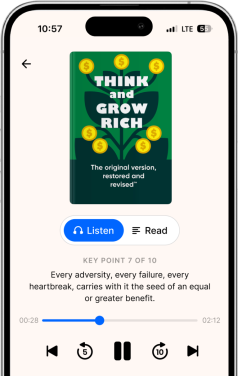
If you want to build that edge deliberately, Headway makes it easier to turn these ideas into daily practice — breaking complex thinking into focused, 15-minute reads and listens that compound over time.
📘 Build strategic judgment with Headway.
1. 'Scientific Advertising' by Claude C. Hopkins
The irony: to beat an AI named Claude, start with the original Claude. Hopkins wrote this in 1923, and it still exposes the fundamental weakness of AI-generated copy — it sounds nice but doesn't sell. While ChatGPT optimizes for "engaging" content, Hopkins obsessed over what actually moves products. Every headline tested. Every claim measured. No fluff survived.
This book teaches you the discipline AI lacks: treating copy as a science, not an art project. When you understand why something works, you can direct AI to produce it — or recognize when its output is just polished garbage.
2. 'Building a StoryBrand' by Donald Miller
Ask any LLM to write brand messaging, and you'll get the same pattern: "We are passionate about delivering innovative solutions that empower..." — corporate word salad that makes the brand the hero. Miller's framework flips this completely. The customer is the hero. Your brand is just the guide.
In 2026, when the internet drowns in AI-generated noise, clarity becomes your competitive weapon. This book gives you the strategic architecture to cut through — something no prompt can replicate because it requires understanding your specific customer's internal narrative, not just predicting the next likely word.
3. 'Influence: The Psychology of Persuasion' by Robert Cialdini
AI can mimic persuasive language patterns. It cannot understand why they work. Cialdini spent decades researching what actually triggers a "yes" — reciprocity, commitment, social proof, authority, liking, scarcity. These aren't writing techniques. They're psychological levers rooted in how human brains evolved.

When you understand these principles at a biological level, you stop being someone who writes copy and become someone who engineers decisions. You'll spot when AI is just shuffling words versus when it accidentally hits a real trigger — and you'll know how to deploy them ethically in ways an algorithm cannot intuit.
4. 'Made to Stick' by Chip Heath and Dan Heath
AI is exceptional at volume and terrible at memorability. That's not a bug — it's how the technology works. Language models predict the most statistically likely next word, which means they gravitate toward the predictable. The forgettable. The average of everything they've seen.
The Heath brothers decoded why some ideas lodge in our brains while others evaporate: simplicity, unexpectedness, concreteness, credibility, emotions, and stories. Master these principles, and you can create copy that haunts people — the kind of message that surfaces in their mind three days later while they're in the shower. Try getting that from a prompt.
5. 'Words That Change Minds' by Shelle Rose Charvet
Generic AI prompts produce generic copy because they treat "the audience" as a monolith. But your actual customers have distinct psychological profiles — some are motivated by moving toward goals, while others are motivated by avoiding problems. Some need options, others need procedures. Some trust internal judgment, others need external validation.
Charvet's framework teaches you to profile these motivation patterns and choose words that resonate with each type. It's the difference between broadcasting and precision-targeting. AI writes for the statistical average. You'll write for the specific human you're trying to move.
6. 'Sell Like Crazy' by Sabri Suby
If the previous books are the theory, this is the street fight. Suby built an agency from nothing by writing copy that actually converts — not copy that wins awards or sounds clever. His approach is aggressive, direct-response, and ruthlessly focused on results. It's the "street smarts" that academic AI training data often misses.
The book gives you a step-by-step system for creating offers that sell, writing ads that stop the scroll, and building funnels that convert strangers into buyers. It's not elegant. It works. And it teaches you the hunger and urgency that AI simply doesn't have.
Compete on thinking with Headway!
These books won't make you faster at producing content. They'll make you dangerous at producing results.
AI is getting better at mimicking good copy. But mimicry only gets you to average. These six books teach you the strategic thinking, psychological understanding, and battle-tested frameworks that turn words into revenue.
In 2026, everyone has access to Claude. Not everyone has the brain to direct it.
📘 Build that brain with Headway — a microlearning app that distills the world's best nonfiction books into quick reads and listens, so you can train strategic thinking daily without falling into endless scrolling.
Frequently asked questions on books for copywriters
What is the 80/20 rule in copywriting?
The 80/20 rule means 80% of your results come from 20% of your efforts. In copywriting, this translates to spending most of your time on headlines, hooks, and calls to action — the elements that drive conversions. A killer headline does more heavy lifting than five polished paragraphs. Focus your energy where it actually moves the needle.
What are the 4 C's of copywriting?
The 4 C's are Clear, Concise, Compelling, and Credible. Clear means your message is instantly understood — no jargon, no confusion. Concise means cutting every word that doesn't earn its place. Compelling means your reader actually wants to keep reading. Credible means backing claims with proof. Use this as your editing checklist before anything goes live.
Is ChatGPT good for copywriting?
ChatGPT is good for first drafts and brainstorming — it gets you past the blank page fast. But it produces average copy because it predicts statistically likely words, not memorable ones. The real skill is knowing what to keep, what to cut, and what to rewrite entirely. AI handles the 70%; you bring the 30% that actually converts.
What is the 30% rule in AI?
The 30% rule suggests AI should handle roughly 30% of your work — the repetitive, structured tasks — while humans own the remaining 70% requiring judgment, creativity, and strategy. In copywriting, let AI draft and brainstorm; you handle positioning, tone, and persuasion. The goal is collaboration, not replacement.
What are the must-read books for copywriters?
Start with 'Influence' by Robert Cialdini for the psychology of persuasion, then 'Scientific Advertising' by Claude Hopkins for timeless testing principles. Add 'Made to Stick' by Chip and Dan Heath to understand why some messages last and others vanish. These three books teach you to think strategically — something no AI prompt can replicate.
Why do copywriters prefer Claude?
Copywriters don't universally prefer Claude — preferences are mixed depending on the task. But many reach for it when nuance matters most. Claude excels at refined, human-like text with sophisticated tone control, making it ideal for storytelling, emotive copy, and avoiding that robotic AI feel. Gemini often wins for brevity and social media fit; ChatGPT for speed and structure. Most pros use a mix — Claude for the human touch, others for quick drafts. No single tool dominates.