Self-growth
 Business & Career
 Success
 Communication
 Healing
 Relationships
 Psychology
 Happiness
Historian Yuval Noah Harari wrote this book after 'Sapiens' and 'Homo Deus' showed him something unexpected: people don't just want to understand humanity's past and future — they need help navigating the overwhelming present. His synthesis of history, technology, and philosophy revealed that most people are drowning in information while starving for wisdom.
In 2026, you're making decisions about AI tools, career pivots, climate concerns, political polarization, and information authenticity faster than you can process what any of it means. The velocity of change has outpaced our ability to create meaning from it. The professionals who stay grounded aren't necessarily the most informed — they're the ones who understand which information actually matters and how different forces connect.
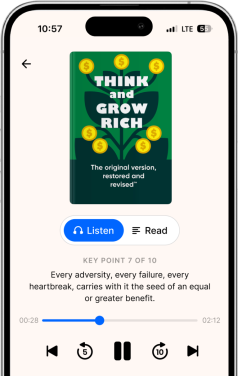
Headway, a daily growth app trusted by 55 million users worldwide, breaks down Yuval Noah Harari's '21 Lessons for the 21st Century' into quick insights you can apply immediately. Whether you're commuting or jogging in the park, you can start building the frameworks that turn confusion into clarity.
Technology is changing what it means to be human
Harari argues that AI and biotechnology aren't just new tools — they're forces that will redefine what humans are capable of and what work even means. When algorithms know you better than you know yourself, when they can predict your choices and manipulate your attention, the nature of free will becomes a practical question, not just a philosophical one.
The challenge isn't whether these technologies exist. They already do. Your phone's algorithm shapes what you see, what you believe, and ultimately who you become. Dating apps determine your romantic options. AI screening tools decide whether you get job interviews. The question is whether you understand these systems well enough to maintain agency within them, or whether you'll drift through life on algorithmic currents you never learned to navigate.
The insight that changes everything: You can't opt out of living in a world shaped by algorithms and AI. But you can choose to understand how they work rather than remaining mystified by them. The gap between those who comprehend these systems and those who don't will define the next economic and social divide.
📘 Download Headway to explore Harari's full framework for understanding how technology, politics, and culture intersect in ways that shape your daily decisions. The app's gamified streaks help you build the habit of connecting big-picture trends to personal choices, not just passively consuming news.
Most people no longer know what to believe
Information abundance has created a crisis of truth. You can find a credible-looking source for almost any claim. Climate change is urgent — or it's exaggerated. Vaccines are essential — or they're dangerous. This isn't about stupidity. Humans evolved to trust their community's consensus. When communities fragment and the internet connects you to a million contradictory communities simultaneously, your evolutionary hardware can't handle it.
Harari points out that the real danger isn't that people believe the wrong things. It's that people lose the ability to determine what's true at all. When everything feels like propaganda and every source seems biased, the response is often retreat into tribalism. You trust what your side says and dismiss what the other side claims. This makes you easy to manipulate — not by forcing you to believe specific lies, but by making you doubt everything enough that you stop trying to figure out what's real.
The practical shift: Don't try to fact-check everything. You don't have time. Instead, develop a mental model for how information ecosystems work. Who profits when you believe this? What's the source's track record? Does this claim require you to believe dozens of other unverified things? These questions won't give you perfect truth, but they'll help you navigate closer to it than pure tribal loyalty ever could.
Headway's 2,500+ book summaries let you explore how other thinkers tackle information, truth, and decision-making — from Kahneman on cognitive bias to Taleb on handling uncertainty. The more frameworks you absorb in quick 3-20 minute sessions, the better you get at spotting patterns across different domains.
📘 Check it yourself. Users report that cross-pollinating ideas from different books dramatically improved their ability to evaluate claims critically.
Your personal choices matter more than you think
Harari challenges both extremes. Some people think individual action is meaningless — climate change requires policy, not recycling. Others think personal choices are everything — just manifest your reality. He argues both perspectives miss the point. Your choices create ripples, but those ripples interact with billions of other choices and systemic forces in ways neither you nor anyone else fully controls.
The question isn't whether to care about big systemic problems or focus on personal growth. It's understanding how they connect. You can't personally reverse climate change, but the aggregate of millions making slightly different consumer choices does shift markets, which shapes what companies produce, which influences policy. You can't single-handedly fix political polarization, but choosing to actually listen to people you disagree with rather than performatively dunking on them does slowly erode tribal boundaries.
What this means for you: Stop asking "Does my action matter?" and start asking "What kind of person do my actions make me?" If you want to be someone who thinks critically, you have to practice evaluating information carefully. If you want to live in a less polarized world, you have to demonstrate less polarized behavior. The outcomes aren't guaranteed, but the practice shapes who you become regardless of whether it saves the world.
📘 Start building your 21st-century navigation skills with Headway's bite-sized wisdom delivered every morning that you can practice throughout your day. Users consistently report that small daily doses of big-picture thinking compound into major clarity about their place in larger systems over months.
Build your understanding of the forces shaping your life with Headway
Harari's book proves that you can't navigate the 21st century with 20th-century mental models. In 2026's complexity, the ability to connect dots across technology, politics, culture, and personal choice isn't optional — it's survival.
Headway makes building this perspective simple and fun. Beyond '21 Lessons for the 21st Century,' you'll find 2,500+ book summaries in text and audio covering philosophy, technology, psychology, and current affairs. The app's gamified challenges turn abstract ideas into daily practices — whether you're standing in line, floating in a pool, or commuting to work.
The app adapts to how you learn best, making self-growth more convenient, enjoyable, and intuitive. Start with 15 minutes today and discover how understanding the big picture makes you dramatically better at navigating your small picture.
📘 Download Headway and join 55 million people who've made daily growth a habit.
Frequently asked questions about navigating the 21st century and Harari's '21 Lessons'
What makes the 21st century different from previous eras that require new ways of thinking?
Previous generations could learn skills once and use them for life. Today, technological change is so rapid that your expertise becomes outdated within years, sometimes months. Information abundance means filtering truth from noise is harder than finding information. Global connectivity means local problems instantly become global and vice versa. Biotechnology and AI are starting to change what humans fundamentally are, not just what we can do. These aren't incremental shifts — they're transformations that require entirely new mental frameworks.
How do I stay informed without becoming overwhelmed by 21st-century complexity?
Focus on understanding systems and patterns rather than tracking every event. Instead of reading 50 articles about specific AI applications, understand how AI fundamentally works and what its economic incentives are. This lets you predict implications without exhaustive news consumption. Set information boundaries — maybe 30 minutes of quality news daily rather than constant scrolling. Prioritize books and long-form analysis over reactive hot takes. The goal isn't knowing everything happening — it's understanding the deeper forces beneath surface events.
What's Harari's main advice for dealing with AI taking over jobs?
Harari argues that the challenge isn't just job loss but irrelevance. When AI can do most cognitive and physical labor better than humans, what's our role? His uncomfortable answer: we don't know yet, and anyone claiming certainty is lying. He suggests focusing on adaptability and emotional intelligence over specific skills, maintaining mental flexibility over rigid expertise, and accepting that lifelong learning isn't optional anymore. The honest truth is humanity is navigating uncharted territory with no guarantee of comfortable resolution.
How can individual people address massive problems like climate change or political polarization?
Harari doesn't offer false comfort that individual action solves systemic problems. But he argues that abdicating personal responsibility because you can't fix everything alone is equally flawed. Your choices aggregate with billions of others. Your consumer decisions shape markets. Your conversational approach models norms. Your vote influences governance. The impact isn't direct or guaranteed, but the alternative — doing nothing because you can't do everything — guarantees things get worse. Contribute your piece while advocating for systemic change.
Is Harari optimistic or pessimistic about humanity's future?
Harari explicitly avoids both labels. He argues that neither naive optimism nor despairing pessimism helps. Optimism can breed complacency when serious threats require urgent action. Pessimism breeds paralysis when agency and effort still matter. He advocates for "sober realism" — acknowledging genuine dangers like nuclear war, climate disaster, and technological disruption while recognizing that human choices still shape outcomes. The future isn't predetermined. It depends partly on whether enough people engage seriously with these challenges rather than retreating into denial or despair.
What does Harari think is the most important skill for the 21st century?
Emotional intelligence and mental flexibility. In a world where factual knowledge becomes obsolete quickly and AI handles most routine cognitive tasks, your ability to learn new things, regulate your emotions under uncertainty, cooperate with others, and distinguish what's true from what's false matters more than any specific expertise. Harari emphasizes knowing yourself — your biases, your triggers, your values — because external change is so rapid that internal stability becomes the only reliable anchor. Self-awareness isn't self-indulgent; it's survival.
How does Harari recommend dealing with information overload and fake news?
Understand your own cognitive biases first. You're not a rational truth-detector — you're a pattern-matching machine that evolved for survival, not accuracy. Recognize when you're engaging in motivated reasoning or tribal thinking. Diversify your information sources but also recognize that more information doesn't equal more truth. Develop heuristics for evaluating sources: What's their track record? What are their incentives? Are they making testable claims? Most importantly, accept uncertainty. You don't need certainty about everything to make reasonable decisions. Comfortable uncertainty beats false certainty.