Self-growth
 Business & Career
 Success
 Communication
 Healing
 Relationships
 Psychology
 Happiness
Ever wonder what a billionaire's day looks like, and what you can learn from it?
Bill Gates' daily routine isn't a random collection of meetings and calls. It's a carefully calibrated system designed to protect time for learning, impact, and well-being.
The co-founder of Microsoft has always been open about the fact that success isn't just about big ideas. The daily habits that keep your brain sharp matter just as much. Whether he's working through the Bill & Melinda Gates Foundation or diving into a complex book, his day offers a genuine lesson in intentionality.
In this article, you'll find a breakdown of Bill Gates' daily routine, backed by what top experts have reported, and how you can use it to boost your productivity.
At Headway, we believe that the habits of the most successful people shouldn't be a secret. By breaking down these schedules and looking at the science behind them, we can all find ways to grow. Curious to see how the world's most famous philanthropist spends his day?
📘 Get the Headway app to unlock your inner billionaire and fast-track your path to elite-level decision-making!

Quick summary: A peek into the daily life of Bill Gates
If you're looking for the "too long; didn't read" version of Bill Gates' daily routine schedule, here's a breakdown of how he structures his time for learning, well-being, and global impact:
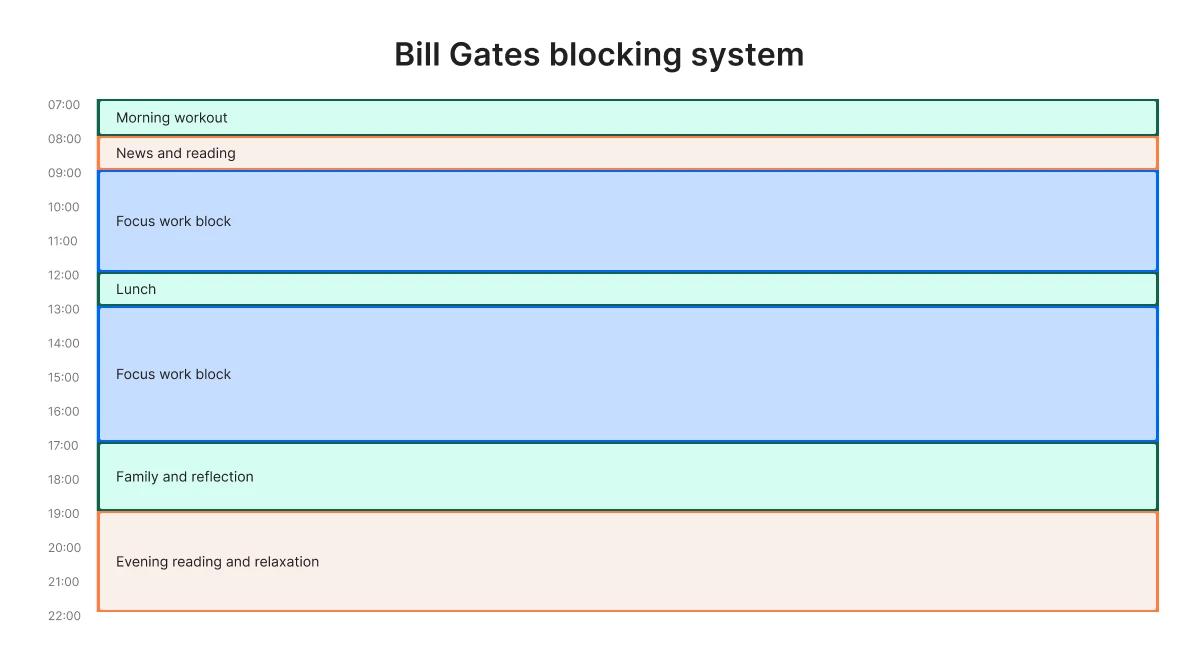
Wake up (~7:00 AM): He prioritizes rest, usually aiming for a solid seven hours of sleep to keep his cognitive functions at their peak.
Morning workout (7:00–8:00 AM): An hour on the treadmill in his private gym, usually paired with educational content.
News and reading (8:00–9:00 AM): He catches up on global events via The New York Times, The Wall Street Journal, and The Economist.
Work blocks (9:00 AM–12:00 PM): Gates famously uses five-minute time blocks to ensure no moment is wasted on low-value tasks.
Lunch and meetings (12:00–1:00 PM): Often quick, though he's known to enjoy a simple cheeseburger while discussing public health or technology.
Afternoon work (1:00–5:00 PM): Deep work sessions and collaborative meetings at the foundation or on his latest ventures.
Family and reflection (5:00–7:00 PM): Winding down and spending time with family.
Evening reading and relaxation (7:00–10:00 PM): This time is where he tackles his legendary reading list.
Sleep (~10:00 PM – 11:00 PM): Heading to bed early enough to repeat the cycle.
Bill Gates daily routine habits: Starting the day right
For most entrepreneurs, the morning sets the tone for the rest of the day. Gates doesn't just roll out of bed and check his email. Instead, his morning routine focuses on feeding both his body and his mind.
Sleep for success: Unlike some high-performers like Elon Musk, who famously struggled with sleep in the past, Gates is pretty vocal about needing seven hours. After his earlier years at Microsoft, he recognized that sleep isn't a luxury; it's a prerequisite for creativity.
Multitasking the right way: You won't find him staring at a wall while on the treadmill. He often watches content from the Teaching Company or Great Courses while getting his cardio in. It's a classic example of "habit stacking" — improving physical health and mental knowledge at the same time.
The morning papers: After his session in his private gym, he spends a good chunk of time with The New York Times, The Wall Street Journal, and The Economist. Staying informed about public health and global shifts is close to full-time work for a philanthropist, and that's where he builds that foundation.
By the time most people are on their second cup of coffee, the co-founder of Microsoft has already exercised and learned something new. That commitment to constant growth is evident on his LinkedIn page and his personal blog, GatesNotes.
Bill Gates' daily routine: Productivity and the power of deep work
Once the morning rituals are done, the real work begins. If you've ever looked at the daily routines of successful people like Elon Musk or Jeff Bezos, you'll notice they don't just show up to work. They protect their time. For the co-founder of Microsoft, the workday is an intense exercise in focus.
Try reading summaries from top founders on structuring focused, high-output workdays.
1) The famous five-minute rule
One of the most talked-about habits of Bill Gates is his time blocking. Rather than a vague "meeting from 9:00 to 10:00," his day is broken down into five-minute intervals. This practice might sound stressful to the average person, but for a billionaire managing a global empire, it's a necessity. Every moment is accounted for, which is a level of time management that few have mastered.
2) Deep work vs shallow work
Gates is a strong proponent of deep work, a concept widely discussed in the business world and featured in major publications such as The Wall Street Journal and Forbes. Rather than answering emails all day, he blocks out large chunks of time for high-impact thinking.
Think weeks: Twice a year, he retreats to a secluded cabin for a "Think Week." No internet, no distractions — just a stack of books and papers.
Strategic focus: Day to day, that translates to protecting his schedule from shallow tasks. He prioritizes what only he can do, leaving the rest to the team at the Bill & Melinda Gates Foundation.
3) Continuous learning as a full-time job
Even during a busy workday, Gates makes time for learning. He's known for reading roughly 50 books a year, a pace that puts most of us to shame. Whether he's reading about public health, climate change, or new technology, he lives by the "five-hour rule" — dedicating at least one hour a day, or five hours a week, to deliberate learning.
📘 You might not have a billionaire's bank account yet, but you can check out their library. Get the Headway app for summaries of the books that Bill Gates swears by.



Bill Gates daily routine 2026: The art of the evening wind-down
After a day spent navigating public health challenges or sitting through high-level meetings, collapsing in front of the TV would be understandable. But for Gates, the evening is just as intentional as the morning. The shift is from doing to reflecting.
1) Family, reflection, and the dishes
Despite his net worth, Gates has famously mentioned that he does the dishes every night. It sounds small, but for him it's a meditative habit. It's a low-intensity task that allows his brain to process the day without the pressure of a screen or a spreadsheet.
Spending time with family is a non-negotiable part of his work-life balance. Whether it's talking through a problem with his kids or catching up on the day, this social connection is what keeps him grounded.
2) The nightly reading habit
Before bed, Gates spends at least an hour reading. This habit goes all the way back to his high school days and carried through even the most intense years as co-founder of Microsoft. He treats reading as his primary way of exploring the world.
To keep his mind from racing, he focuses on:
Deep focus: No phones or distractions during that hour.
Varying topics: He might jump from a book on plant-based innovation to a history of Warren Buffett's investment strategies.
Note-taking: He's notorious for scribbling in the margins, something he often shares on GatesNotes.
Core principles behind the habits of Bill Gates
When you look at Bill Gates' daily routine, it's easy to get lost in the five-minute blocks and the treadmill sessions. But if you zoom out, there are four core principles that make the whole thing work. These are what most entrepreneurs try to emulate to become part of the most successful people in their field.
Sleep is a force multiplier: Gates moved away from the all-nighter culture that he helped create at Microsoft. He realized that a tired brain is a mediocre brain. High-quality sleep is the foundation for his creativity.
Continuous learning over shallow consumption: He doesn't just scroll through the news. He engages with deep content from the Teaching Company, Great Courses, or long-form articles in The Wall Street Journal.
Focused work (the five-minute rule): By eliminating wasted time, he ensures that his energy goes exactly where it needs to. It's about being effective, not just being busy.
Play and recovery: Whether it's a game of bridge with Warren Buffett or a simple walk, Gates knows that the brain needs off-time to solve the hardest problems.
📘 If you're too busy for an hour of daily learning, let Headway give you the big ideas in just 15 minutes — perfect for your own focused time blocks.
★★★★★ 172K+ reviews
Empower yourself with the best insights and ideas!
Get the #1 most downloaded daily growth app.
Get startedActionable takeaways: How to live like a billionaire (on a budget)
Here's your checklist to start implementing Bill Gates' daily routine in your own life:
Start the morning with reading: Instead of reaching for your phone to check LinkedIn first thing, try spending 20 minutes with a deep-dive article from The Economist or The Wall Street Journal.
Try focused time blocks: You don't need to have five-minute intervals yet, but try blocking out 90 minutes of deep work with your phone in another room. It's a habit shared by most successful people.
Use the five-hour rule: Dedicate one hour a day to deliberate learning.
Prioritize the wind-down: Cut the screen time an hour before bed. Pick up a physical book and let your mind decompress the way Gates does.
Habit stack on the treadmill: If you're at the gym, don't just listen to music. Swap the playlist for something educational or listen to make the most of that time.
Master your mindset and daily routine with Headway!
Building a daily routine that actually sticks is the hardest part of self-improvement. If you're feeling inspired by Bill Gates' daily routine but don't have time to read 50 books a year, let Headway be your shortcut.
We've pulled the big ideas from the exact nonfiction titles that Gates, Elon Musk, and Jeff Bezos swear by. Whether you want to master time management, strengthen your well-being, or understand what separates good entrepreneurs from great ones, our 15-minute summaries are designed for your busy life.
📘 Ready to build your own billionaire-level habits? Download the Headway app today and start your first summary of 'Atomic Habits' or 'Deep Work' to elevate your routine!
FAQs about Bill Gates' daily routine
What is Bill Gates' daily routine?
Bill Gates follows a highly structured day, often broken into five-minute increments to maximize productivity. Bill Gates' daily routine and sleep work schedule include early mornings on the treadmill, followed by deep-work blocks at his foundation. He balances intense cognitive tasks with dedicated time for reflection, so no part of the day goes to waste.
What time does Bill Gates go to sleep?
He typically heads to bed around 11:00 PM to get seven hours of rest. That consistent approach to Bill Gates' sleep hours and daily routine gives his brain time to process everything he takes in each day. He's been public about choosing quality sleep over hustle culture, knowing that mental clarity is his most valuable tool for tackling global challenges.
What is Bill Gates' five-hour rule?
The five-hour rule involves dedicating at least one hour every workday to deliberate learning. Bill Gates' daily routine and sleep reading habit mean he spends five hours a week focusing on new concepts, regardless of how full his schedule gets. It's about moving beyond passive consumption to actively expanding his expertise in fields like climate change, energy, and global health.
What are the five habits of billionaires?
Most billionaires often share five key traits: prioritized sleep, daily exercise, continuous learning, strict time-blocking, and a dedicated evening wind-down. Bill Gates' daily routine of sleep, exercise, and reading reflects all five. Together, these habits build a sustainable system that allows for high-level decision-making without the constant threat of mental burnout or fatigue.
What is the IQ of Bill Gates?
While Gates himself has never confirmed a number, his IQ is widely estimated to be around 160. That kind of cognitive capacity is supported by Bill Gates' sleep hours and daily routine, which give his mind the recovery it needs to stay sharp. He pairs that natural ability with a relentless work ethic and a lifelong commitment to reading and education.