Self-growth
 Business & Career
 Success
 Communication
 Healing
 Relationships
 Psychology
 Happiness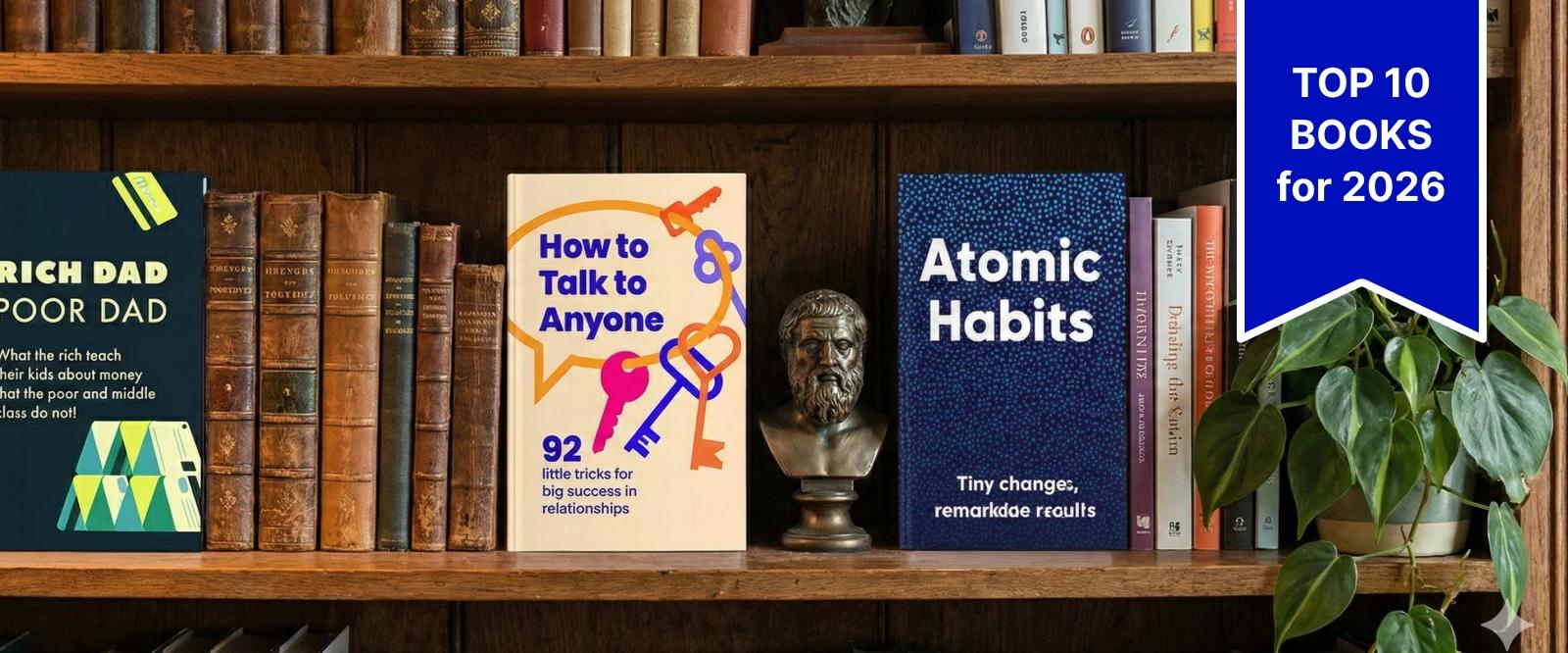
You made it through 2025. Barely. Now you’re staring down 2026 with that familiar mix of ambition and dread, wondering if this is finally the year you’ll get it together — or just another twelve months of the same patterns dressed up in new goals.
These ten books give you the frameworks, strategies, and insights to make 2026 different. Not through willpower or New Year’s resolutions, but through understanding how habits form, how influence works, how your brain makes decisions, and why your relationship with money might be sabotaging everything else.
Read them. Don’t just add them to some aspirational list you’ll ignore by February.
‘Atomic Habits’ by James Clear
Small changes don’t feel like they matter, but that’s exactly why they work. James Clear breaks down the compound effect of tiny improvements — how getting 1% better each day transforms into being 37 times better by year’s end. Not through overhauls that fail by January 15th, but through small tips so they feel almost embarrassing.
Clear reveals why motivation is overrated, and environment design is everything. Your habits aren’t about you being lazy or undisciplined. They’re about whether your kitchen makes eating healthy the default option or a constant battle of willpower. The book gives you a great framework to build habits that stick and break the ones that are quietly destroying your life.
If you only read one book from this list, make it this one. Everything else gets easier when you understand how to actually change your behavior.
‘How to Talk to Anyone’ by Leil Lowndes
Ninety-two techniques sound overwhelming until you realize most of us are using maybe three of them, badly. Lowndes studied how charismatic people operate and reverse-engineered their strategies into practical, usable tactics anyone can deploy.
This isn’t about becoming someone you’re not. It’s about understanding that social confidence is a skill, not a personality trait you’re either born with or without. You’ll learn how to start conversations without the awkward small talk, how to make people feel heard (which matters more than being interesting), and how to leave impressions that last beyond the interaction.
Whether you’re networking, dating, or just trying to navigate normal human interaction without wanting to disappear, this book gives you the specific language and strategies that work.
‘Rich Dad Poor Dad’ by Robert Kiyosaki
Your relationship with money was probably shaped by people who were broke. That’s not an insult — it’s just statistical reality. Most of us learned about finances from parents who worked for money instead of making money work for them. Kiyosaki contrasts the advice from his highly educated “poor dad” with lessons from his friend’s entrepreneur father, the “rich dad.”
The core insight flips conventional wisdom: assets put money in your pocket, liabilities take money out. Your house isn’t an asset if it drains your income. Your car definitely isn’t. Rich people acquire assets. Everyone else accumulates liabilities while calling them investments.
This book won’t make you rich overnight, but it will change how you think about income, expenses, and building actual wealth instead of just looking wealthy. Start here if your current financial strategy is “work hard and hope things work out.”
‘The 48 Laws of Power’ by Robert Greene
Power makes people uncomfortable. Good. That discomfort is why others have it, and you don’t. Greene studied historical power dynamics — from ancient courts to modern corporations — and distilled 48 laws that govern human influence and control.
Some laws feel manipulative because they are. “Conceal your intentions.” “Get others to do the work, but take the credit.” Greene isn’t prescribing morality — he’s describing reality. Understanding these laws helps you recognize when they’re being used on you, which matters more than whether you choose to use them yourself.
The book is dense, historical, and sometimes brutal in its honesty about how power actually works, rather than how we pretend it does. Read it to understand the game being played around you, even if you decide not to play.
‘Thinking, Fast and Slow’ by Daniel Kahneman
Your brain is lying to you constantly. Daniel Kahneman, who won a Nobel Prize for this work, reveals the two systems running your mind: the fast, intuitive system that jumps to conclusions, and the slow, analytical system that actually thinks things through.
The problem? The fast system runs the show most of the time, making snap judgments riddled with cognitive biases while you confidently believe you’re being rational. You’re not. None of us is. Kahneman shows exactly how we get tricked by our own brains — and more importantly, how to catch yourself before making predictable errors.
This book will make you question every “gut feeling” you’ve ever trusted and every “obvious” decision you’ve ever made. It’s uncomfortable and essential. Your thinking is probably the biggest obstacle to better outcomes.
‘The 80/20 Principle’ by Richard Koch
Eighty percent of your results come from 20% of your efforts. Most of what you do doesn’t matter. This should be liberating, but instead we spread ourselves thin trying to do everything, convinced that more effort equals better results.
Koch shows how the 80/20 principle applies to everything — your work, relationships, time, and money. Twenty percent of your clients generate 80% of your revenue. Twenty percent of your activities produce 80% of your happiness. The strategy isn’t balanced. It’s the ruthless elimination of the 80% that’s wasting your life.
The book provides frameworks for identifying your high-impact 20% and cutting the rest without guilt. Most productivity advice tells you how to do more. This tells you how to do less but better — which is the only strategy that actually works long-term.



'Emotional Intelligence 2.0’ by Travis Bradberry and Jean Greaves
Your IQ is basically fixed. Your emotional intelligence isn’t. This matters because EQ predicts success better than intelligence, talent, or education — yet most people have never deliberately developed it.
Bradberry and Greaves break emotional intelligence into four skills: self-awareness, self-management, social awareness, and relationship management. The book includes an assessment to show you exactly where you’re weak, then provides specific strategies to improve.
Understanding your own emotions and reading others’ isn’t some soft skill that matters less than hard skills. It’s the difference between being technically competent and actually effective. Start here if you’re smart, but your career or relationships aren’t reflecting that.
‘How to Win Friends and Influence People in the Digital Age’ by Dale Carnegie and Associates
Dale Carnegie’s original principles still work. But the medium has changed. This update tackles influence when half your interactions happen through messengers, where tone disappears, and context collapses.
You’ll learn how to build connections when meeting face-to-face isn’t the default, how to communicate persuasively through email and messages without sounding manipulative, and how to maintain relationships in an era when “keeping in touch” means liking someone’s post every three months.
The core Carnegie principles — make people feel important, show genuine interest, remember names — translate to digital spaces but require adaptation. This book shows you how, without turning you into a LinkedIn engagement bot.
‘The 5 AM Club’ by Robin Sharma
Waking up at 5 AM won’t change your life. What you do between 5 and 6 AM will. Sharma’s argument isn’t about the specific time — it’s about claiming the first hour of your day before the world makes demands on your attention.
The book provides a formula: 20 minutes of moving, 20 minutes of reflecting, and 20 minutes of learning. No email, no news, no distractions. Just focused time for the things you claim matter, but never prioritize once the day starts pulling you in different directions.
This works if you actually do it, not if you just like the idea of being someone who wakes up early. The victory hour concept matters more than the 5 AM part — protect your first hour, and you protect your entire day.
‘No Excuses!’ by Brian Tracy
Self-discipline isn’t a personality trait. It’s a decision you make repeatedly until it becomes automatic. Tracy cuts through the noise with a simple premise: excuses are the primary obstacle between you and everything you want.
The book provides frameworks for developing self-discipline across major life areas — health, relationships, career, and overall wealth (not through willpower, but through systems that make discipline the path of least resistance!)
You’ll learn how to set goals that drive behavior, how to overcome procrastination without relying on mood, and how to build the specific habits that separate people who achieve from people who try. No excuses.
Start your 2026 by finishing something
These ten books give you different tools for the same outcome: becoming someone who actually follows through. Not someone who makes plans or sets intentions or talks about change. Someone who changes.
You don’t need to read all ten in January. Pick the area where you’re weakest and start there. Struggling with consistency? Start with ‘Atomic Habits.’ Money stress keeping you up at night? Go to ‘Rich Dad Poor Dad.’ Can’t figure out why your career stalled despite being good at your job? Try ‘Emotional Intelligence 2.0’ or ‘The 48 Laws of Power.’
The books you read in the next few weeks will influence your entire year. Not because reading is magical, but because understanding how things actually work — influence, money, habits, power, thinking — gives you leverage. And leverage is how small efforts create disproportionate results.
2026 is going to challenge you regardless. Show up prepared.