Self-growth
 Apps & Digital Tools
 Business & Career
 Success
 Growth Tools
 Psychology
 Communication
 Relationships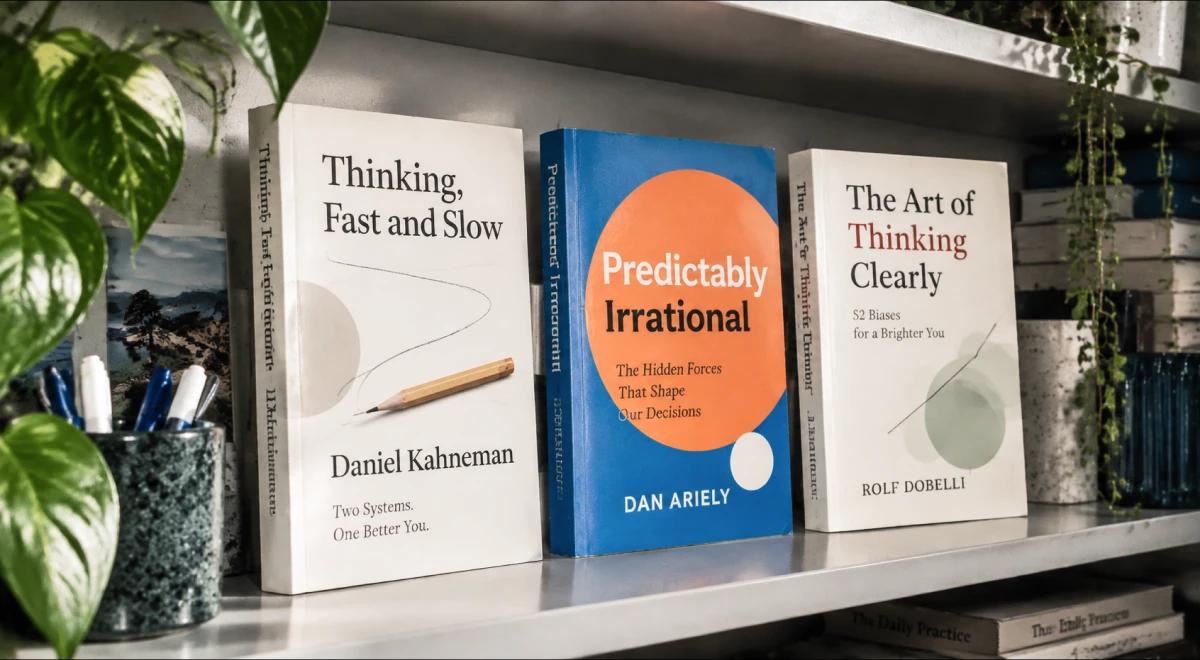

Shoppers offered six jam flavors bought 10 times more often than shoppers offered 24.
That comes from a study by Sheena Iyengar and Mark Lepper at a Menlo Park supermarket. Roughly 30% of people who stopped at the six-jam table bought a jar, against 3% at the 24-jam table. The bigger display drew a bigger crowd, then froze it. Psychologists call the effect choice overload, and it scales badly.
Swap jam for job offers or a hiring call you've been sitting on since March, and you have a decent picture of modern adult life. The best books for decision-making don't hand you more options. They give you a method for sorting the ones already in front of you.
Books about decision making tend to fall into two camps: the ones explaining why your judgment fails, and the ones handing you a process for the moment of choice. You want both, because decision-making skills are built from diagnosis plus method.
The 12 titles below are grouped by the kind of decision they help with — everyday judgment errors first, then the calls you can't take back. All of them are on Headway as 15-minute summaries if you'd rather take the key ideas first and decide later which ones earn a full read.
➡️ What is Headway and how does it work?
📘 Match a growth plan to your goals on Headway.

Quick answer: What are the best books on decision-making?
Start with 'Thinking, Fast and Slow' by Daniel Kahneman for the psychology of decision-making, 'Thinking in Bets' by Annie Duke for decision-making under uncertainty, and 'The Dip' by Seth Godin for the specific question of whether to push on or walk away. Everything else on this list sharpens one of those three angles.
Here's how the 12 compare at a glance:
| Book | Best for | What you can use tomorrow |
|---|---|---|
'Thinking, Fast and Slow' | Understanding where errors come from | Catching yourself before you trust a snap read |
'Predictably Irrational' | Money and buying calls | Ignoring the decoy option in any pricing menu |
'The Art of Thinking Clearly' | Building a bias vocabulary fast | Naming the trap you just fell into |
'Thinking in Bets' | Decision-making under uncertainty | Asking "how sure am I?" and giving a number |
'Antifragile' | Volatile, high-stakes situations | Capping your downside before chasing upside |
'Effective Decision-Making' | Choices with a deadline attached | Running a risk check when the clock is loud |
'Influence' | Seeing when a choice isn't yours | Recognizing a scarcity pitch in real time |
'Start, Stay, or Leave' | Career and relationship crossroads | Separating a bad season from a bad fit |
'The Baby Decision' | The irreversible personal call | Sorting your own wants from other people's |
'The Dip' | Knowing when to quit | Telling a temporary slump from a dead end |
'Unglued' | Deciding while emotions run hot | Buying yourself a pause before you react |
'The Power of Regret' | Learning from past calls | Using anticipated regret as a test |
Best books on decision-making psychology and cognitive biases
These three explain the machinery. Read any one of them, and you'll start catching your own errors mid-sentence, which is uncomfortable and extremely useful.
1. 'Thinking, Fast and Slow' by Daniel Kahneman
Kahneman splits thinking into two systems. System 1 runs fast and automatic, mostly on emotion. System 2 is slow and effortful, and it's lazy — it would rather endorse System 1's answer than do the work itself. Most bad calls happen when the fast system handles a problem that needed the slow one.
The book is a catalog of the ways this goes wrong. Loss aversion means losing $100 stings roughly twice as much as gaining $100 feels good, which explains why you're still holding a stock you'd never buy today. The planning fallacy explains why your last three projects ran long, and overconfidence explains why you'd still bet on the next estimate. WYSIATI — what you see is all there is — explains why you decided based on the two facts you happened to have.
2. 'Predictably Irrational: The Hidden Forces That Shape Our Decisions' by Dan Ariely
Ariely ran experiments on real people making real choices, and the results are funny until you recognize yourself. His most famous example is a magazine subscription page: add a print-only option that nobody wants at the same price as print-plus-digital, and bundle sales jump. The useless option exists to make another look generous.
That's relativity at work, and it's one of several forces he documents. The zero-price effect explains why people take free items they don't want. Anchoring explains why the first price you see sets your sense of fair value for everything after. Social norms and market norms clash in ways that make paying your friend for help feel worse than not paying at all.
3. 'The Art of Thinking Clearly' by Rolf Dobelli
Dobelli gives you 99 biases in 99 short chapters, three or four pages each. Survivorship bias: you study the winners because the losers left no records. Sunk cost: you finish the bad movie because you paid for the ticket. Confirmation bias: you find the evidence you went looking for.
The format is the selling point. There's no argument to follow across the book, so you can read one entry over coffee and spend the day noticing that particular trap. Among books on cognitive biases, this is the one you return to as a reference.
📘 Build a bias-spotting habit in 15 minutes a day with Headway.
Books to improve decision-making under uncertainty and pressure
Knowing your biases doesn't tell you what to do when the facts are genuinely incomplete, and the clock is running. These three are about acting anyway.
4. 'Thinking in Bets: Making Smarter Decisions When You Don't Have All the Facts' by Annie Duke
Duke spent 18 years as a professional poker player before writing about judgment, and poker gave her the single most useful reframe on this list: separate the quality of a decision from the quality of its outcome. She calls the failure to do that "resulting" — judging a call by how it turned out, when luck was doing much of the work.
Her fix is to treat every choice as a bet and put a number on your confidence. Not "this will work," but "I'm about 70% sure." Probabilistic thinking sounds fussy until you try it, at which point you notice how often your certainty was performance. She also makes a case for truth-seeking groups: a few people who've agreed to check each other's reasoning rather than simply agree with one another.
5. 'Antifragile: Things That Gain from Disorder' by Nassim Nicholas Taleb
Taleb's category is things that gain from disorder. Fragile things break under stress, resilient things endure it, and antifragile things improve because of it. His argument is that we consistently underrate volatility and overrate our ability to forecast our way around it.
The decision-making application is about structure rather than prediction. His barbell approach — very safe on one side, small speculative positions on the other, nothing in the mediocre middle — is a way to stay exposed to good surprises while capping the bad ones. It works on careers and side projects as readily as portfolios.
Taleb is opinionated and enjoys picking fights with economists, which some readers find bracing, and others find exhausting. The core insight survives the tone. Our list of the best books for men covers more titles in this vein if resilience under pressure is the thread you're pulling.
6. 'Effective Decision-Making: How to Make Better Decisions Under Uncertainty and Pressure' by Edoardo Binda Zane
Where Kahneman explains the science, Binda Zane is interested in the twenty minutes before you have to answer. His subject is high-stakes choices made under real-time pressure, and the book stays close to the practical questions: how to weigh a risk quickly, how to keep your emotional state from doing the deciding, and how to get to a workable answer when a perfect one isn't available.
It's short and openly instructional, closer to a field manual than a popular science read, and it treats problem-solving and decision-making as one continuous task rather than two. That makes it a good complement to the heavier titles above — the decision-making strategies here are meant to be run, not admired. If your problem is that you freeze when the stakes and the clock rise together, start here.
📘 Get the key ideas before your next big call on Headway.
The book on decision-making that explains who's steering you
Some of your choices were shaped before you got to them. This one shows the mechanics.
7. 'Influence: The Psychology of Persuasion' by Robert B. Cialdini
Cialdini spent three years training undercover in car dealerships, telemarketing rooms, and fundraising operations to watch persuasion up close. He came back with six principles: reciprocity, commitment and consistency, social proof, authority, liking, and scarcity. Each one is a shortcut your brain uses to decide quickly, and each one can be triggered on purpose.
The commitment principle is the one worth watching in yourself. Agree to something small, and you'll feel pressure to stay consistent with it, which is how a minor yes turns into a standing obligation. Scarcity explains countdown timers. Authority explains why a lab coat in an ad moves product.
Books for the decisions you can't take back
Frameworks are easiest to apply to reversible choices. These three deal with the ones that reshape a life, where the cost of getting it wrong is measured in years.
8. 'Start, Stay, or Leave: The Art of Decision Making' by Trey Gowdy
Gowdy spent years as a federal prosecutor before a career in Congress, and the book organizes personal decisions around three questions: when to begin something new, when to hold your current position, and when walking away is the strategically sound move. Most of us default to one of the three regardless of the situation, which is where the trouble starts.
His method is closer to case preparation than to self-help. Establish what you're really optimizing for, gather evidence against your own preferred answer, and be honest about which parts of a situation you control. It's most useful at the career and relationship crossroads, where the hardest work is telling a genuinely bad fit apart from a rough patch you'd regret abandoning.
9. 'The Baby Decision: How to Make the Most Important Choice of Your Life' by Merle Bombardieri, MSW, LICSW
Whether to have children is among the few decisions with no undo, and Bombardieri, a clinical social worker, treats it with the seriousness that it implies. The book is built around structured exercises rather than arguments, because her aim is to surface what you want rather than tell you what to choose.
The exercises separate your own values from inherited expectations, put your fears in writing where they can be examined, and give couples a way to work through disagreement without one partner steamrolling the other. Of the books for making difficult decisions here, this is the most narrowly focused, and it's the one to reach for when a choice is entangled with identity, family pressure, and a timeline you didn't set.
10. 'The Dip: A Little Book That Teaches You When to Quit (and When to Stick)' by Seth Godin
Godin's book runs about 80 pages and does one thing well: it tells you when quitting is the right answer. The dip is the long, unrewarding stretch between starting something and getting good at it, and it exists to shake off people who aren't committed. Push through it, and the payoff is real, because scarcity of persistence is what makes expertise valuable.
The uncomfortable half of his argument is that most things aren't dips. They're dead ends, and quitting a dead end frees the resources you need for something with an actual slope. His test is forward-looking: not how much you've already sunk in, but whether pushing on gets you meaningfully closer to being best at something worth being best at.


Books on making wise choices when emotions are loud
Judgment doesn't fail only from bad logic. It fails at 11 pm after a bad conversation. These two work on that.
11. 'Unglued: Making Wise Choices in the Midst of Raw Emotions' by Lysa TerKeurst
TerKeurst writes about the gap between feeling something intensely and acting on it, and the reactions we regret within the hour — the sent message, the sharp reply, the decision made to end a conflict rather than resolve it. Her categories for how people mishandle raw emotion are unusually recognizable: exploding, stuffing it down, or doing both in sequence.
The practical core is about creating a pause and choosing a response inside it. It's written from a Christian perspective and quotes scripture throughout, which some readers will want and others won't, so it's worth knowing going in. Taken on its own terms, it's a clear-eyed treatment of a failure mode the analytical books on this list mostly skip.
12. 'The Power of Regret: How Looking Backward Moves Us Forward' by Daniel H. Pink
Pink surveyed thousands of people about what they regret and found the answers cluster into a handful of types: the risks not taken, the foundations not built, the right thing not done, the relationship allowed to lapse. His claim is that regret, examined rather than avoided, is information about what you value.
That turns it into a decision tool. Anticipated regret — asking which choice you're likelier to be explaining to yourself in ten years — cuts through a surprising number of stalled deliberations, and it tends to favor action, since bold-move regrets outnumber the other kind. Pink is also useful on the difference between productive reflection and rumination, which is the trap this kind of thinking can fall into.
More decision-making books worth adding to your list
The 12 above will keep you busy for a while. When you want to go further, these are the titles that come up most often among critical thinking books and books about rational thinking. Between them, they cover the best-known decision-making frameworks and the mental models for decision-making that keep resurfacing in the field, and each one is worth a look:
'Decisive: How to Make Better Choices in Life and Work' by Chip Heath and Dan Heath
'Clear Thinking: Turning Ordinary Moments into Extraordinary Results' by Shane Parrish
'The Scout Mindset: Why Some People See Things Clearly and Others Don't' by Julia Galef
'How to Decide: Simple Tools for Making Better Choices' by Annie Duke
'Nudge: Improving Decisions About Health, Wealth, and Happiness' by Richard H. Thaler and Cass R. Sunstein
'Algorithms to Live By: The Computer Science of Human Decisions' by Brian Christian and Tom Griffiths
'Principles: Life and Work' by Ray Dalio
'Smart Choices: A Practical Guide to Making Better Decisions' by John S. Hammond, Ralph L. Keeney, and Howard Raiffa
'Mistakes Were Made (But Not by Me): Why We Justify Foolish Beliefs, Bad Decisions, and Hurtful Acts' by Carol Tavris and Elliot Aronson
'The Paradox of Choice: Why More Is Less' by Barry Schwartz
How to pick which decision-making book to read first
Matching the book to your actual complaint beats reading in list order. The best decision-making books for you are the ones aimed at the specific way your judgment is currently failing, so use the table below rather than starting at the top.
| Your problem | Start with | Why it fits |
|---|---|---|
Stuck in something that may not be working | 'The Dip' | Gives you a forward-looking test for quitting |
Big call, incomplete information | 'Thinking in Bets' | Teaches confidence estimates over false certainty |
High stakes and a deadline | 'Effective Decision-Making' | Built for choices made under time pressure |
You keep repeating the same error | 'The Art of Thinking Clearly' | Fastest route to naming your own patterns |
Deciding while emotions run hot | 'Unglued' | Focused on the pause between feeling and acting |
A career or relationship crossroads | 'Start, Stay, or Leave' | Separates a bad season from a bad fit |
An irreversible personal decision | 'The Baby Decision' | Structured exercises instead of advice |
Still chewing on a past choice | 'The Power of Regret' | Converts regret into a usable signal |
Money choices that don't add up | 'Predictably Irrational' | Behavioral economics applied to spending |
You want the foundations, properly | 'Thinking, Fast and Slow' | The source most of the others draw on |
One aside worth making: judgment under pressure is also what most enduring fiction is about, and reading it does more for your sense of how people decide than another framework will. Our picks for the best classic novels are a fair place to look. For shorter formats between books, we keep a list of the best articles to read.
What changed for readers who put these ideas to work
Frameworks read well and apply badly. Five of Headway's 55 million users describe what the transfer looked like.
Abdelrahman Mohamed Soliman, a lead cost control engineer at NMDC Energy, spent years making calls that were correct but short-term and driven by urgency. A 20-minute morning habit gave him room to pause in a high-pressure cost deviation meeting and reframe the discussion around root causes instead of defending himself. Read his full story.
Deyvis Bebicaci, an executive coach with 30 years of experience, picks his reading by client theme: decision fatigue among them. One summary on deciding under pressure helped a CEO regain clarity mid-restructuring. His verdict: clients decide faster, and conversations go deeper sooner. Read his account.
Olena Khodos, a content marketing manager at MacPaw, treats summaries as a filter before committing hours. She'd rather spend three months testing six frameworks than three months reading about one, and she tested Cal Newport's 'Deep Work' on her own schedule that way. See her method.
Ivan Karačić, a developer, triathlete, and father of three, finished over 120 summaries in four months on 5:30 am walks, starting with 'Don't Overthink It' by Anne Bogel. He reports being less paralyzed by perfectionism at work and no longer stuck deciding what to learn next. See his routine.
Rahaf Sobh, an information systems student, swapped scrolling for summaries during in-between moments and got back into full books as a result. Her rule for anyone hesitating is a decision rule of its own: don't overthink the first pick. Read what changed.
None of them found more hours. They lowered the cost of starting, then let the habit compound.
📘 Set up your own 15-minute habit with Headway.
Put these decision-making books to work with Headway
If reading about biases were enough to stop having them, Kahneman would have written a pamphlet. He spent 500 pages on it and still admitted his own judgment barely improved from writing the book. The gap between knowing about anchoring and catching yourself anchoring in a salary negotiation is a matter of practice, not information.
That gap is what a daily habit closes. Headway condenses 2,500+ nonfiction titles into 15-minute summaries you can read or listen to, so the ideas from 'Thinking in Bets' or 'The Dip' get in front of you on a commute rather than waiting for a free weekend that keeps not arriving. In 2025, TIME named Headway one of the world's top five EdTech companies, ranking it fourth.
You start by answering a few questions about what you're working on. Headway uses those answers to build a plan — books for better decision-making if that's your focus, or something else entirely once this list is behind you. Our roundup of the best books for self-improvement and our picks for the best books of 2026 are both good places to go next.
Your next hard call is probably already on your calendar. Twenty minutes of the right reading beforehand does more for it than an hour of worrying afterward.
📘 Build your decision-making reading plan with Headway.
Frequently asked questions on the best books for decision-making
What are the best books for decision-making overall?
'Thinking, Fast and Slow' is the foundation, since most later work builds on Kahneman and Tversky's research into bias. Pair it with 'Thinking in Bets' for judgment under uncertainty and 'Effective Decision-Making' for choices with a deadline attached. Those three books on making better decisions cover the psychology, the probability, and the practical method, which is most of what you need before specializing further.
What is the best book on decision-making psychology?
'Thinking, Fast and Slow' remains the standard for the psychology of decision-making, though it's demanding at roughly 500 pages. 'Predictably Irrational' covers similar ground through behavioral economics experiments and reads much faster. If you want breadth over depth, 'The Art of Thinking Clearly' gives you 99 biases in short, self-contained chapters you can read in any order.
Which books help with analysis paralysis and overthinking decisions?
'The Dip' is the most direct fix, because it converts a vague stuck feeling into one answerable question: is this a slump worth pushing through or a dead end? 'The Power of Regret' helps too, since anticipated regret breaks ties that pro-and-con lists can't. Both beat general bias books here, which explain error rather than indecision.
Are there good books on decision making under uncertainty?
'Thinking in Bets' by Annie Duke is the clearest one. She draws on professional poker to separate decision quality from outcome quality and teaches you to state confidence as a percentage rather than a certainty. 'Antifragile' takes a structural approach instead, arguing you should design situations that benefit from volatility rather than trying to predict it.
What should I read for strategic decision-making at work?
'Effective Decision-Making' fits workplace conditions best, since it's built for high-stakes calls on a deadline. 'The Dip' is the one to reach for on whether to keep resourcing a struggling project. For the interpersonal side, 'Influence' helps you notice when a colleague's framing is doing the deciding for you.
Do decision-making books work if I only read the summaries?
Summaries work well for identifying which frameworks fit your situation and for keeping ideas circulating between full reads. Several Headway users describe using them exactly that way — as a filter before committing hours to a 400-page book. For methods you plan to apply repeatedly, the full text gives you the worked examples that make a process stick.
Which book explains cognitive biases most clearly?
Of the books on this list for critical thinking and decision-making, 'The Art of Thinking Clearly' is the most accessible entry point, with one bias per short chapter and no argument to track throughout the book. 'Predictably Irrational' explains fewer biases but shows the experiments behind them, which makes them memorable. Kahneman goes deepest and rewards the effort.
How long before better decision-making shows up in practice?
Recognizing a bias takes one reading; catching it in the moment takes repetition. Users who report real change describe daily habits measured in months rather than one-off reading sessions — 15 to 20 minutes consistently, with a deliberate pause before responding to anything high-stakes. Expect noticing to come first, then the pause, then better calls.