Self-growth
 Business & Career
 Success
 Communication
 Healing
 Relationships
 Psychology
 Happiness
Are you tired of staring at your phone, feeling stuck trying to learn a new language? Picking between Babbel and Duolingo is a big decision for learners right now. Especially if you want to make sure your time actually leads to real conversations. This struggle is making the Babbel vs Duolingo debate more heated than ever before.
As practice shows, learning languages connects you to a much bigger goal: improving yourself. When you practice Spanish or French, you sharpen your focus, challenge your memory, and prove to yourself that you can stick with something hard.
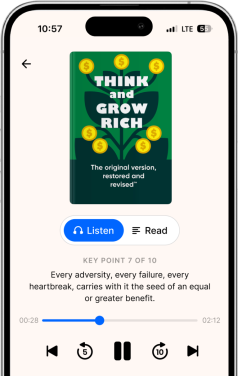
The Headway app supports personal growth by helping you understand different cultures and fit learning into busy days, so you can make consistent progress without overhauling your schedule.
Try Headway for daily insights from top nonfiction books.
Quick summary to help you choose the best app
Let's look at a brief comparison of these two popular language-learning apps. Here's what matters most, so you can see the differences right away.
Pricing: Duolingo offers a free version with ads, while Babbel requires a paid subscription after a short trial.
Features: Duolingo focuses on a gamified experience with streaks and leaderboards. Babbel focuses on structured lessons and real-life conversations.
Learning styles: Duolingo works well for visual learners and casual study. Babbel suits people who want clear grammar explanations and practical speaking skills.
Duolingo is a great starting point for casual learners who want to build a daily habit. Babbel is a better fit for serious learners who want to understand grammar and speak confidently.
📘Boost your language learning mindset with Headway!
Babbel review: What it is and how it works
Babbel is a mobile app designed to help you speak confidently in real-world situations. It moves past simple vocabulary games to offer a deeper learning experience.
Babbel focuses on providing structured lessons with linguistic depth. You learn phrases that you can use at a restaurant or a train station. Each Babbel lesson also gives you context for why sentences are built a certain way.
The learning path follows a clear progression from beginner to advanced. You start with basic greetings and move toward complex discussions. Each step is clearly laid out, so you always know where you're headed.
Pricing and academic backing
The price of a subscription varies based on how many months you buy at once. A longer commitment usually drops the monthly cost. Babbel also provides a money-back guarantee if you aren't satisfied within the first few weeks.
Babbel offers popular language options such as Spanish, French, German, Italian, and Portuguese. It also covers Polish, Turkish, Indonesian, Dutch, Russian, Norwegian, and Swedish.
Studies show that learners using Babbel can improve their conversational skills faster than in traditional classroom settings in some cases. The method relies on proven educational science to help you remember new words.
📘Build habits and improve language skills with Headway.
Duolingo review: What it is and how it works
Duolingo is famous for making language study feel like playing a video game. Its bright, friendly design is built to keep you coming back every day.
The whole experience provides a gamified approach with high accessibility. You earn points, unlock new levels, and compete with friends. For a total beginner, that makes a new target language feel a lot less intimidating.
Duolingo's lessons are very short. You can finish a session while waiting for a bus or drinking your morning coffee. Daily streaks keep you accountable without making it feel like homework.
Gamification insights and costs
You can use the free version of Duolingo forever if you don't mind watching ads. For an ad-free experience with extra features, you can upgrade to Super Duolingo.
Duolingo offers a massive list of languages. You can learn anything from Arabic to Japanese. They even have courses for fictional languages.
The gamification works because it triggers a reward response in your brain. That urge to keep your streak alive is a real motivator, especially for language learners who struggle to stay motivated.
📘Expand your language learning with Headway's daily tools.
Babbel vs Duolingo: Head‑to‑head comparison
Find out how these two apps compare in different areas.
Lesson formats and learning styles
Babbel provides a very structured learning experience. You get clear grammar explanations and practice with real-life conversations. The pacing feels like a traditional classroom adapted for your phone.
Duolingo relies on bite-sized, repetitive exercises. You translate sentences, match words to pictures, and type what you hear. It works well if you want quick, casual practice without having to sit through long grammar explanations.
| Feature | Babbel | Duolingo |
|---|
Free version | No (only a free trial lesson) | Yes (ad-supported) |
Premium cost | Starts at $8.95/month (billed annually at ~$107.40) or around $13.95/month for shorter terms. Lifetime plans are also available. | Super Duolingo is $12.99/month (or ~$84/year). The Super Family plan covers up to 6 people for $119.99/year. |
Money-back guarantee | Yes (20 days) | No (cancel anytime, but offers a 1 to 2-week free trial) |
If you want a free tool, Duolingo is the obvious choice. If you're willing to pay for in-depth instruction, Babbel offers strong value.
Finding the target audience
Babbel is best for adults and professionals. If you need to learn German for a business trip, Babbel helps you learn useful phrases fast.
Duolingo appeals to casual learners and children. It's perfect if you just want to pick up a few phrases before a vacation, or if you're just exploring a new language for fun.
Learning outcomes and retention
User reviews often show different results for these two apps. People who use Babbel report feeling better prepared for actual conversations. The focus on dialogue pays off when it counts.
Duolingo users often build solid vocabulary but struggle to form complex sentences. Translation exercises don't always mimic natural speech patterns.
Support and learning resources
Babbel offers additional resources, such as podcasts and live classes. The Babbel app gives you access to language experts who guide the curriculum.
Duolingo relies mostly on the core app exercises. They do have some podcasts for specific languages, but they lack formal tutoring options. If you want direct teacher support, you might need to look at platforms like italki.
Cultural and language depth
Babbel includes cultural notes in its lessons. You learn how native speakers actually talk and behave in social settings. That kind of context helps you avoid awkward mistakes when you're abroad.
Duolingo focuses strictly on words and sentence structure. You won't get much context about the cultures behind the languages you're learning.
Pair language practice with daily growth using Headway.


How Babbel and Duolingo boost language learning efficiency
Understanding how the brain acquires language can help you choose the right tool.
A structured curriculum like Babbel builds a strong foundation. You learn the rules of the language so you can create your own sentences. Studies show this approach leads to better long-term fluency.
Gamified learning like Duolingo's keeps you engaged. Research suggests that simply translating sentences doesn't build true conversational skills. You need to use the language.
Spaced repetition techniques
Both apps use spaced repetition. Essentially, this means that they show you older vocabulary right before you're likely to forget it.
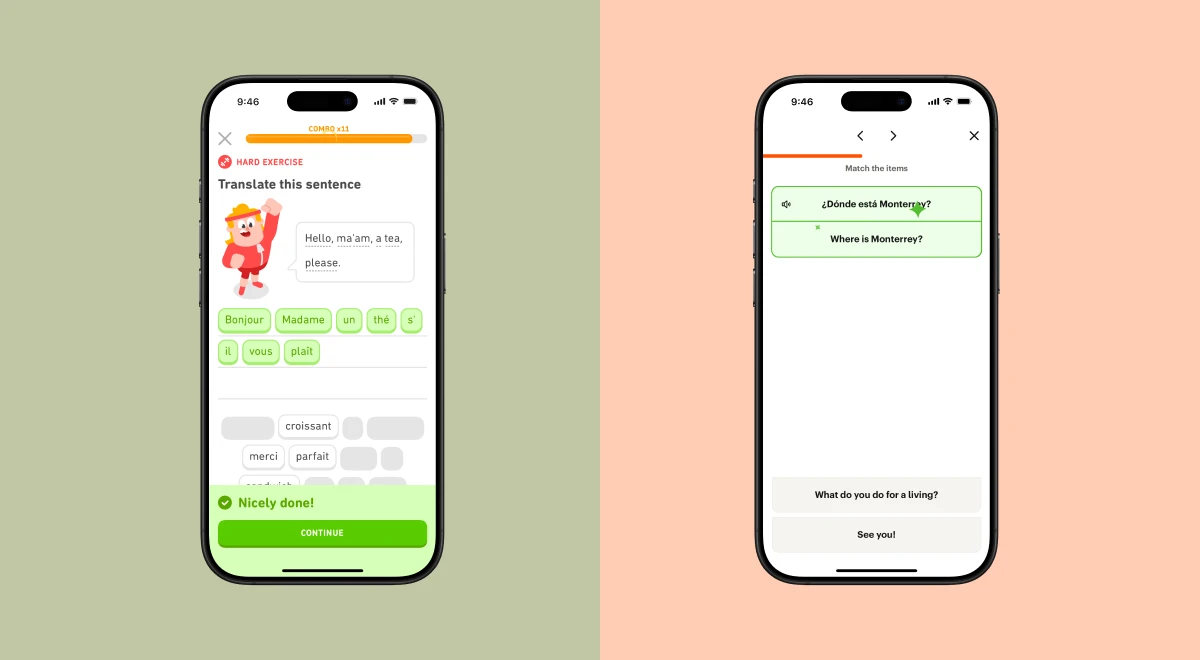
Duolingo tracks the words you struggle with and mixes them into new lessons. Babbel has a dedicated review manager that tests your memory using flashcards and speech recognition.
Spaced repetition is a proven way to move new information into your long-term memory. It's a big part of why mobile apps work so well for studying.
📘Short on time? Get key insights in minutes with Headway.
Duolingo vs Babbel: Social learning and community features
Feeling connected to others can change how you study.
Duolingo has a strong social element. You can follow friends, join clubs, and compete on leaderboards. For many users, this friendly competition is what pushes them to practice on days when they feel lazy.
Babbel lacks these community features. The experience is very solitary. You focus purely on your own progress without comparing yourself to anyone else.
The need for community support
Some people need peer interactions to stay on track. If you learn best by talking to others, Babbel's solitary design might start to feel lonely.
But that doesn't have to be a dealbreaker. You can find language exchange groups online to supplement your app study.
You could also consider a hybrid strategy. You can use Duolingo for fun, social competition, and Babbel for your serious grammar study.
Practice language and productivity with Headway's daily tips.
How to use both apps in your learning strategy
You don't have to choose just one app. Using both together can give you a more complete learning experience.
You can use Babbel for structured learning and deep grammar review. Spend 15 minutes there to understand how the language works, then open Duolingo for a quick, 5-minute vocabulary game to keep your streak alive.
Or flip it: use Duolingo to focus on vocabulary expansion, since it introduces many strange and memorable words. Then, switch to Babbel to practice real-life conversations and pronunciation.
This approach leverages each app's strengths. You get the fun gamification and the serious linguistic depth.
Language learning and personal growth goals: Your perfect combo
Learning a new language changes how you see the world. It improves your memory and helps you think more clearly.
It also fits perfectly with other self-improvement goals. When you dedicate time to learning Spanish, you prove to yourself that you can build new habits.
To support your personal growth, you should explore tools like Headway. It acts as a great companion to language study. You can read a book summary on time management to help you better organize your Babbel lessons, or use "deep work" mode.
To boost your focus while studying, you might want to try other helpful learning platforms:
📘 Maximize your learning time — add Headway to your routine!
Time commitment: How much time do you really need to learn a language?
Finding time to study a new language can feel impossible when your day is already packed. You're already busy with work, family, and trying to get enough sleep. So, how much time will these apps take up in your schedule?
With Duolingo, you can practice while waiting in line for coffee. A single lesson takes about three to five minutes. It's built around the idea that anyone can find a spare moment, even on their worst days.
Babbel asks for a little more focused attention. Their lessons usually take around 10 to 15 minutes. You need to sit down, listen closely to native speakers, and read through the specific grammar explanations. It's a slightly bigger daily commitment, but it pays off if you want to understand the mechanics of a language, like Spanish or French.
The best approach is to be realistic about your schedule. If you only have tiny pockets of free time, start with the quick gamified app.
If you can carve out 15 uninterrupted minutes during your morning commute, you're ready for a more traditional learning experience.
📘 Learn how to build better habits while learning French — try Headway!
What's the best pronunciation tool?
Reading and writing are great, but the ultimate goal is actually talking to real people. Few things are more frustrating than knowing all the new words but freezing up when it's time to order food or ask for basic directions.
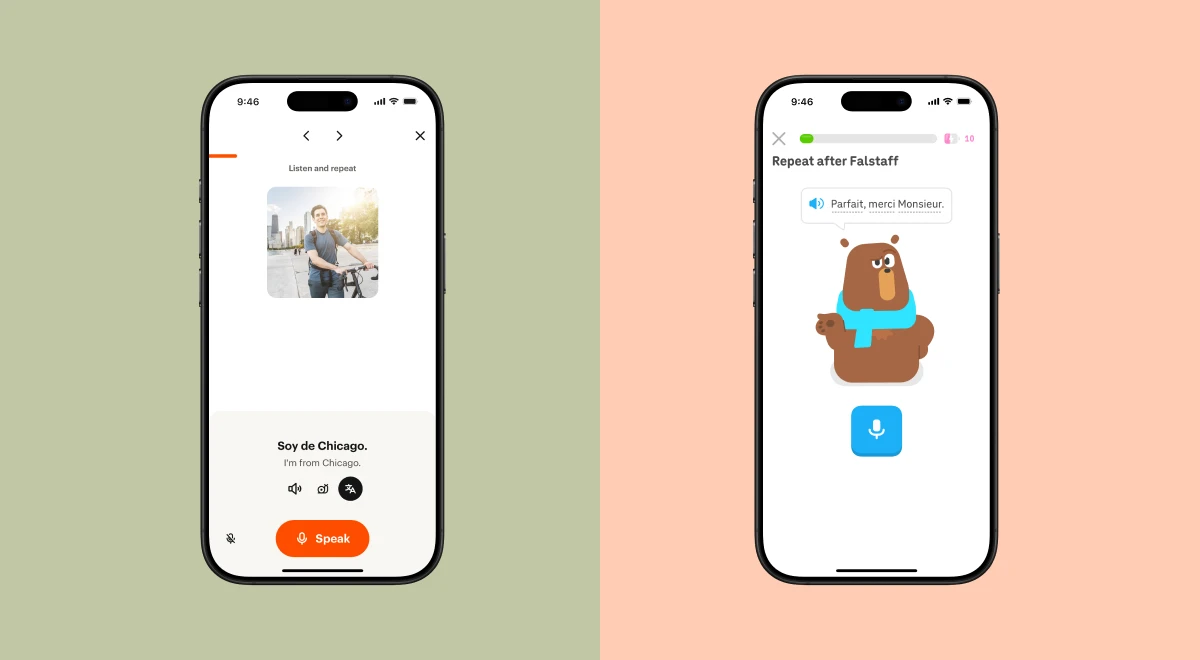
Both platforms offer speech recognition software to help you practice out loud. Duolingo asks you to repeat sentences into your phone's microphone. It's a fun way to get used to making the sounds of a target language, but it's fairly forgiving. It will often pass you even if your accent is a bit off.
Babbel takes speaking much more seriously. Their voice recognition is strict. If you mispronounce a tricky German or Arabic vowel, it'll make you try again until you get it right. Babbel also focuses heavily on practical conversational context, so you practice dialogues that mirror real situations, like checking into a hotel or buying train tickets.
If your main goal is to build the confidence to speak with locals on your next trip, a stricter approach is usually better. It forces you to fix your pronunciation mistakes before you put your language skills to the test in the real world.
📘 Support your language journey with daily insights from Headway!
Offline access: Can you learn on the go and during travel?
So, you're on a long flight to Rome, and you realize you forgot how to say basic phrases in Italian. You pull out your phone to check, but there's no Wi-Fi. That's exactly where offline learning becomes a lifesaver.
If you're using the free version of Duolingo, you need a constant connection to keep playing. Downloading lessons for offline use requires a paid upgrade to Super Duolingo. Even then, offline mode can feel a bit limited if you want to jump ahead to new topics.
Babbel handles offline learning beautifully. Since it's a paid platform from the start, you can easily download entire units to your phone before you leave. That's absolutely perfect for commuters who take the subway or travelers who want to study while in the air.
Having your language courses available offline means you have no reason to skip a day of practice. It turns dead time, like sitting on a train or waiting at an airport gate, into a highly productive and focused study session.
📘 Boost your personal development alongside your Spanish — download Headway!
Who should choose which app?
The right choice depends completely on what you want to achieve.
Duolingo is best for casual learners. If you want a free, flexible way to study on the go, it's perfect. It's also great for people who love daily challenges and bright rewards.
Babbel is best for serious learners. If you prefer a traditional approach to mastering a language, this is for you. Professionals who need to learn quickly for career reasons will appreciate the practical focus.
For maximum efficiency, try using both apps. You can also explore other Duolingo alternatives to see what else is out there. Programs like Rosetta Stone offer different methods that might suit you.
Real learner outcomes:
Looking at what other people have achieved can help guide your decision.
Many user success stories show that Babbel users feel more confident ordering food or asking for directions. The focus on dialogue prepares them for the real world.
Duolingo users often praise the app for helping them build a learning habit. Even if they aren't fluent, they're proud to have maintained a 300-day streak.
How daily reading helps
If you want to accelerate your progress, try combining language study with reading habits. If you read a summary of 'Atomic Habits' on Headway, you learn how to stick to your study routine.
This combination helps you grow in multiple ways at once. You improve your target language and expand your mental horizons.
📘 Languages and life skills equal unstoppable growth. Start with Headway!
Personal learning strategy: Your five-day plan to master a new language
Creating a personal learning plan gives your daily routine a clear structure. This five-day guide combines the strengths of Duolingo, Babbel, and Headway.
Day 1: Set the foundation
Goal: Set realistic goals and dive into basic vocabulary.
Duolingo (15 minutes)
Activity: Complete three beginner lessons in your target language.
Focus: Pay attention to the spelling and sound of new words.
Babbel (15 minutes)
Activity: Take the first introductory lesson.
Focus: Learn the basic greetings and how to introduce yourself.
Headway (15 minutes)
Activity: Read a summary of 'The Power of Habit.'
Focus: Understand how to trigger your new study habit every day.
Day 2: Build early grammar skills
Goal: Start understanding how sentences are put together.
Duolingo (15 minutes)
Activity: Practice the latest unlocked module to reinforce yesterday's words.
Focus: Speed and accurate translation.
Babbel (20 minutes)
Activity: Complete a grammar-focused lesson.
Focus: Read the grammar explanations carefully. Don't rush.
Headway (10 minutes)
Activity: Listen to a short audio summary on the focus.
Focus: Learn how to block out distractions while using your language apps.
Day 3: Speaking and pronunciation
Goal: Get comfortable hearing your own voice in a new language.
Duolingo (10 minutes)
Activity: Do a review session of older material.
Focus: Keep your daily streak going and review weak words.
Babbel (25 minutes)
Activity: Do a dialogue lesson using speech recognition.
Focus: Repeat sentences out loud until the app marks them correct.
Headway (15 minutes)
Activity: Read a summary about building self-confidence.
Focus: Apply these confidence tips to your speaking practice.
Day 4: Real-world application
Goal: Connect your language skills to practical situations.
Duolingo (15 minutes)
Activity: Try a new lesson category, like food or travel.
Focus: Memorize specific nouns you would use in a restaurant.
Babbel (20 minutes)
Activity: Complete a cultural lesson or dialogue about traveling.
Focus: Notice the formal and informal ways native speakers talk.
Headway (10 minutes)
Activity: Review your saved insights from previous days.
Focus: Check if your study routine is actually working for you.
Day 5: Review and adjust
Goal: Look at your progress and plan for the next week.
Duolingo (15 minutes)
Activity: Check your leaderboard ranking and do a hard practice lesson.
Focus: Push yourself to answer quickly under pressure.
Babbel (15 minutes)
Activity: Use the review manager to test everything you learned this week.
Focus: Identify which grammar rules are still confusing.
Headway (15 minutes)
Activity: Start a new book summary on continuous learning.
Focus: Find motivation to keep this routine going next week.
At the end of the day, having a structured plan prevents you from wasting time. You know exactly what to do when you open your phone.
📘 Building a daily habit? Get the science behind it on Headway!
Commit to daily learning with Headway
The Babbel vs Duolingo discussion comes down to what you want to achieve. If you want a fun, free way to build a habit, Duolingo is a great choice. If you want to invest in deep, structured lessons to speak confidently, a Babbel review shows it offers better practical training.
Language study is a big step in self-improvement. It forces you to be patient and consistent. To support this journey, the Headway app gives you bite-sized knowledge from top nonfiction books. You can learn about productivity, psychology, and success while you practice your new language.
Download the Headway app today to access thousands of book summaries and boost your personal development.
FAQs
Is Duolingo better than Babbel?
It depends on your specific goals. Duolingo is better for casual practice and keeping a daily habit through fun games. Babbel provides better structure and clearer grammar rules. If you want to learn great conversational skills for travel or work, Babbel usually offers a stronger learning experience.
Which app is more effective for beginners?
Duolingo is very friendly for total beginners because it feels like a game and removes the fear of making mistakes. Babbel is also excellent for beginners, but it requires more focus. Babbel gives you a solid foundation in rules early on, which helps later.
Can I learn to speak fluently with Duolingo?
Most language experts agree that Duolingo alone won't make you fully fluent. It's great for building vocabulary and basic reading skills. To become fluent, you need real-life conversations with native speakers and a deeper understanding of grammar that the app doesn't fully provide.
How long will it take to become fluent using Babbel?
Fluency takes hundreds of hours of practice. Babbel claims that 15 minutes a day can lead to basic conversational skills in a few months. However, true fluency requires stepping outside the app. You must consume native media and practice speaking with real people regularly.
Is it better to use Duolingo or Babbel for professional use?
Babbel is much better for professional use. The app includes practical dialogues tailored for business and travel. You learn formal greetings and the appropriate cultural context. Duolingo's sentences can sometimes be silly or impractical, which doesn't help in a serious business environment.
Can I use both apps together for maximum learning?
Yes, using both apps is a very smart strategy. You can use Babbel for your main grammar study and deep learning sessions. Then, use Duolingo's fun games to practice vocabulary when you only have five minutes to spare. This fusion keeps your motivation high while ensuring you learn properly.