Self-growth
 Apps & Digital Tools
 Business & Career
 Success
 Growth Tools
 Psychology
 Communication
 Relationships


A 2009 University College London study found that forming a new habit took anywhere from 18 to 254 days, averaging 66 in total. That data directly contradicts the old myth that it takes exactly 21 days to change your life.
Reading an 'Atomic Habits' review by James Clear helps explain why a short burst of motivation rarely works. 'Atomic Habits' is a self-help book that provides a proven framework for behavior change. This review breaks down what the Four Laws actually ask you to do, where the framework holds up, and where it falls short.
Quick summary: What this 'Atomic Habits' by James Clear review covers at a glance
If you want the core takeaways fast, here is the breakdown.
The Four Laws make habits obvious, attractive, easy, and satisfying to repeat.
Breaking a habit means reversing each law: invisible, unattractive, difficult, unsatisfying.
Habit stacking pairs a new habit with one you already do daily.
The two-minute rule shrinks any new habit into a tiny starting action.
The book sold over 30 million copies and spent 164 weeks on the NYT list.
What the book argues
James Clear is considered one of the world's leading experts on habit formation. He teaches that having trouble changing your habits is rarely a personal failing. Instead, bad habits repeat due to the wrong system for change.
You do not rise to the level of your goals; you fall to the level of your systems. Clear argues that to achieve remarkable results, you have to focus on identity-based change rather than chasing a specific outcome. Real success comes from the compound interest of small, repeatable habits that shape who you are on any given day.
The four laws of behavior change, side by side
The book breaks down the psychology of a habit into four steps: cue, craving, response, and reward. Making good habits easy and bad habits hard is effective because it aligns with how the human brain actually works.
| The Law | How to build a good habit | How to break a bad habit |
|---|---|---|
1st Law (Cue) | Make it obvious | Make it invisible |
2nd Law (Craving) | Make it attractive | Make it unattractive |
3rd Law (Response) | Make it easy | Make it difficult |
4th Law (Reward) | Make it satisfying | Make it unsatisfying |
To build good habits, you follow the Four Laws. To break bad ones, you simply invert the Four Laws.

Habit stacking in practice
One of the most practical steps in the book is called habit stacking. Habit Stacking links a new habit to an existing one using the formula: After [CURRENT HABIT], I will [NEW HABIT].
You take an action you already do without thinking and use it as the trigger for a new behavior. For example, I wanted to drink a glass of water every morning, but I kept forgetting. I looked at an existing morning routine and picked a trigger.
The formula became: "After I turn on the coffee maker, I will drink one glass of water." The physical environment acted as the cue. Standing in front of the coffee maker made the new action stick within a few days because the reminder was automatic.
📘 Stop struggling to build a better routine. Find out exactly how top performers organize their days by downloading Headway today.
The two-minute rule as a starting ritual
The two-minute rule helps establish new habits gradually. Clear states that when you start a new habit, it should take less than two minutes to complete. The goal is to master the art of showing up.
If you want to read more books, your two-minute rule is to read one single page. If you want to run three miles, your two-minute rule is to tie your running shoes. Shrinking a massive task down to the first step eliminates the usual excuses for not starting and creates a ritual that you can actually sustain.
Why identity change outlasts willpower
A core philosophy in 'Atomic Habits' is that true behavior change is identity change. If you rely on willpower alone, you will eventually burn out. When you decide to build a new identity, you shift from saying "I am trying to quit smoking" to saying "I am not a smoker."
Every time you perform a small habit, you cast a vote for the type of person you wish to become. This is the secret to building discipline that holds under pressure.



Why did this book become a publishing phenomenon?
'Atomic Habits' was published on October 16, 2018. It quickly became a massive cultural force. The book topped the New York Times bestseller list for 164 weeks. Since its release, 'Atomic Habits' has sold over 30 million copies worldwide.
It resonated with readers in business, sports, and daily life because it offered a mechanical, proven system instead of abstract motivation and vague advice.
The Clear Habit Journal and the Atoms app
Clear built specific tools to help readers operationalize these rules. The Clear Habit Journal aids in developing good habits by providing a physical space to track your progress and reflect on your daily routine.
For people who prefer a digital system, the smartphone app 'Atoms' helps with habit formation by sending reminders and logging the small steps you take each day.
What works and what doesn't
The framework provides concrete, repeatable mechanics. You can read a chapter and immediately change your physical environment to make a bad habit difficult. The advice on removing friction to make a good habit easy is universally helpful.
However, the book has blind spots. The neuroscience is fairly thin. Clear addresses the basic loop of cue, craving, response, and reward, but he largely ignores the deeper emotional reasons people hold onto destructive patterns.
If a habit is tied to deep trauma, profound anxiety, or clinical addiction, rearranging your environment will not fix the root issue.
Is this book built for you?
This book delivers exactly what it promises for specific types of readers.
People who want a mechanical, step-by-step system to follow.
Professionals trying to optimize their daily workflow and business output.
Parents who want to teach their kids a simple way to build better routines.
Anyone who has read other practical self-improvement reads, like 'Deep Work' or 'Eat That Frog!' and wants actionable tactics.
It is less helpful for people already fluent in advanced behavioral psychology or those looking for deep emotional healing.
Should you read the whole book or start with the highlights on Headway?
'Atomic Habits' remains one of the best books on personal growth because the core idea works. Small habits compound over time. If you want to see if this system fits your specific goals before buying a 300-page hardcover.
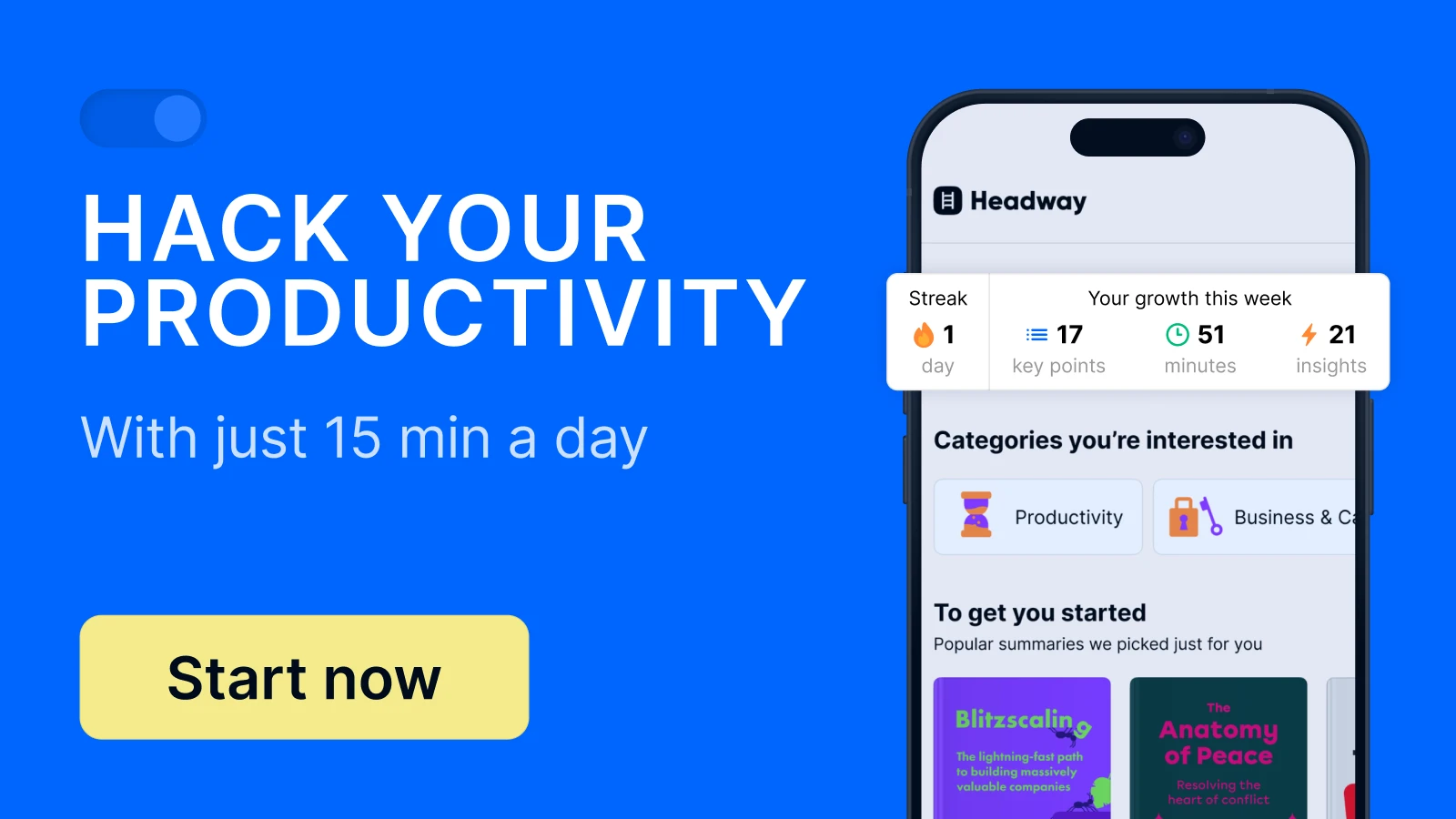 Headway offers a comprehensive 15-minute summary. You can test the Four Laws in your own life today and then explore stories built around personal transformation when you are ready for a new challenge.
📘 Turn reading into your strongest daily habit. Try Headway to access 15-minute text and audio summaries of the world's smartest nonfiction.
FAQs about Atomic Habits by James Clear
What is the core message of 'Atomic Habits'?
The core message is that massive success does not require massive action. Instead, tiny, everyday changes compound over time to create remarkable results. By focusing entirely on building better systems and changing your identity, you naturally overcome the trouble of relying on motivation.
How do you break a bad habit using James Clear's rules?
To break bad habits, invert the Four Laws: make it invisible, unattractive, difficult, and unsatisfying. If you want to stop eating junk food, you remove it from your kitchen (invisible), associate it with feeling sluggish (unattractive), leave your wallet at home so you cannot buy it easily (difficult), and track how bad you feel afterward (unsatisfying).
What is habit stacking and how does it work?
Habit stacking is a strategy where you tie a brand new behavior to an action you already do every single day without fail. By using the simple formula "After [CURRENT HABIT], I will [NEW HABIT]," your brain uses an established routine as the direct cue to trigger the new task.
Does the two-minute rule actually help build good habits?
Yes. The two-minute rule forces you to scale down a daunting goal into a simple, two-minute action. This prevents procrastination. Once you master the art of just showing up and starting the task, you naturally build the momentum required to keep going.
How to destroy procrastination in 5 minutes?
To get rid of procrastination in 5 minutes, break the task into small steps and start with the easiest one. Set a timer for 5 minutes and work only for that time. Often, it is the beginning that moves the block, and after five minutes, it is easy to continue working.