Self-growth
 Apps & Digital Tools
 Business & Career
 Success
 Growth Tools
 Psychology
 Communication
 Relationships

What is critical reading? It's the skill you're missing when an article sounds convincing, and only afterward do you realize you never asked who wrote it or why.
A Stanford study found that 96% of high schoolers didn't consider whether a climate change website's ties to the fossil fuel industry might affect its credibility. Reading the words on a page is not the same as reading them with judgment.
Critical reading is the active process of questioning, analyzing, and weighing a text instead of simply absorbing it. It means checking the evidence, spotting bias, and noticing what an author leaves out.
Writers like Rolf Dobelli and Hans Rosling built entire careers on mapping the blind spots that make weak arguments feel solid.
📘 If you want a quick way to test some of these ideas, try book summaries on Headway!
Quick answer: What is critical reading?
Here's the fast answer on what critical reading is and how it works:
Critical reading means analyzing and questioning a text instead of simply absorbing it.
It asks who wrote a text, why, and if the evidence holds up.
Critical reading is a process: preview, question, analyze, and evaluate.
Critical reading skills include spotting bias, the author's purpose, and underlying assumptions.
It turns reading into thinking, and stronger writing follows from there.
Keep reading for the full breakdown, plus a simple process you can use on any text.
Go deeper into the ideas that fascinate you.
Explore thousands of book insights across any topic. A library built for lifelong learners.
Start exploringWhat is critical reading? A plain, full definition
Critical reading is the active practice of analyzing, questioning, and evaluating a text rather than simply absorbing it. That's the plain critical reading definition: you look past what a text says and check what it does and what it means, too.
A surface reader treats an article as a fact. A critical reader treats it as a claim that needs testing. This is the critical reading meaning most people miss: it's a process, not a single trick you use once and forget.
You can practice how to read critically on a news article, a research paper, or a text from a friend, and the same questions apply every time. Critical reading is a process you build with repetition, not a switch you flip once and never think about again.
Critical reading vs reading comprehension: What's the difference
Reading comprehension means understanding what a text says. You can summarize the plot, list the main points, and pass a quiz on the details without questioning a single one of them.
Critical reading takes it a step past that. You ask if those points are accurate, fair, and complete, and you start to think critically about the evidence behind them instead of just the words on the page.
Comprehension is the ground floor. Critical thinking, the skill of reasoning through claims and evidence, is what you build on top of it.
If you strengthen your reading comprehension first, critical reading gets easier, since you're not stuck decoding sentences while also trying to judge them.
📘 Build stronger reading comprehension with book summaries on Headway!
Critical reading is a process: How to read critically
Here's how to read critically, step by step.
Preview the text and note the author's purpose and intended audience.
Ask guiding questions such as what the claim is and what backs it up.
Separate what a text says from what it only implies.
Check for bias, unstated assumptions, and gaps in the author's methodology.
Summarize the argument in your own words, then weigh it against likely counter-arguments.
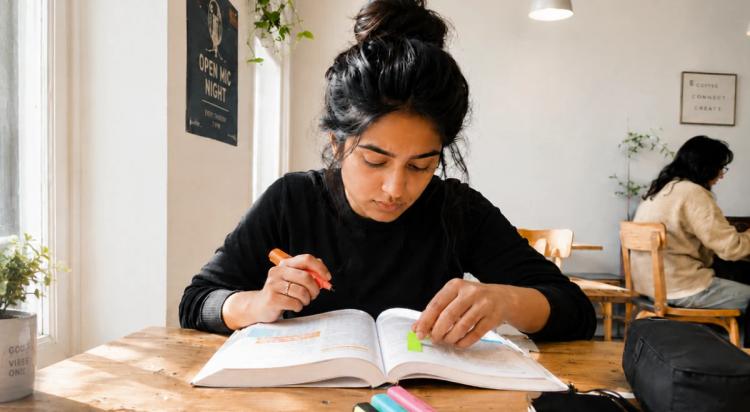
It helps to annotate while you read: underline a claim, or jot a question in the margin. That keeps the process visible instead of something that only happens in your head.
Once you've read through, try summarizing the argument in one or two sentences. If you can't state what the author is claiming, you probably haven't finished the critical reading process yet.
Critical reading questions to ask at each stage
Some questions work better at certain points in the process. Use this table as a quick check for what a text does at each stage, and how to catch bias, an author's intention, and implicit messages you might miss on a first pass.
Stage | What to look at | Question to ask |
Before reading | Source and author | Who wrote this, and why? |
Before reading | Purpose | Is this meant to inform, persuade, or sell? |
While reading | Claims and evidence | What's the claim, and what backs it up? |
While reading | Bias and assumptions | What is the author taking for granted? |
While reading | What the text does | Is it arguing, describing, or implying? |
After reading | Counter-arguments | What would a smart critic say back? |
After reading | Your view | Do I agree, and on what grounds? |
The after-reading questions matter most. That's where you weigh the supporting points against what a sharp critic might say back, and decide what you actually believe and why.
📘 Try a 15-minute summary and put these questions to work with Headway!
Critical reading in academic reading and writing
Critical reading matters most in academic writing and research, where one weak assumption can undo an entire argument.
When you read a study, look hard at the methodology section: how big was the sample, what did the researchers measure, and does the data actually support the conclusion drawn from it?
Good academic reading also draws on prior knowledge. If you already know something about the topic or the text structure researchers tend to follow, you'll spot gaps faster than someone reading cold.
Active, questioning reading beats passive review every time you're studying for an exam or writing a paper of your own. Skimming for keywords gets you through the material once. Critical reading gets you through it in a way you can defend later, in a seminar or in your own paper.
From critical reading to critical writing
This is critical reading towards critical writing in action. Once you've built the habit of questioning as you read, you start collecting the raw material, evidence, counter-arguments, and gaps in other people's logic that stronger writing needs.
Synthesis is a big part of this: pulling ideas from several sources and noticing where they agree, disagree, or leave something out. This is also where reading between the lines pays off, since the implicit messages in a text (what an author assumes you'll accept without proof) often matter as much as what's stated outright.
A simple way to frame it: read to question, then write to argue. Every claim you make in your own writing should survive the same scrutiny you'd apply to someone else's.



Five practical tips from book summaries
If you want to know how to improve critical reading skills without carving out extra hours, these five critical reading strategies are a good place to start.
Headway breaks down insights from nonfiction writers into quick formats, so you can try one technique this week and decide later if a full book is worth the extra hours.
1) Learn the biases that hijack your judgment
Based on 'The Art of Thinking Clearly' by Rolf Dobelli.
Tip: Dobelli catalogs the thinking errors that make weak arguments feel convincing. Naming a bias is the first step to catching it in a text.
Exercise: Pick one bias, say confirmation bias, and reread an article you agreed with to see where it flattered your existing view.
2) Question the numbers as closely as the words
Based on 'Factfulness' by Hans Rosling.
Tip: Rosling shows how easily statistics mislead once you strip away context. Critical reading means asking what a figure leaves out.
Exercise: Find one statistic in an article and write down what's missing: the baseline, the timeframe, or the comparison group.
3) Weigh evidence and update your view
Based on 'Superforecasting' by Philip E. Tetlock and Dan Gardner.
Tip: Tetlock's best forecasters treat their beliefs as provisional and revise them as evidence shifts, the same habit that sharp readers rely on.
Exercise: After reading an argument, note one thing that would change your mind. If nothing could, you're probably not reading critically.
4) Notice how a text is framed to steer you
Based on 'Predictably Irrational' by Dan Ariely.
Tip: Ariely shows how framing and anchoring quietly shape decisions, and writers lean on the same tricks, so watch how a point gets presented.
Exercise: Spot one place where an article frames a choice (free, limited, best) and rewrite it in neutral terms to see the actual claim underneath.
5) Read widely so you can spot what's missing
Based on 'Range' by David Epstein.
Tip: Epstein argues that broad knowledge helps you catch blind spots that specialists miss. Prior knowledge from other fields makes you a sharper reader.
Exercise: Before you trust a claim, connect it to something you know from an unrelated field and check if it still holds up.
Make critical reading a habit with Headway!
Critical reading is a skill you can practice on anything you read: a work email, a product review, a chapter of a book. The process stays the same every time: preview, question, analyze, and evaluate before you accept a claim as true.
Reading a lot of different things is one of the best ways to build that kind of judgment, and Headway makes it easy to stick with it. Summaries only take about 15 minutes to read or listen to. That means you can test drive a book's ideas before deciding if you want to read the whole thing.
Plus, personalized recommendations point you to topics you actually care about, and tracking your daily streaks helps keep the habit alive without stressing you out. Making active reading a normal part of your routine doesn't require hours of free time - you just have to be consistent.
📘 Try Headway today and turn 15 minutes into a sharper, more questioning way to read!
FAQs about what is critical reading
What is critical reading in simple terms?
Critical reading is understanding the author's real intent and intentions while analyzing what they are trying to get across through the text. Critical reading is about investigating various aspects of the text, like the author's background, objectives, and whether the arguments presented in the text are backed by facts.
What is the difference between critical reading and critical thinking?
Critical thinking is the broader mental skill of reasoning through ideas and evidence in any situation, from an argument at work to a news headline. Critical reading applies that same skill to a written text specifically. You use critical thinking every time you question a source, a statistic, or an author's argument on the page.
What are the main critical reading skills?
The skills of critical reading include the ability to identify biases, understand why the author has written the text, question evidence, and recognize hidden assumptions. A skilled critical reader can summarize the content and present it in their own words as well as compare it with opposing viewpoints.
What are the steps in the critical reading process?
The process of critical reading consists of three steps. First, it is necessary to research the text's source and the author's purpose. Second, while reading, it is important to monitor key claims presented in the text, analyze evidence, and highlight possible biases. The final phase is analyzing counterarguments and understanding one's point of view based on the gathered evidence.
How is critical reading different from reading comprehension?
Reading comprehension refers to serving the purposes of a reading task by understanding what is written: identifying the principal ideas, the storyline, and the main facts. Critical reading takes that conceptualization a step further by questioning whether those ideas are correct, objective, and properly argued. Comprehension forms the basis, while critical reading creates an evaluation of what has been understood.
Why is critical reading important?
Critical reading is important because a lot of the written material aims not solely to convey information but also to influence or deceive its readers. If one does not apply critical reading when evaluating written texts, the effect may be an acceptance of weak arguments, questionable statistics, and bias. Critical reading enables one to tell strong arguments from those that sound solid only on the surface.
How can I improve my critical reading skills?
You can develop your critical reading skills by practicing every piece of reading material. You should preview the material, speculate what the author wants the audience to believe, and check the evidence before agreeing to any statement made. Frequent short attempts are better than one long practice, and reading various texts will enable you to see more patterns.