Self-growth
 Apps & Digital Tools
 Business & Career
 Success
 Growth Tools
 Psychology
 Communication
 Relationships

How many meditation apps have you downloaded, opened twice, and quietly forgotten?
If you've cycled through a few and still feel like something's missing, you're not the only one. Most meditation apps promise calm and a streak. The Waking Up app, created by Sam Harris, promises something bigger: not just a quieter mind, but a real shift in how you understand your own experience.
This Waking Up app review will put that ambition under the microscope — what you actually get, what it costs, and who it's built for.
I've spent years reviewing growth tools of every kind, so I'll keep this honest. Waking Up is one of the more distinctive meditation apps out there, and for the right person, it's excellent. It also asks more of you than a typical mindfulness app does. By the end, you'll know whether it fits the way you want to practice — and where a bite-sized learning habit might sit alongside it.
📘 Prefer building a daily habit through short, practical lessons instead? See what Headway lines up for you.
All app features described in this article are accurate as of September 2026.

Quick answer: Is Sam Harris's meditation app worth it?
Waking Up is a secular meditation app for people who want more than stress relief. It pairs guided meditation with lessons and conversations about the mind, drawing on neuroscience, philosophy, and psychology. Here's the short version before the full breakdown:
Best for: curious meditators who want theory alongside practice, and anyone drawn to consciousness, awareness, and the harder questions about the self.
What you get: a 30-day Introductory Course with Sam Harris, a Daily Meditation, a meditation timer, and 600+ hours of audio across topics and traditions.
Teachers: Sam Harris plus 100+ others, including Joseph Goldstein and Adyashanti.
Price: $129.99/year or $19.99/month, with a 7-day free trial and a money-back guarantee.
Free option: a full scholarship for anyone who can't afford it — no questions asked.
The catch: it leans philosophical and asks for real commitment, so it's a lot if you just want to wind down before bed.
Want a lighter daily habit that still makes you sharper? Build your Headway plan in a couple of minutes.
What is the Waking Up app?
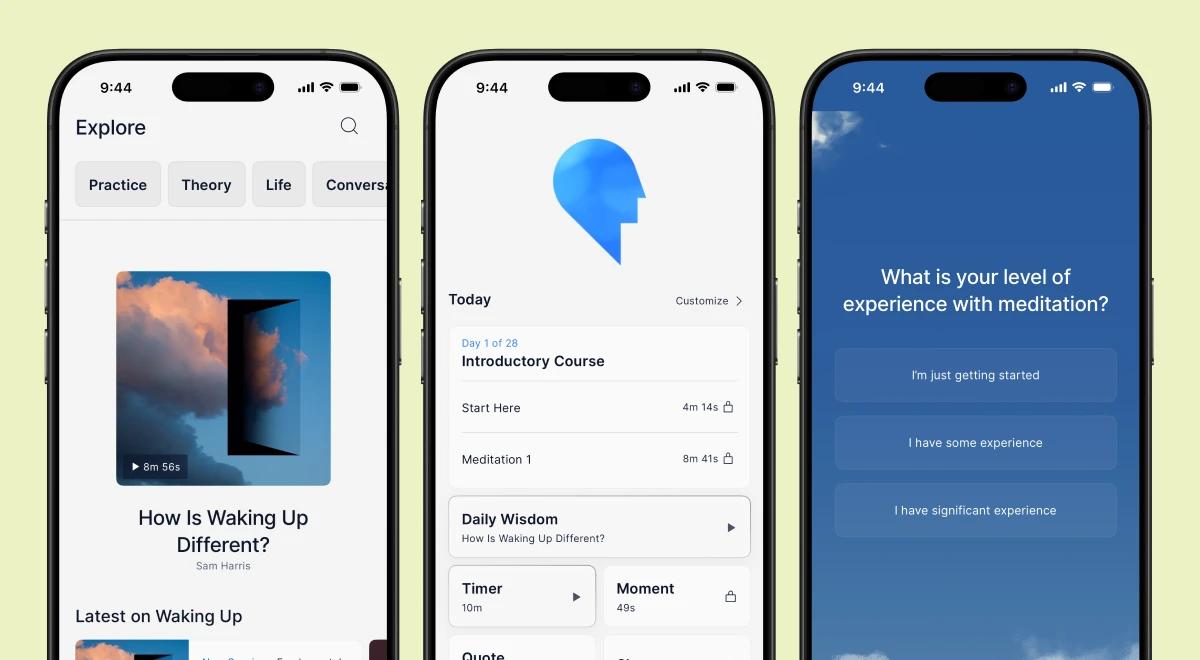
Often shorthanded as the Sam Harris meditation app, Waking Up is a meditation and mindfulness platform he launched in 2018. On the surface, it looks like other meditation apps — you press play, someone guides your attention, you breathe. Underneath, it's about something different. Waking Up's own tagline calls it "your last meditation app," and the pitch is that most apps stop at helping you feel calm, while this one wants to change how you relate to your mind.
That shows up in how the app frames meditation itself. In its words, meditation is "a way of training attention" — noticing thoughts as they arise and pass, and giving yourself space to observe them without getting pulled into judgment or reaction.
In practice, that means learning to turn your attention to the breath, notice sensations in the body, and watch emotions come and go, becoming more mindful of what your mind is doing moment to moment. From there, the app builds toward bigger ideas about consciousness, awareness, and the nature of the self, which is where the "waking up" in the name comes from.
It's also explicitly secular. According to the app's FAQ, you don't need to believe anything to use it — no ideology or spiritual commitments, just a willingness to examine your own experience. Waking Up says it has gathered over 600 hours of audio and describes itself as offering the largest collection of nondual teachings of any mindfulness app. Whether that depth appeals to you or feels like a lot depends entirely on what you want from a meditation practice.
What's inside the app: 30-day introductory course, guided meditation, and theory
Most people start with the Introductory Course, which Waking Up frames as a 30-day introductory course led by Sam Harris. It's a day-by-day sequence of guided meditations paired with short talks, designed to give you a foundation whether or not you have any prior meditation experience.
If your first meditation ever happens here, the course holds your hand; if you're one of the more experienced meditators, you can move faster or skip ahead.
Once you're past the basics, the daily rhythm centers on the Daily Meditation — a fresh guided session from Sam Harris each day — plus a rotating Daily Wisdom talk and a short Moment to reset during a busy afternoon. There's also a plain meditation timer for unguided sitting, a Quote of the day, and dedicated Sleep content for winding down at night. You can save sessions into playlists and download them, which makes the app easy to use offline.
The content splits into three lanes the app labels Practice, Theory, and Life. Practice is the guided meditation itself — the daily guided meditation, plus sessions like a loving-kindness practice, a form of meditation aimed at cultivating compassion.
Theory is where the short lessons live — talks that explain what you're doing and why, pulling from a mix of traditions and modern science. Life is about applying all of it: conversations on relationships, work, and the messier parts of being human — how mindfulness holds up during a hard conversation, for example.
You can also browse by Topics and Traditions. Topics group sessions around real situations — mindfulness and meditation, anxiety and stress, life transitions, sleep, and even psychedelics. Traditions let you go deeper into a school of thought: Vipassana (insight meditation), Zen, Stoicism, modern psychology and neuroscience, and arts and literature.
It's genuinely well curated, and it rewards curiosity — you can wander from a breathing exercise into a talk on the Buddhist tradition or a Stoic reflection without ever leaving the app.
The teachers behind Waking Up
A big part of the app's appeal is who's talking. Waking Up says you can hear from 100+ interdisciplinary teachers, so while Sam Harris is the anchor, he's far from the only voice. You'll find insight-meditation teacher Joseph Goldstein — who helped bring insight meditation to the West alongside teachers like Jack Kornfield — plus Zen-rooted teacher Adyashanti, poet and teacher Henry Shukman, and mindfulness teacher Diana Winston, among many other teachers.
The range is part of the point — different teachers, different traditions, one app.
That variety matters because meditation teachers aren't interchangeable. The person guiding a loving-kindness session brings a different texture than someone walking you through a dense talk on awareness. Waking Up leans into that, letting you follow a teacher whose style clicks for you rather than forcing everyone through one voice. Over a regular practice, that range gives you a strong sense of which approach actually fits you.
There's also a community layer most meditation apps skip. Waking Up reports a global community of 50K+ members and 90 in-person groups across 26 countries, plus live Q&As and discussion threads where people compare notes on practice and everyday life. If meditating alone has ever felt isolating, that real-world connection is a genuine differentiator.
Waking Up app review: pros and cons of Sam Harris's meditation app
No app is perfect, and a fair Waking Up app review has to name the trade-offs. Here's the honest balance.
What works well:
Depth you won't find elsewhere. The theory and conversations turn a meditation habit into a real education about your own mind.
A clear point of view. Waking Up isn't trying to be everything to everyone, and that focus makes the content feel intentional and well curated.
Strong teachers and traditions. From Vipassana to Stoicism, the range gives your practice somewhere to grow.
A generous free path. The scholarship means money is never the reason you can't practice.
Community. In-person groups and live Q&As make solo practice feel less solo.
What to weigh before you commit:
There's a learning curve. The philosophical material is rich, but it can feel heavy if you just want to decompress. The app itself says it isn't about quick fixes.
It's pricey. At $129.99 a year, it sits at the higher end of meditation apps.
It's narrow by design. Waking Up does meditation and the mind deeply — but it won't help you pick up practical skills, business ideas, or habits outside that lane.
Commitment required. The Introductory Course rewards showing up daily; dabblers may not get their money's worth.
📘 If that last point hits home — you want daily progress without a steep learning curve — take Headway's two-minute quiz and see the plan it builds.

Waking Up pricing: How much does it cost?
The Waking Up team keeps pricing simple. There are two paid plans, and both open with a 7-day free trial:
Annual: $129.99 per year (billed once, then renews yearly).
Monthly: $19.99 per month.
Every subscription is backed by a money-back guarantee, so if it's not for you, you can request a refund. Cancellation is straightforward through your account settings, and your access runs to the end of the billing period.
The part I genuinely respect: Waking Up is free for anyone who can't afford it. Its scholarship gives full access to the app at no cost, no questions asked — a rare, values-driven move in the meditation apps space. If cost is your only hesitation, that removes it entirely.
Prices are shown as of September 2026 for US users; prices and discounts vary by region and promotion.
Who is the Waking Up app for?
Sam Harris Waking Up is a strong fit if any of these sound like you:
You already have a meditation practice and want theory and depth, not just another meditation timer.
You're drawn to the big questions — consciousness, awareness, the nature of the self — and want a spiritual practice that stays secular.
You like learning from many teachers across the Buddhist tradition, Stoicism, and modern psychology.
You want structure, and a 30-day introductory course led by a single clear voice sounds appealing.
It's probably not your app if you want quick, no-friction stress relief before bed, if you're brand new and easily overwhelmed by heavier ideas, or if daily meditation isn't actually the habit you're trying to build.
Plenty of people love the idea of meditating every day but really want something else — a way to keep learning and growing that fits into a busy life. If that's you, it's worth looking at a different kind of daily practice. And if you're auditing your subscriptions in general, our takes on whether Audible is worth it and the Reflectly journaling app can help you decide what earns a spot on your phone.
Waking Up vs Headway: Your first meditation can be different
One point is worth stating plainly: Waking Up and Headway aren't really competitors — they do different jobs. Waking Up trains your attention and deepens your relationship with your own mind. Headway hands you the key ideas from the world's best books in about 15 minutes, so you keep learning and growing without carving out hours to read. One sharpens how you pay attention; the other feeds you what to think about. Many people happily use both.
Still, if you're deciding where your next subscription dollar goes, a side-by-side helps.
This comparison reflects publicly available information as of September 2026. Prices and features may vary by region, promotion, and season.



Where Headway fits into the picture
So where does Headway come in? The vast majority of us download apps with big intentions and then struggle to spend time on them daily. If the real goal underneath "I want to meditate every day" is "I want to keep growing and feel sharper," a book-summary habit can scratch that itch in a way a meditation app — or most other apps — can't.
Headway distills bestselling nonfiction — think 'Atomic Habits' by James Clear or 'Sapiens' by Yuval Noah Harari — into roughly 15-minute reads or listens, so big ideas fit into the gaps in your day.
That audio piece matters more than it sounds. Headway has an audio mode, and a lot of people treat it the way they'd treat a podcast — pressing play on a summary while lifting at the gym, walking the dog, or heading out for a run.
You get the same "I used my time well" feeling a good meditation session gives you, just pointed at ideas instead of your breath. One Headway user, a developer and triathlete raising three kids, wrote about exactly this in how I fit learning into my life — proof that a growth habit can survive a genuinely packed schedule.
The habit side is where Headway does its quiet work. It starts with a short quiz about your goals, then builds a personalized plan and keeps you moving with daily recommendations, progress streaks, flashcards, and recaps that help ideas actually stick — and helps you discover books you'd never have gone looking for.
Readers describe the shift in their own words: one went from reactive manager to strategic leader on 20 minutes a day, another used it to transform a leadership coaching practice, and a third simply replaced scrolling with daily learning. If consistency is your struggle, the two-months-in check-in is an honest read on what changes.
None of this replaces sitting in silence. If a deep meditation practice is what you're after, Waking Up does that beautifully. But if you've been using "meditate more" as a stand-in for "grow more," Headway may be the tool you were actually reaching for — and it plays nicely next to a mindfulness habit rather than competing with it.
For a sense of how it stacks up against other summary apps, see Headway vs Blinkist, whether Blinkist is worth it, our Imprint app review, and the Knowt review if study and retention are your thing. Learning a language instead? The LingQ and Pimsleur reviews cover that daily practice too.
📘 Answer a few quick questions and get a Headway plan shaped around your goals.
Set the meditation timer aside and make your next 15 minutes count with Headway
Meditation will always have its place — and if this Waking Up app review helped you find the practice that speaks to you, that's a great outcome. But growth isn't only about stillness. It's also about steadily feeding your mind ideas worth having, in the small pockets of time you already have. That's where Headway shines: it turns a commute, a workout, or a coffee break into real, compounding progress.
📘 Start with a quick quiz and see your first summaries.
Frequently asked questions about the Waking Up app review
Is the Waking Up app worth it?
For the right person, yes. If you want a meditation practice with genuine depth — theory, conversations, and teachers across several traditions — the Waking Up app offers more than most mindfulness apps. Expect a learning curve, though: it rewards daily commitment over quick fixes. It's less worth it if you only want fast stress relief. The free scholarship lets you test it at zero risk.
How much does the Waking Up app cost?
The Waking Up app costs $129.99 per year or $19.99 per month, and both plans start with a 7-day free trial. Every subscription includes a money-back guarantee, so you can request a refund if it isn't a fit. Prices are current as of September 2026 for US users and can vary by region and promotion.
Is the Waking Up app available on Android?
Yes. The Waking Up app is available on both the App Store and Google Play, so it runs on iPhone and Android. You can also save sessions to your library and download them to practice offline — useful for flights, commutes, or anywhere without a signal. That flexibility is standard across the better meditation apps, and Waking Up handles it cleanly.
How long are the daily meditation sessions?
They vary. The Daily Meditation is a short, guided session you can fit into a busy morning, while individual meditations and lessons run from a few minutes to longer sits — enough for your first meditation or for experienced meditators who want depth. Short on time? There's a Moment for a quick reset and a meditation timer for silent practice. Most people build a daily meditation habit on roughly 10 to 20 minutes.
Is Waking Up religious or connected to Buddhism?
No. Waking Up takes a secular approach — its FAQ states you don't need to adopt any beliefs, ideology, or spiritual commitments to use it. It does draw on the Buddhist tradition, Stoicism, and modern psychology for its lessons, and you'll find practices like loving-kindness and insight meditation guided by teachers such as Joseph Goldstein. But the framing stays practical: examine your own experience, no faith required.
Does meditation actually have health benefits?
Meditation isn't a cure-all, but the evidence is real. A 2014 JAMA Internal Medicine meta-analysis of 47 randomized trials found mindfulness meditation programs eased anxiety and depression, with effects comparable to an antidepressant in primary care (Goyal et al.).
Waking Up pairs guided meditation with lessons that modern psychology keeps refining, so real health benefits and well-being can show up in everyday life. Still, treat it as support, not a replacement for professional care.
Waking Up vs Headway: Which should I choose?
They solve different problems. Waking Up is for building a meditation and mindfulness practice; Headway is for learning the key ideas from top nonfiction books in about 15 minutes a day. If your aim is a calmer, more aware mind, choose Waking Up. If it's practical growth and a daily learning habit — often via audio at the gym or on a walk — Headway fits better. Plenty of people use both.
How does Waking Up compare to other meditation apps like Headspace?
Most other meditation apps — think Headspace, co-founded by Andy Puddicombe, or Calm — center on relaxation, sleep, and gentle guided meditation. Waking Up covers that ground too, but it pushes further into theory, consciousness, and awareness, with talks and conversations you won't find on mainstream apps. If you want simple calm, the big names deliver. If you want to understand your mind, Waking Up is the more ambitious pick.