Self-growth
 Apps & Digital Tools
 Business & Career
 Success
 Growth Tools
 Psychology
 Communication
 Relationships
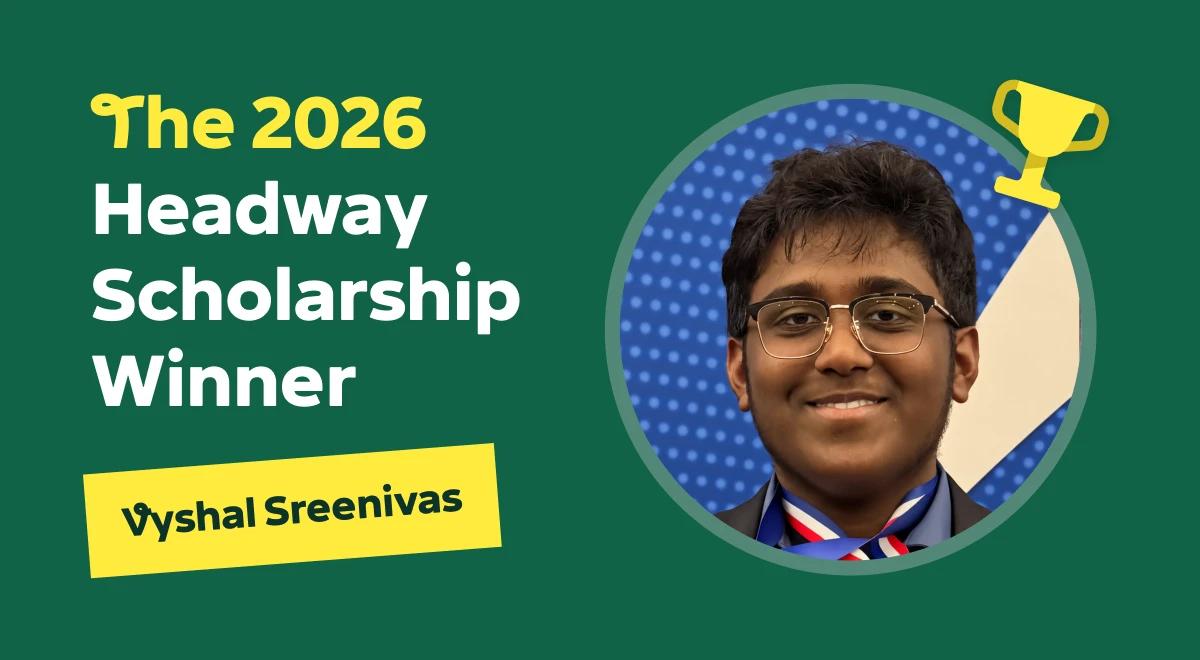

Each year, Headway sets aside a $1,500 scholarship for a student who treats nonfiction as more than assigned reading. Not the read-it-for-fun kind (those count too), but the books that change how you think about your choices, your money, and the work you want to do. This year's Headway scholarship winner did exactly that.
We gave students one prompt: If you could place a single book in every home as a timeless handbook for life, which one would you choose — and why? We wanted to know which ideas this generation thinks the rest of us can't manage without.
The answers weren't safe or predictable. Students reached for books about meaning, history, habits, and money — the quiet stuff that decides how a life really goes. One essay stood out for turning a single book into a case study pulled straight from the writer's own street.
This year's question: The book you would hand the world
Our winner's pick was 'The Psychology of Money' by Morgan Housel, and his case for it started at a dinner table, not a spreadsheet.
In his essay, Vyshal wrote about neighbors who ran a restaurant for 15 years — good food, loyal regulars, a full room most nights. What undid them was buried in the lease: a balloon payment, a single lump sum due years later that nearly took the business down. Nobody in that family lacked intelligence or effort. What they lacked, he argued, was a way of thinking about money that went beyond arithmetic.
That is Housel's whole premise: financial outcomes depend far less on what you know than on how you behave. Across 20 short chapters, he writes about what spreadsheets miss — room for error, rare events that swing everything, the gap between being rich and being wealthy, and the way your personal history quietly sets your tolerance for risk. No finance degree required, which Vyshal says is the entire point.
He has tested that idea in the real world, not just on the page. Over three years, he founded Personal Finance For All, taught more than 600 students, and wrote a personal finance book in Tamil so the material could reach families who would never pick up an English textbook.
His takeaway from teaching: people rarely fail at money because they can't calculate interest — they fail because admitting they don't understand a document feels worse than signing it.
Meet the winner: Vyshal Sreenivas
Behind the essay is a student who has spent years putting its lesson into practice.
Vyshal is an Arizona student headed into finance and technology, and his track record already reads like a founder's. He served as vice president of Sewa and as one of Arizona's Youth Leads for Sankara Nethralaya, organizing fundraising and awareness events. With a group of friends, he built a Dance for Sight event with more than 150 participants and raised $16,000 for cataract surgeries for people in India who couldn't afford them.
He also has a practical streak that shows up in small, telling decisions. As vice president of his DECA chapter, he inherited a fundraiser that wasn't working — members struggled to sell the usual candles — so he swapped it for a Krispy Kreme fundraiser that brought in comparable money and got members excited to sell again. It's a tiny version of the exact thing Housel writes about: fix the behavior and the incentives, not only the math.
Then there's the project that ties it together. Watching his parents sort a week's worth of pills at the kitchen table, Vyshal built the Smart Medicine Dispensing System — an affordable, Bluetooth-enabled medication dispenser paired with an app that automates dosing and flags missed doses.
The engineering taught him something he didn't expect: behind every technical choice sat a business question. Who pays was really about reimbursement. What it should cost was behavioral economics. Why no one had solved it already came down to misaligned incentives, not missing technology.
Vyshal put it this way:
"Morgan Housel taught me that wealth is built by behavior, not brilliance, and the same is true of any goal worth chasing. Read widely, write honestly about what a book changed in you, and then go use it. Winning this scholarship reminded me that the ideas I share with my community are worth sharing, and it will help me take the next step toward studying finance and technology and building tools that make financial literacy accessible to everyone."
Next, he's aiming for the Wharton School at the University of Pennsylvania to study finance and technology, with the goal of building ventures where the two meet — starting with financial access and the systems that fail ordinary people who did everything right. He has already started a business, taught financial literacy to hundreds of students, and turned a kitchen-table idea into a working prototype. What he wants now is the depth to make those instincts last.
That's what this scholarship is really about. For Vyshal, a book earns its keep only when it changes what he does next — the kind of tool you use to build the career and the life you want.
What's next: Keep an eye on next year's Headway scholarship
We'll run the Headway scholarship again, so if you're a US student who cares about books and ideas (or you know one who does), watch this space. We'll share the theme, the requirements, and the deadline when applications open.
And it won't come down to perfect grades or a polished resume. We want to see how a book changed the way you think and where you're taking that next — whether you're connecting finance with technology like Vyshal, or bringing philosophy into design, history into activism, or psychology into business.
If you're between big books and short on time, our 15-minute summaries on Headway are built for busy weeks. Vyshal's essay is a good reminder of why the full books still matter too — sometimes one chapter, read at the right moment, is the thing that saves the restaurant.
Congratulations again, Vyshal. We can't wait to see what you build. And to everyone thinking about applying next time: your essay could be the one we can't stop talking about.