Self-growth
 Apps & Digital Tools
 Business & Career
 Success
 Growth Tools
 Psychology
 Communication
 Relationships

You know the exact spot where your morning falls apart. The alarm goes off, you reach for your phone, and 40 minutes later you're still in bed, half-scrolling, half-panicking, with the whole day already behind schedule. If that sounds familiar, you're the person Routinery was built for.
Routinery is a morning routine app that turns your daily routine into a timed, step-by-step sequence — less "remember to do the thing" and more "the thing is already queued and counting down." It leans hard on behavioral science, and it markets itself as a routine planner and habit tracker rolled into one. The tagline on routinery.app says it plainly:
Move forward smoothly without willpower.
This Routinery review walks through the features, the price, how it holds up as a Routinery habit tracker, why it's such a strong fit for ADHD brains, and the alternatives worth weighing before you commit. And because the whole point of a routine is what you do inside it, we'll also look at where a daily learning habit with Headway fits into the picture — a different job, but a natural companion to any routine app.
📘 Want a growth habit that slots into the routine you're building? Start with Headway.
*All app features described in this article are accurate as of September 2026. Prices may vary depending on your region, current promotions, and seasonal offers.*

Quick answer: Is Routinery routine-building app worth it?
Short version: Routinery is one of the strongest step-by-step routine apps out there, and it's an especially good fit if you struggle with starting tasks, time blindness, or executive dysfunction. The timer-first design does real work for people who freeze at the "just begin" stage. Whether it's worth paying for depends on how much structure you need and whether a timed sequence fits your day or fights it.
Here's the snapshot before we go deep.
| Detail | What to know |
|---|---|
What it is | A routine timer app that runs your daily routine as a timed, ordered sequence |
Best for | ADHD brains, task-initiation struggles, and anyone rebuilding a morning routine |
Standout feature | Per-step timers plus habit stacking in a fixed order |
Platforms | iOS and Android, with Apple Watch support (per routinery.app) |
Free option | Free to download; a 30-day free-access guest pass is advertised |
Lifetime option | Advertised at $71.99 (marked down from $143.99) at the time of writing |
Recognition | Apple App of the Day, plus 2026 "Support To ADHD" and "Best Self Care App" badges; 5 million+ users across 200+ countries (per Routinery) |
📘 Prefer to build the growth part of your routine right now? Get your Headway plan.
What is the Routinery app and how does it work?
Routinery treats a routine like a recipe: a set of small steps, in order, each with its own timer. You build a routine — say, a morning routine — then tap play, and the app walks you through it one step at a time. Make the bed for one minute. Stretching. Jogging. Shower. Get dressed. A little self-care routine like skincare. Breakfast. Each step counts down, then hands you off to the next, so you never have to stop and decide what comes next.
That design borrows directly from habit science. On its "Why Routinery is different" page, the app frames its whole approach around three ideas: your environment drives your actions, habit strength grows with practice, and you don't have to be perfect — you just have to be consistent.
If you've read 'Atomic Habits' by James Clear, that first idea will sound familiar; it's environment design and habit stacking dressed up as a mobile app.
Routinery features worth knowing
Beyond the core routine planner, Routinery bundles a small ecosystem of focus and wellbeing tools. Let's take a closer look at each of them.
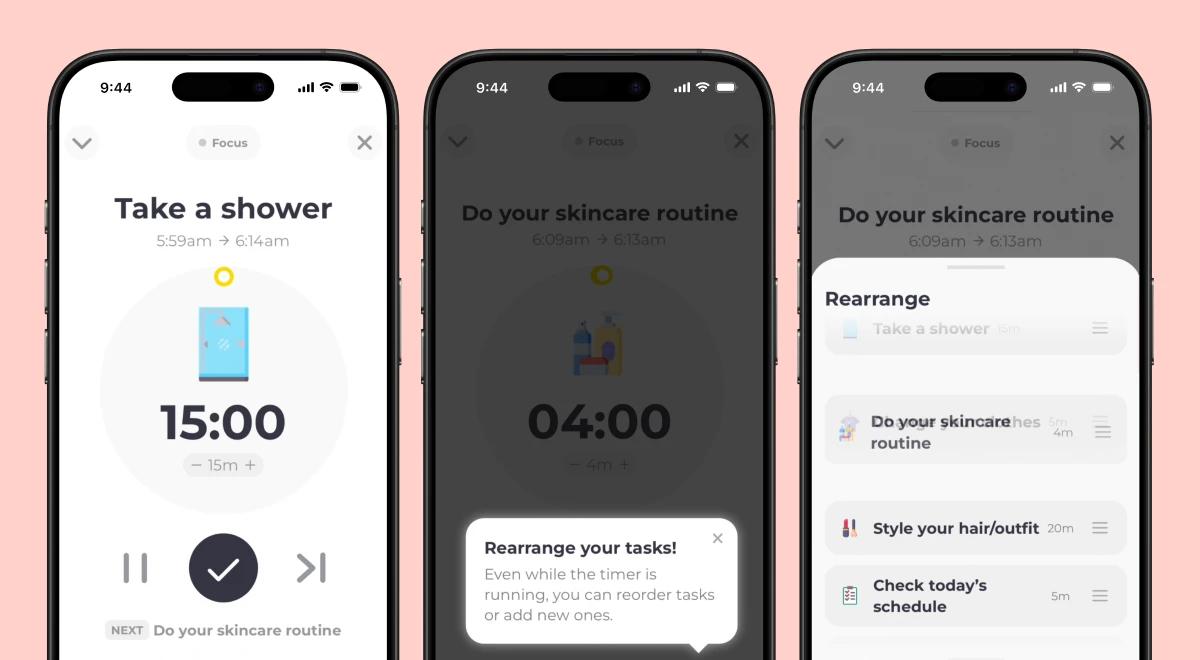
The routine timer and step-by-step flow
This is the heart of the app and its best argument. Turning a vague intention ("have a better morning") into a concrete, timed, step-by-step routine removes the friction that stops most people from starting. If you're the type who knows what to do but can't get moving, the countdown is a quiet, effective push.
The trade-off: a timed sequence assumes your day is predictable. On chaotic days, a rigid routine can feel like one more thing to fall behind on. Routinery softens this with its "you don't have to be perfect" philosophy, but the tension is real for anyone with an unpredictable schedule.
Habit tracking, reminders, and the timeline
As a Routinery habit tracker, the app logs your streaks and shows them on a timeline, so you can see consistency build over weeks. Routinery reminders and push notifications nudge you to start on time, and the widget keeps the day's routine one tap away. It's a clean take on habit tracking that keeps the focus on doing the routine rather than admiring a wall of charts.
The ADHD-friendly toolkit
Routinery clearly courts neurodivergent users, and it backs that up with more than marketing. Its self-discovery quizzes ("Is my focus Even-Steven?" and "Am I a perfectionist?") speak directly to focus and perfectionism, and the wider Routinery family adds Puff (a focus trainer built around five-minute sessions), Fun Tap (a fidget tool for restless hands), and Arden (a CBT journal aimed at calmer parenting).
There's also a set of free templates, including CBT therapy worksheets, a 75 Hard challenge tracker, and — fittingly — an 'Atomic Habits' cheat sheet.
The trade-off: those companion tools are largely separate apps, so the "ecosystem" can feel scattered rather than unified. Great if you want a focus timer and a fidget toy on tap; less great if you wanted everything in one place.
AI assistant integration
Editing your routines by chatting with an AI assistant is the app's most forward-looking feature, and Routinery built it with sensible guardrails — nothing gets created or changed without your say-so. For people who already live in ChatGPT or Claude, tweaking a routine mid-conversation ("make meditation five minutes") is a small delight. It's early, and most users won't need it, but it's a smart bet on where task managers are heading.
📘 Building the habit is half the battle — filling it with ideas that stick is the other half. See your Headway plan.



Is Routinery good for ADHD?
This is the question that brings most people to the app, so it deserves a straight answer. Routinery isn't a medical tool and won't treat anything, but its design lines up unusually well with the friction points that make routines hard for ADHD brains.
That's the heart of the Routinery ADHD case, and it's why the app is positioned as an ADHD routine app and an ADHD habit tracker rather than a generic planner. Looked at closely, Routinery for ADHD holds up better than most tools that bolt the label on after the fact.
Three things do the heavy lifting. First, the timers put a number on abstract time, which helps with time blindness — the "I have no idea how long this takes" problem that derails so many routines.
Second, the step-by-step sequence lowers the barrier to starting, which is the whole ballgame for anyone dealing with executive dysfunction or task initiation.
Third, the "consistency over perfection" framing takes the shame out of a missed day, which matters more than any feature for people who tend to quit after one slip.
Routinery's own site leans into this. It displays an Apple "Support To ADHD" badge for 2026 and frames its entire approach around shaping environments rather than relying on willpower — the design principle it pitches most directly to an ADHD audience.
Independent coverage lands in a similar spot: in a dedicated ADHD review, the UK site sbneurofocus.co.uk singles out Routinery's real-time, step-by-step guidance as its strongest quality, pointing out that ADHD friction "often appears between activities" and that keeping the next action visible is where the app earns its keep.
Routinery price: Is Routinery free, and what does Premium cost?
Let's talk money, because this is where a lot of routine apps lose people.
Routinery is free to download and start using, so you can build a routine and test the timer flow before paying anything. Routinery also advertises a 30-day free-access guest pass, which is worth grabbing if you want to trial the full feature set before deciding.
That answers the most common question — is Routinery free? — with a yes, at least to get going. The catch is that the ongoing, fuller experience sits behind Routinery Premium.
On the pricing screen we reviewed, Routinery Premium is offered as a lifetime plan at $71.99, marked down 50% from $143.99 ("own it forever"). That plan advertises unlimited access, cloud sync and backup, and all future updates.
Routinery also references standard subscription billing elsewhere in its flow, and its FAQ notes that a lifetime purchase replaces an existing subscription without a double charge, that access is tied to your account so you can switch between iOS and Android, and that the lifetime plan is refundable within 30 days.
Two practical details worth knowing: subscriptions renew on their own unless you cancel before the next cycle, and web purchases are handled by a third-party seller (a merchant of record such as Paddle), so taxes and refunds run through that provider.
A quick note on the Routinery free vs Premium decision: the free tier is enough to learn whether timed routines suit you and to put the Routinery routine planner through its paces, while Premium makes sense once the habit sticks and you want it backed up across devices.
If you're the type who commits to a tool and keeps it for years, a one-time lifetime price can pencil out better than an open-ended subscription — just be honest with yourself about whether you'll still be opening the app in six months.
Routinery pros and cons
Here's the balanced view, so you can weigh it against your own needs.
What works:
Task initiation: The timed, step-by-step flow is genuinely good at getting you moving — the best reason to try it.
ADHD fit: Timers for time blindness, sequences for executive dysfunction, and a no-shame approach to missed days.
Grounded in psychology: The environment-and-consistency framing is real behavioral science, not fluff.
Extras: Apple Watch support, widgets, a focus trainer, a fidget tool, and free templates round out the package.
What to weigh:
Rigidity: A timed sequence can chafe on unpredictable days.
Scattered ecosystem: The companion tools are mostly separate apps.
The content gap: Routinery structures when and how you act, but it doesn't teach you the ideas behind the habits you're chasing — more on that below.
Commitment: The lifetime price is a real upfront ask, and subscription details vary by region.
Routinery alternatives: Apps like Routinery worth a look
Routinery isn't the only routine planner app in town. If it doesn't click, or you want to compare before committing, these are the alternatives people most often compare it to. The positioning below reflects how each app is generally known; check the current features and pricing yourself before you decide.
| App | What it's best known for | Who it tends to suit |
|---|---|---|
Fabulous | Coaching-style guided routines and gentle daily prompts | People who want encouragement, not just a timer |
Tiimo | Visual, neurodivergent-friendly day planning and a timeline view | ADHD and autistic users who think in pictures |
Structured | A clean daily schedule that maps tasks to the clock | People who want a visual timeline over habit coaching |
Habitica | Turning habits into a role-playing game with points and quests | People motivated by gamification and accountability |
Habitify | Minimalist habit tracking and streaks across devices | People who want a simple daily habit tracker, nothing more |
TickTick | A to-do list with a built-in Pomodoro timer | People who want tasks and focus timing in one place |
A few quick head-to-heads people search for:
Routinery vs Fabulous: Fabulous coaches you with programs and motivational nudges; Routinery hands you a stopwatch and a running order. Pick Fabulous if you want a cheerleader, Routinery if you want a metronome.
Routinery vs Tiimo: Both cater to neurodivergent users. Tiimo leans visual and calendar-like; Routinery leans timed and sequential. Time-blind planners often prefer Tiimo's picture-first layout, while task-initiation strugglers tend to prefer Routinery's countdowns.
Routinery vs Structured and Routinery vs Habitica: Structured is a timeline-style schedule planner rather than a habit coach, and Habitica gamifies the whole thing. If a plain habit tracker is all you're after, our take on Habitify is worth a read too.
Looking for a free alternative to Routinery? Most of these offer a free tier with a paid upgrade, so you can trial two or three before spending a cent.
Where Headway fits: A different job, not a rival
Here's the thing a lot of routine-app reviews miss. A tool like Routinery is scaffolding — it decides when you brush your teeth, stretch, or sit down to focus. What it can't do is give you the ideas that make a routine worth keeping. That's a different job, and it's the one Headway does.
Think about it: Routinery even ships an 'Atomic Habits' cheat sheet as a free template. Those principles — habit stacking, environment design, tiny consistent wins — come from books. Headway is where you absorb the key insights from 'Atomic Habits' and hundreds of other titles in about 15 minutes each, in text or audio, so the thinking behind your routine is as strong as the schedule holding it up.
And Headway is built to become a daily habit itself, which is exactly what a routine app user is chasing. It builds a guided plan around your goals, keeps you moving with streaks, resurfaces core ideas with Recaps, and lets you save Highlights in both audio and reading modes.
The Shorts tab turns book ideas into quick, swipeable lessons — the same scroll-through feeling as social media, minus the guilt. You can slot a five- to fifteen-minute summary into the "learning" step of your morning routine and let the two apps do their separate jobs.
| Routinery | Headway | |
|---|---|---|
Core job | Structures when and how you act | Feeds you the ideas and mindset behind the habits |
Format | Timed, step-by-step routines | 15-minute book summaries, text and audio |
Keeps you going with | Timers, reminders, streaks | Growth Plans, streaks, Recaps, Highlights |
Best used as | Your daily scaffolding | The growth content inside it |
📘 Give your routine something worth doing — build your Headway plan.
What Headway users say about building the habit
The pattern that recurs in Headway stories is the same one Routinery is trying to solve: how to make good behavior automatic. These readers cracked it by anchoring learning to a moment they already owned.
Abdelrahman Mohamed Soliman, a cost control manager, built a 20-minute early-morning routine and found it changed how he led: "I treat learning like cost control: with structure and discipline. You monitor daily, you build habits, and you create systems." His takeaway line is the kind of ROI a routine app can't deliver on its own: "20 minutes of thinking saves hours of rework."
For Rahaf Sobh, a university student, the win was fitting it into the cracks of a packed day — a summary while doing her makeup or during her night routine. Her verdict on why it stuck: "It didn't take discipline. It took a different option."
And Ivan Karačić — a developer, triathlete, and parent of three — turned a 5:30 a.m. walk into an anchor habit, logging 120+ summaries in four months with zero missed days. His reason it works is one Routinery users will recognize: "I didn't have to find time to read. The time was already part of my routine."
If you're weighing learning apps the way you're weighing routine apps, it's worth seeing how Headway stacks up elsewhere: we've covered Headway vs Blinkist, whether Blinkist is worth it and whether Audible is worth it, plus reviews of Imprint, Uptime, BeFreed, and 12min.

Turn your routine into daily growth with Headway
Routinery earns its reputation. As a routine timer app, it's one of the cleanest ways to beat the "I can't get started" wall, and its ADHD-friendly design runs deeper than the marketing — a fair pick if you're rebuilding a morning routine or need a step-by-step routine app to fight time blindness. It's a weaker fit for unpredictable days, and by design it organizes your behavior without growing your thinking.
That gap is the whole reason to pair it with Headway. A routine decides when you sit down to focus; Headway gives you something worth focusing on — the key ideas from the books that built modern habit science, 'Atomic Habits' among them, in about 15 minutes of reading or listening. Your schedule ends up holding sharper thinking, not just another checked box.
Better still, Headway is built to stick, just like a good routine does. A personalized plan forms around your goals, streaks keep the momentum, Recaps bring back the ideas that matter, and the Shorts tab hands you quick, swipeable lessons when a spare minute would otherwise be spent on a feed. The readers in this review who made growth automatic all used the one move your routine already sets up: anchor it to a moment you own, then let consistency compound.
So build the routine with Routinery if it suits you — then give that routine a point. Slot Headway into the step where you learn, and let the two do their separate jobs: one runs your day, the other grows the person living it.
📘 Put a real growth habit inside your routine — start with Headway and let your first plan build around your goals.
Frequently asked questions about the Routinery app
Is Routinery free, and how much does Routinery Premium cost?
Yes — Routinery is free to download, and it advertises a 30-day free-access guest pass so you can trial the full app before paying. That covers the "is Routinery free" question and the Routinery free vs Premium split. Routinery Premium was offered as a lifetime plan at $71.99 (marked down from $143.99) alongside standard subscription billing. The exact Routinery price shifts by region and promotion, so confirm it at checkout.
Is Routinery worth it?
If you struggle to start your day or hold a daily routine together, Routinery is worth trying, and since it's free to begin, testing it costs nothing but a few minutes. It's most worth paying for once the habit sticks, and you want it backed up across devices. As an ADHD routine app and a no-nonsense morning routine app, it earns its keep, though it's a weaker fit if your schedule is too unpredictable for a fixed sequence.
What are the best Routinery alternatives?
Popular apps like Routinery include Fabulous for coaching-style routines, Tiimo for visual, neurodivergent-friendly planning, Structured for a timeline-based daily schedule, Habitica for gamified habits, Habitify for minimalist habit tracking, and TickTick for tasks plus a Pomodoro timer. Whether you're weighing Routinery vs Fabulous, Routinery vs Tiimo, Routinery vs Structured, Routinery vs Habitica, or Routinery vs Habitify, most offer a free tier, so a free alternative to Routinery is easy to trial first.
How do I cancel Routinery or get a refund?
You can cancel your Routinery subscription anytime. The plan renews on its own unless you cancel before the next billing cycle, and you keep access until that cycle ends. If you subscribed inside an app store, cancel through your Apple or Google account settings. Web purchases run through a third-party seller (a merchant of record), and Routinery advertises a 30-day refund window on its lifetime Premium plan.
Can I use Routinery as a Pomodoro timer for focus?
Not exactly. Routinery isn't marketed as a Pomodoro timer with the classic 25-minutes-on, five-off cycle; it's a routine timer app that runs each habit on its own countdown. That said, you can build a focus routine — a work block, a short break, repeat — that mimics the Pomodoro rhythm, and set a morning routine timer the same way. For pure focus sprints, its companion app Puff leans that direction.
Does Routinery replace a calendar or task manager?
Probably not, and it isn't trying to. Routinery is built for repeatable routines rather than one-off appointments or a shifting to-do list, so it works best alongside a calendar or task manager rather than instead of one. Think of your calendar as the daily schedule and Routinery as the step-by-step engine that gets each routine done. If you want one schedule planner for everything, pair the two.
Is my data safe with Routinery?
Routinery handles standard account and routine data, and its terms note that it's operated by Routinery Inc. under Korean law, with third-party payment processing for web purchases. Its integration with AI assistants uses OAuth sign-in and asks for explicit approval before it reads or changes anything, so nothing syncs to ChatGPT or Claude without your say-so. As with any wellbeing app, review the current privacy policy on routinery.app before connecting accounts.
Does Routinery work offline and on Apple Watch?
Routinery supports Apple Watch, so you can run a morning or evening routine and tick off steps from your wrist, while home-screen widgets and a timeline view let you start without opening the app first. Cloud sync and backup come with Premium and keep your routines on your account across iOS and Android. Confirm current offline behavior and device support on the official store listing.