Self-growth
 Apps & Digital Tools
 Business & Career
 Success
 Growth Tools
 Psychology
 Communication
 Relationships

Have you ever finished a page and realized not one word stayed with you?
Reading comprehension strategies exist for exactly this reason. And it's more common than you think: The US Department of Education's 2023 PIAAC results state that about 28% of American adults score at the lowest level of literacy. It means that they find it hard to compare information, paraphrase, or make a simple inference from a text.
Reading comprehension is the process of building meaning from what you read, rather than only sounding out the words.
This article is written for adults who are reading to learn and grow. You'll get a full set of moves you can use on your own, before, during, and after you read. You'll also meet ideas from writers like Scott H. Young, Cal Newport, and Daniel Kahneman along the way.
📘 If you'd rather practice these habits with short, expert-backed summaries, you can get started with Headway and try one today.
*Disclaimer: This article shares practical reading techniques for general self-growth. Results vary from person to person, and Headway is a microlearning and daily growth app, not a medical or clinical tool. If you have a diagnosed reading difficulty, please consult a qualified specialist.
Quick answer: Reading comprehension strategies at a glance
Here's a fast answer before the full walkthrough:
Reading comprehension strategies are special actions that help you understand and retain text.
Preview the text and activate prior knowledge before you start reading.
Ask questions, picture the ideas, and infer meaning while you read.
Summarize, retell, and connect ideas after you finish a section.
Watch your own understanding and reread the moment meaning breaks down.
Keep reading for the full walkthrough, plus book-backed tips and a stage-by-stage table you can save.
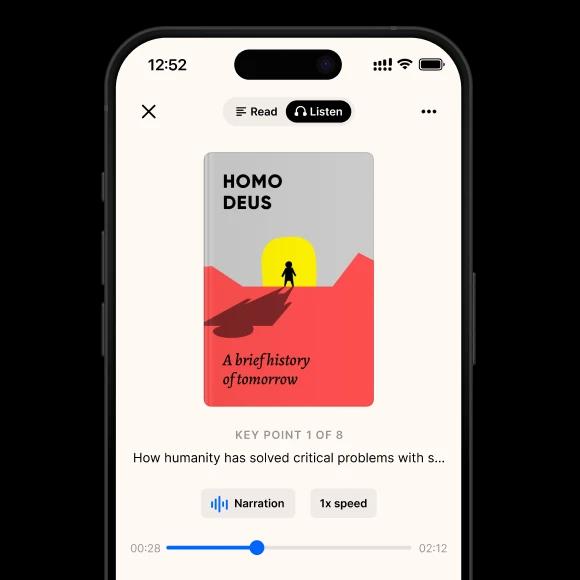
Re-reading the same page three times?
Headway lets you store key insights with saved highlights.
Save Key InsightsWhat is reading comprehension? A plain definition
Reading comprehension is the ability to make sense of a text, connect its ideas, and hold on to them afterward. That's the short reading comprehension definition.
The longer reading comprehension meaning is worth sitting with, because two things are happening whenever you read:
The first layer is decoding: turning letters and symbols into words. That's the phonics side of reading, and most adults handle it without thinking.
The second layer is understanding: grasping what those words mean together and how the argument holds up.
However, you can sound out every word on a page with perfect fluency and still walk away having understood almost nothing. That gap between smooth reading and real understanding is the exact problem these strategies solve.
If you want to strengthen the underlying reading comprehension skills over time, that work runs in the background while the strategies do the heavy lifting today.
Skills vs strategies: Why the difference actually matters
Skills are abilities you build slowly over the years: fluency, vocabulary, and decoding. Strategies are the deliberate reading strategies you pick in the moment to understand one specific text: previewing, questioning, and summarizing.
Why does that matter for a busy adult? Because you can borrow a strategy today and see the payoff on the very next page, while your reading comprehension skills keep growing quietly underneath.
Much of this comes from the science of reading, the research on how people actually learn to read.
In schools, it shows up as explicit instruction, guided practice, and the gradual release of responsibility, where a teacher models a skill, practices it with students, then hands it over.
Reading strategies for students often include read aloud and reciprocal teaching, where learners take turns leading a discussion. As a solo adult, copy the core idea: model the move for yourself, practice it, then let it run on its own.
📘 Get sharper with every book you open on Headway!
Before you read: Set yourself up to understand
Pre-reading strategies do a lot of quiet work. A minute of setup makes everything after it easier. Try these before you start:
Preview the text by scanning headings, first lines, and any summaries to build a mental map.
Activate prior knowledge by asking what you already know about the topic.
Build background knowledge with a quick search if the subject is brand new to you.
Set a purpose by deciding the one question you want the text to answer.
Make predictions about where the argument is heading, then read to confirm or correct them.
Use KWL charts (Know, Want to know, Learned) to frame the whole read.
Give yourself 60 seconds to preview a nonfiction chapter. Read the title, the first sentence of each section, and the closing lines.
That thin skim gives your brain a place to hang everything that follows. Doing this daily also helps you build a reading habit that sticks.
While you read: Strategies that keep your mind on the page
Passive reading is where understanding goes to die, so the goal is active reading. Two moves matter most here: activating prior knowledge you set up earlier, and making inferences the author leaves unspoken. These reading techniques keep your attention working instead of drifting:
Keep answering questions as you go: who is this about, why does it matter, so what?
Practice visualizing by turning descriptions and processes into mental images.
Make inferences and read between the lines, using context clues to fill the gaps the author leaves.
Use synonyms and nearby words to guess an unfamiliar term before you reach for a dictionary.
Do comprehension monitoring, which means noticing the exact moment meaning slips and stopping right there.
Think aloud or annotate, narrating your reasoning or marking the page to stay engaged.
That last pair leans on metacognition, a fancy word for thinking about your own thinking. When you catch yourself confused and name it, you've already started fixing it.
Active moves like these beat rereading the same paragraph on autopilot. For more on this, these reading techniques go further into reading with intent.
After you read: Lock in what you learned
Comprehension you can't recall later is comprehension lost. The moves that decide if an idea survives past the last page all happen after you finish:
Practice summarizing in your own words, which is the fastest test of real understanding.
Try retelling the main idea and its supporting details without looking back.
Synthesize by connecting the new key details to what you already knew or read elsewhere.
Lay ideas out with graphic organizers or story maps so you can see how the pieces fit.
Space it out by revisiting the key points a day later so they hold.
After any chapter, summarize it in three sentences. One for the main idea, one for the strongest supporting point, and one for how you'll use it.
If you can't manage three clean sentences, that's your signal to reread. This step is where reading turns into memory, and it's the key to remembering what you read weeks down the line.
📘 Turn today's reading into a lasting memory with Headway!
Seven reading comprehension strategies by stage
Here's the whole system in one view. Each row pairs a stage with a strategy you can try in about 30 seconds.
Stage | Strategy | What it does | Try it in 30 seconds |
Before reading | Preview and set a purpose | Builds a mental map and a reason to read | Scan the headings, then write the one question you want answered |
Before reading | Activate prior knowledge | Connects new ideas to what you already know | List three things you already know about the topic |
While reading | Ask questions | Keeps attention active and directed | After each section, ask yourself, "So what?" |
While reading | Visualize and infer | Turns words into meaning and fills the gaps | Picture the idea, then guess what the author implies |
While reading | Comprehension monitoring | Catches the moment understanding breaks | Notice the confusion, stop, and reread that part |
After reading | Summarize and retell | Confirms and stores understanding | Explain the main idea in three sentences |
After reading | Synthesize and space it | Links ideas and moves them into long-term memory | Revisit your summary tomorrow |
Do different texts need different strategies?
Yes, and matching the move to the material saves you a lot of effort. The type of text changes how you should read it.
For narrative texts, follow the story structure: characters, setting, conflict, and resolution. A story map works well here, laying out how events connect from start to finish. Fiction and memoir reward this kind of reading.
For expository texts, follow the text structure the author chose, such as cause and effect, compare and contrast, or problem and solution. Hunt for the key details, and slow down for any graphs, charts, or tables, since those often carry the point in compressed form.
One more factor is reading level and density. A light article can be read fast without losing much. Dense nonfiction rewards a slower pace, and pushing your speed there usually costs you understanding.
If speed is a goal on easier material, better reading fluency helps you move quickly without sacrificing the meaning.
Five practical tips from top book summaries
Understanding is a skill you can build, and the right ideas speed it up. Headway lets you get the key points from expert nonfiction in quick formats, so you can test a technique this week and decide later which full book earns a closer read.
Each tip pairs a book with one thing you can do.
1) Learn how you learn before you learn the text
Based on 'Ultralearning' by Scott H. Young.
Young favors testing yourself over rereading, because pulling an idea out of memory is what makes it stick. After a chapter, close the book and write down everything you remember. Then reopen it and fill only the gaps you missed.
2) Drop the belief that you're a bad reader
Based on 'Limitless Mind' by Jo Boaler.
Boaler pushes back on the idea that comprehension ability is fixed. Struggling with a passage is a sign of learning in progress, not a verdict on your intelligence. Next time a paragraph confuses you, reread it slowly and treat the difficulty as growth, rather than skipping ahead.
3) Protect the focus that comprehension depends on
Based on 'Deep Work' by Cal Newport.
Understanding dense material needs uninterrupted attention. Newport argues that focus is trainable and that distraction is the quiet tax that erodes it. Read one section with your phone in another room for 20 minutes, and notice how much more of it you can recall afterward.
4) Know when to read slowly and when to read fast
Based on 'Thinking, Fast and Slow' by Daniel Kahneman.
Kahneman's two mental systems map neatly onto reading. Fast, automatic reading is fine for the easy parts, but real comprehension calls for the slower, deliberate mode. Mark the two or three hardest paragraphs in a chapter, then reread only those slowly, questioning each claim as you go.
5) Build a repeatable routine, not a burst of motivation
Based on 'Smarter, Faster, Better' by Charles Duhigg.
Duhigg shows that small systems beat raw willpower, and a short, consistent reading routine compounds your comprehension over weeks. Pick a fixed 15-minute slot each day for reading plus a one-line summary, and track the streak so the habit builds on itself.
📘 Put these book-backed tips to work on Headway!



Common mistakes that quietly wreck comprehension
A few habits undercut understanding without ever announcing themselves. Here they are, each with a quick fix pulled from the strategies above.
Reading on autopilot with no purpose set. Fix it by writing your one question before you start.
Pushing through confusion instead of stopping. Fix it with comprehension monitoring, so you catch the slip and reread.
Highlighting everything, which ends up signaling nothing. Fix it by marking only the single most important line per page.
Skipping the hard paragraphs, which usually carry the whole argument. Fix it by rereading those in slow mode.
Reading while half-distracted, so nothing consolidates. Fix it by clearing the distraction first, since it's tough to stay focused while reading with a phone lighting up nearby.
This last one is worth repeating, since "why can't I remember what I read?" almost always traces back to divided attention.
Why Headway works for reading and retention
Headway is built around the same moves this guide teaches, which makes it a handy place to practice them daily.
2,500+ of audio and text summaries let you read or listen, so you can fit a session into a commute, a walk, or a coffee break.
Personalized growth plans point you toward the right summaries based on your goals and reading history.
Spaced repetition cards and saved highlights bring key ideas back a day or two later, so retention actually happens.
Offline mode downloads summaries for flights and dead zones, and CarPlay and Android Auto support keep you learning hands-free while you drive.
Daily streaks give you gentle motivation to keep the routine going without pressure.
Together, those features turn summarizing, active reading, and spaced review into a daily habit.
Turn reading into understanding with the Headway app!
Strong comprehension comes down to a rhythm you can repeat: set up before you read, stay active while you read, and lock ideas in after you read.
None of these reading comprehension strategies asks for special talent, only a little intention and practice, and the payoff shows up fast.
Reading is one of the smartest ways to train your brain, but time is short, and the shelf of great books keeps growing. Headway helps by giving you the key points in 15-minute text or audio summaries, with personalized recommendations, spaced repetition, and progress tracking that make it feel like a nonfiction curator in your pocket.
📘 If you want a low-pressure place to practice everything above, try the Headway app and turn a few spare minutes a day into a lasting understanding.
FAQs about reading comprehension strategies
What are the main reading comprehension strategies?
In principle, there are three distinct phases in reading comprehension. First, a reader is supposed to preview the text before beginning to read. Second, questions are put before starting to read the text; try to visualize and make inferences. Last but not least, what is done after one finishes reading the text: you summarize, retell, and connect ideas.
What is the difference between reading skills and reading strategies?
Reading skills refer to various skills, which one acquires bit by bit through constant practice (e.g., fluency, decoding). Reading strategies are those that provide help in the present moment. Through intensive practice of reading strategies, reading skills expand over time, while strategies allow solving reading problems right away.
How can adults improve reading comprehension?
The best way to understand the text is to read it intentionally instead of casually. The adult reader should first look at the text to grasp what he/she is going to read about. Then, the reader should ask questions before starting to read. Summarizing each section of the reading provides further improvement in reading comprehension.
Why do I forget what I read so quickly?
In general, it is a matter of having fragmented attention and not using active strategies. The primary reason passive reading while distracted keeps information in short-term memory is that the words are never transferred to long-term memory. This means you should use comprehension monitoring techniques, summarize, and review the material the next day. Such a simple approach makes it possible to turn a page read into a memorized one.
What are the best strategies for understanding difficult or dense texts?
The main thing is to slow down. You need to read the whole text and analyze and comprehend the hardest parts twice. Break long sections of the text into smaller pieces. Check and summarize what each paragraph was about before moving on. Context clues can help you understand the meaning of unfamiliar words. Identify structures of the text (e.g., cause-and-effect) in expository texts and pay attention to graphs.
Do summaries help or hurt reading comprehension?
If you use summaries in an active manner, they are helpful because they build background knowledge and a map of the book content, which will be useful when reading the entire book. The danger lies in passive reading. Consider using a summary as a way to practice: take your time and try to recall what the summary has conveyed.
How long does it take to improve reading comprehension?
You can already notice the difference in your skills after reading actively instead of passively during your first reading session. The improvement in reading skills is usually achieved only after several weeks of performing the reading habits on a daily basis.