
 Self-growth
 Apps & Digital Tools
 Business & Career
 Success
 Growth Tools
 Psychology
 Communication
 Relationships

A peer-reviewed randomized controlled trial published in JMIR mHealth and uHealth found that Japanese employees using the INTELLECT app for cognitive behavioral therapy reported significantly lower depressive symptoms than a no-treatment control group.
That means the mental health intervention effects did not simply hold over time; they actually deepened as participants continued applying the skills in their daily lives.
If you have spent any time looking into mental wellness apps recently, you have likely seen advertisements promising rapid relief from stress management challenges, low mood, and chronic worry.
But when you are dealing with real personal mental health challenges, marketing claims are rarely enough. You want to know if a digital platform can genuinely help you navigate negative thoughts, build self-esteem, and maintain long-term mental well-being.
Intellect is a digital mental health and self-care platform designed to provide low-barrier access to mental health tools.
However, it is essential to establish a clear boundary right up front: the app is not a substitute for immediate crisis intervention or formal clinical care, and its self-guided modules cannot adequately treat severe clinical disorders.
Instead, Intellect functions as an accessible, supplementary tool for personal development and preventative mental wellness.
In this Intellect app review, learn about the platform's core architecture, dissect its subscription pricing, review real user feedback, and unpack what peer-reviewed research reveals about its true effectiveness.
📘 Want to learn more about mental health? Get the Headway app and access the summaries of the books from known experts in the field.
*This review was prepared by the Headway editorial team and is current as of October, 2026. App prices, ratings, and features can change — check the App Store, Google Play, Trustpilot, and the app's official site for the latest updates.

Quick summary: What this Intellect app review found
Here is a quick overview of how the platform performs across key categories:
Platform type: A Singapore-based mental health app offering self-guided CBT tools alongside professional telehealth coaching.
Core features: Structured Learning Paths, guided journals, immediate Rescue Sessions, and daily check-ins.
Clinical backing: Supported by randomized controlled trial data showing significant improvements in anxiety levels and depressive symptoms.
User reception: Highly positive overall, maintaining a 4.9/5 rating across more than 3 million users worldwide.
Primary limitation: Self-guided modules cannot replace clinical treatment for severe psychiatric conditions, and live coaching access varies by market.
What is the Intellect app, and who built it?
To understand the real nature of the platform, it helps to look at where it started and how fast it grew. Intellect is a Singapore-based startup founded in 2019 by Theodoric Chew, who serves as co-founder and CEO.
Chew created the company after experiencing firsthand how difficult it was to access affordable, stigma-free mental health care in Asia. His primary mission was to break down the heavy social stigma surrounding mental healthcare and make daily mental well-being as culturally normal as going to the gym.
The platform grew rapidly, transforming from a local mobile application into an international health ecosystem. When breaking news hit the venture capital world that the startup had secured major backing, prominent institutional investors quickly took notice.
Early funding rounds attracted top-tier venture capital, including Insignia Ventures Partners, HOF Capital, and Y Combinator, alongside notable angel investors. Later funding brought in regional tech leaders, with Sequoia partner Tim Lee and other prominent figures backing the expansion.
Today, the startup serves over 3 million users across dozens of countries. Intellect offers a dual approach: a consumer-facing app available on iOS and Android, and an enterprise B2B platform sold directly to employers.
The commercial strategy centers on removing traditional barriers to care — such as high costs, long waiting lists, and societal judgment — by delivering bite-sized cognitive behavioral therapy (CBT) modules straight to a user's smartphone.
Through this low-cost model, the company aims to bridge the gap for millions of employees and individuals who might otherwise never seek formal support.
Intellect app features: Learning Paths, Guided Journals, and Rescue Sessions
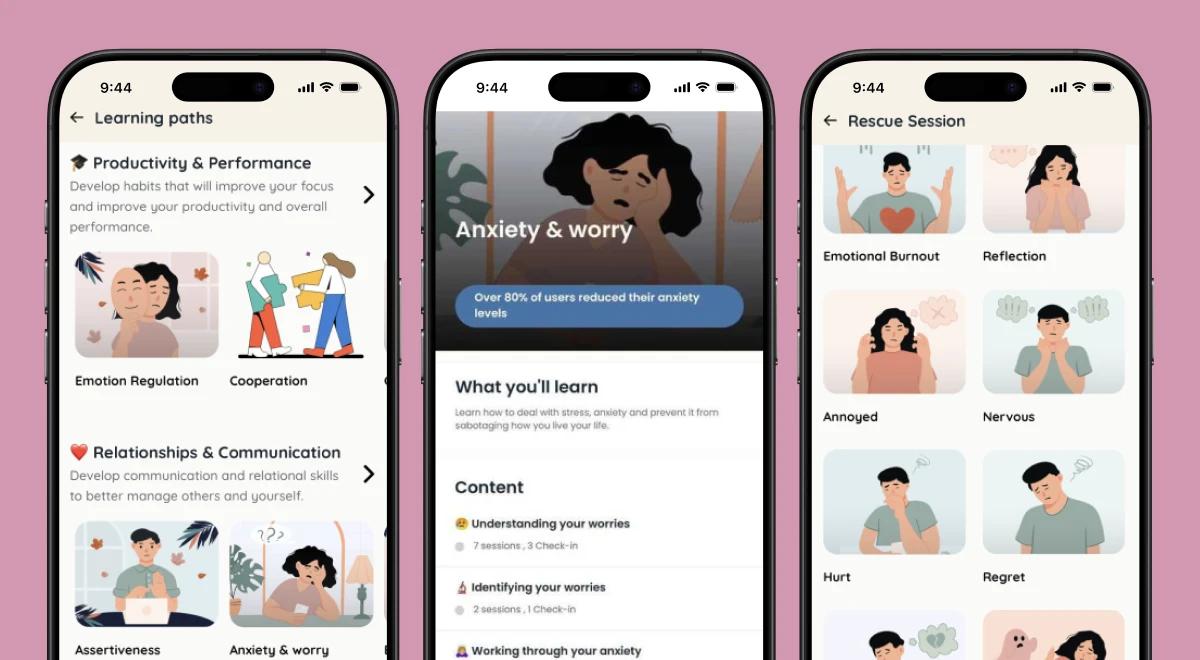
The user experience within the Intellect app centers on an intuitive design built to encourage consistent daily app engagement. When you open the application for the first time, onboarding requires you to complete a brief psychological assessment.
These baseline ratings evaluate your current stress levels, emotional regulation, and overall focus, allowing the algorithm to tailor specific program recommendations to your unique needs.
Here is a breakdown of the app's core feature architecture:
Onboarding Assessment: Baseline ratings evaluate stress, anxiety, and current focus levels to personalize your journey.
Learning Paths: The app provides 10+ multi-day programs, with each session lasting 5-10 minutes. These paths focus heavily on Cognitive Behavioral Therapy (CBT) skill building for areas like anxiety, self-esteem, relationships, and body image.
Guided Journals: These are structured reflection prompts that cover themes like gratitude, problem solving, and reframing triggers, resulting in enhanced self-monitoring and emotional awareness.
Rescue Sessions: Intellect includes 15 short, on-demand audio drills designed for rapid distress relief during moments of panic, anger, or acute stress.
Wellbeing check-ins: Interactive tools for daily emotion logging and pattern tracking.
Want to support your personal growth without spending hours reading long textbooks?
📘 Download the Headway app to absorb key insights from the world's best psychology and self-improvement books in 15-minute summaries.

Will a self-help app stick?
Headway's streaks turn daily learning into a habit worth keeping.
Build a streak1) Structured learning paths for long-term growth
A learning path is a structured, multi-session program designed to help users tackle specific personal development goals or emotional hurdles over several weeks. Intellect offers over 10 Learning Paths covering a broad spectrum of mental wellness topics.
These include managing anxiety, building self-esteem, overcoming procrastination, improving relationship dynamics, navigating body image concerns, and addressing mild disordered eating patterns.
Each individual lesson inside a learning path takes approximately 5 to 10 minutes to complete, making it easy to weave into a busy routine. The modules break complex Cognitive Behavioral Therapy (CBT) principles down into simple, digestible steps.
For example, a session on negative thoughts teaches you how to identify cognitive distortions, reframe harmful self-talk, and cultivate self-compassion. By combining short psychoeducational audio clips with interactive prompts, these self-guided modules help users build practical problem-solving skills for everyday life.
2) Interactive guided journals for reflective self-monitoring
Journaling is a proven cognitive technique, but staring at a blank page can feel overwhelming when you are experiencing low mood or racing thoughts. Intellect addresses this by offering specialized guided journals.
Instead of an empty text box, these digital exercises provide structured prompts that guide your reflection around specific psychological themes.
The guided journals cover topics like building self-compassion, examining personal risk factors for burnout, practicing gratitude, and reframing perfectionist tendencies. As you type your responses, the app prompts you to identify the specific triggers behind your emotions.
This systematic approach strengthens your self-monitoring abilities, helping you spot unhelpful behavioral patterns over time. Furthermore, the app prioritizes user privacy through strong end-to-end encryption practices, ensuring that your personal reflections and participant data remain completely secure and confidential.
3) On-demand rescue sessions for immediate relief
While Learning Paths focus on long-term skill acquisition, acute emotional distress requires immediate support. To address moments of sudden overwhelm, Intellect offers 15 Rescue Sessions.
These short, 2-to-5-minute audio exercises are specifically engineered to assist users experiencing sudden anxiety spikes, intense anger, panic, or acute stress.
Whether you are preparing for a difficult presentation at work or trying to calm racing thoughts before sleep, a rescue session acts as a rapid psychological circuit breaker.
The exercises guide you through deep breathing mechanics, progressive muscle relaxation, and somatic grounding techniques.
Having instant access to these micro-interventions reduces the perceived barriers to emotional regulation, giving users a reliable coping tool whenever challenging moments arise. Building healthy habits requires consistent, daily inspiration.
📘 Check out the Headway app to explore bite-sized book summaries on mindfulness, productivity, and emotional intelligence.
4) Daily well-being check-ins and personal goal tracking
To tie the experience together, the app incorporates a daily Wellbeing Check-in feature. Users log their current mood using an interactive mood wheel, tag the specific activities or circumstances influencing their feelings, and note their energy levels.
Over time, these daily check-ins create a visual record of your emotional trajectory. By tracking these outcome measures continuously, the platform helps you identify recurring triggers and celebrate small improvements.
Research indicates that users who engage with the app for at least 20 minutes weekly experience the most significant improvements in emotional stability and self-awareness.
Does the Intellect app work? What the clinical research shows
Many mHealth apps make bold marketing claims without providing a single shred of empirical evidence. What sets Intellect apart in a crowded marketplace is its rigorous commitment to scientific validation.
The company actively collaborates with academic institutions and clinical researchers to evaluate the real-world effectiveness of its platform.
The 2025 JMIR randomized controlled trial on workplace depression and anxiety
A major landmark study published in JMIR mHealth and uHealth (Yokomitsu et al., 2025) offers compelling evidence regarding the app's clinical impact.
The investigation was conducted as a formal randomized controlled trial (RCT) designed to measure the efficacy of Intellect's CBT-based modules among full-time employees suffering from elevated stress and low mood.
JMIR Trial Results (Yokomitsu et al., 2025):
| Metric | Baseline | Postintervention | 2-Month Follow-Up |
|---|---|---|---|
Depression Reduction (Cohen's d) | -- | -0.57 | -0.85 |
Employee Anxiety Reduction | -- | 93% reported a decrease | -- |
Self-Monitoring Skill Gain (d) | -- | +0.68 | -- |
Overall Program Satisfaction | -- | 79% positive | -- |
(Study Design: Randomized Controlled Trial (RCT) involving 123 Full-time Employees. Registration Number: UMIN000051354. Standards: CONSORT Flow Diagram Compliant)
The trial was conducted under strict academic standards, adhering to consolidated standards of reporting trials (CONSORT) guidelines. Every participant provided formal informed consent prior to data collection.
The participant data was processed through a structured trial flow diagram, randomizing 123 employees into two distinct cohorts: an intervention group that received full access to the Intellect app, and an active waitlist control group that received delayed access.
The sample included both female participants and male participants across various corporate roles, ensuring a balanced demographic distribution.
The study's abstract background highlighted the growing need for low-cost, scalable mHealth apps capable of reducing workplace anxiety levels and depressive symptoms. All psychological outcome measures utilized in the trial demonstrated good internal consistency and high statistical reliability.
The statistical findings were remarkably strong:
Depression reduction: The intervention group showed statistically significant improvements in depressive symptoms compared to the control group. Immediately postintervention, the effect size reported for depression reduction reached a moderate Cohen's d of -0.57.
Sustained follow-up gains: At the 2-month follow-up evaluation, the effect size expanded to -0.85. This indicates that as participants continued using self-guided CBT techniques in their daily lives, their depressive symptoms decreased even further.
Anxiety reduction: Among employees who engaged with the app over a 4 to 6-week period, an astonishing 93% reported decreased anxiety levels and improved emotional resilience.
Self-monitoring skill acquisition: The study documented a substantial increase in self-monitoring skills among the intervention group (d = 0.68). Participants learned to identify early warning signs of stress before reaching a point of emotional exhaustion.
The 2022 trial on university students and acute stress
This workplace trial was built directly upon previous research conducted in 2022 (Toh et al., published in JMIR Formative Research). That earlier randomized controlled trial evaluated an 8-day self-guided stress management intervention among 321 university students.
In that study, university students assigned to the Intellect intervention group demonstrated higher scores in emotional regulation and self-compassion compared to those in the control condition.
Exactly 81% of participants in the trial showed measurable improvements in their ability to navigate stress and process negative emotions constructively. The internal consistency across all psychometric scales remained consistently high throughout the data collection period.
Research limitations and considerations for future studies
While these clinical findings are undeniably impressive, systematic review literature on mobile health tools emphasizes the importance of evaluating research context carefully.
Both trials focused on specific populations — namely, Japanese corporate employees and Asian university students.
Authors of both papers explicitly noted that future research and future studies should explore whether these exact intervention effects replicate across broader, more culturally diverse global populations.
Additionally, while a meta-analysis of general mHealth apps shows broad promise, self-guided digital interventions work best for individuals with mild-to-moderate distress. For individuals dealing with severe psychiatric conditions, clinical care remains indispensable.
User satisfaction & program acceptability metrics:
| Metric | Rating / Percentage |
|---|---|
Overall App Store Rating | 4.9 / 5.0 (Across 3+ Million Users) |
Overall Program Satisfaction | 79% Satisfied |
Program Acceptability | 83% Found Acceptable |
Ease of Understanding | 79% Easy to Comprehend |
Content Appropriateness | 66% Rated Highly Relevant |
Looking to deepen your understanding of Cognitive Behavioral Therapy and emotional resilience?
📘 Use the Headway app to read key summaries of foundational psychology texts in just 15 minutes.
Intellect app pricing plans and subscription options
Understanding the commercial structure of Intellect is essential before committing your time to the platform. Intellect uses a freemium pricing model, allowing new users to download the app, complete the onboarding assessment, and access basic tracking tools without paying anything up front.
Intellect subscription & access tier breakdown:
| Plan Tier | What it includes | Price |
|---|---|---|
Free Tier | Basic mood tracking, daily check-ins, intro sessions for select Learning Paths, and limited access to Rescue Sessions. | $0 / month |
Intellect Premium | Full access to all 10+ Learning Paths, Guided Journals, 15 Rescue Sessions, and advanced progress analytics. | $5.99 – $9.99 / month (Up to $79.99 / year) |
Live Care & Coaching | 1:1 sessions with certified behavioral health coaches and licensed therapists (available in select markets). | Out-of-pocket bundles |
Enterprise B2B | Full premium consumer app access and employer-sponsored coaching for all staff. | Covered 100% by the employer |
The individual consumer subscription — Intellect Premium — unlocks the complete library of over 10 Learning Paths, all 15 Rescue Sessions, and the full suite of guided journals. Premium pricing generally ranges from $5.99 to $9.99 per month when billed monthly, or up to $79.99 when paid as an annual plan.
*Regional pricing variations apply across global App Stores, so users should always verify current rates directly on Google Play or the Apple App Store.
In select markets, Intellect offers out-of-pocket live care sessions and 1:1 coaching bundles. These sessions connect users directly with certified behavioral health coaches or licensed therapists via in-app video and chat.
However, telehealth coaching availability remains restricted by geographical market and subscription level. For users whose employers partner with Intellect Enterprise, the entire app — including 1:1 coaching sessions — is provided as a fully funded employee benefit.
Pros and cons of the Intellect app
Every digital platform has its distinct strengths and structural drawbacks. Here is a balanced look at where Intellect shines and where it falls short:
Pros
Strong clinical backing: Supported by rigorous randomized controlled trial data showing real reductions in anxiety levels and depressive symptoms.
Bite-sized, practical structure: Each learning path session takes only 5 to 10 minutes, making daily engagement manageable even for busy professionals.
Instant crisis tools: Features 15 specialized Rescue Sessions that deliver immediate coping mechanisms during moments of acute stress.
High user satisfaction: Maintains an outstanding 4.9/5 star rating across 3 million users, with 79% reporting overall program satisfaction.
Low-barrier mental healthcare access: Drastically reduces social stigma and financial barriers to entry, making basic CBT tools accessible to anyone with a smartphone.
Robust privacy protection: Utilizes strong data encryption standards to keep journal entries and personal assessments completely confidential.
Cons
Not a clinical replacement: Self-guided modules cannot adequately treat severe clinical disorders or acute psychiatric crises.
Geographical coaching limits: Out-of-pocket telehealth coaching and live therapy options are restricted by region and market.
Minor UI glitches: Some users report occasional bugs in the mood tracker interface when tapping specific check-in icons.
Requires self-discipline: As a self-guided app, long-term success depends heavily on the user maintaining consistent app engagement.
Interested in discovering more strategies for personal wellness?
📘 Try the Headway app to access actionable insights from top-rated books on mental clarity, habit formation, and emotional health.
What users say about the Intellect app (App Store reviews)
To give you a well-rounded picture of the user experience, it helps to look at feedback directly from the App Store. Here is what actual users report about their daily interactions with the platform:
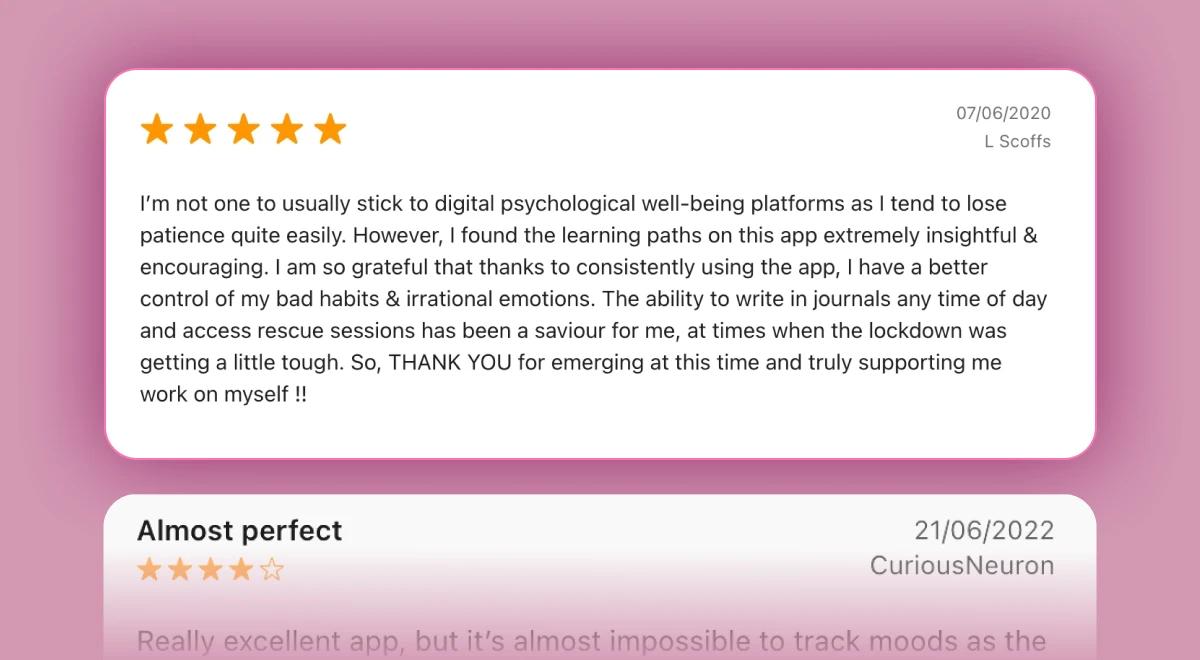
"I'm not one to usually stick to digital psychological well-being platforms as I tend to lose patience quite easily. However, I have found the learning paths on this app extremely insightful & encouraging." — 5/5 stars
"Really excellent app, but it's almost impossible to track moods as the app doesn't respond to tapping on the mood spaces in the mood tracker." — 4/5 stars
"This app has helped me a lot in finding motivation and willpower." — 5/5 stars
*These are selected reviews, not the full rating. Current scores are available on Trustpilot/Google Play/App Store.
Intellect vs. other mental wellness apps in the US
When searching for mental wellness apps, users in the United States face an overwhelming array of choices.
To understand where Intellect fits into the broader digital health ecosystem, it helps to evaluate how it compares to other leading products across key categories:
Mental wellness app category matrix (US Market):
| App | Core Focus | Primary Method | Trial Data |
|---|---|---|---|
Intellect | CBT & Skill Building | Learning Paths | Yes (RCT) |
Headspace | Mindfulness & Meditation | Guided Audio | Yes |
Calm | Sleep & Stress Relief | Soundscapes/Stories | Yes |
Ahead | Emotional Regulation | Bite-sized Drills | Limited |
Brain.fm | Focus & Cognitive State | Neural Music | Yes |
GrowthDay | High Performance | Journaling/Coaching | Limited |
Comparing cognitive behavioral tools versus meditation platforms
If you are conducting a mental health app comparison USA, the first distinction to draw is between meditation apps and cognitive behavioral tools. Popular platforms like Headspace and Calm focus heavily on mindfulness, breathwork, and sleep stories.
If you read the comparison of Headspace vs Calm, you know those apps excel at calming an overactive nervous system in the moment. However, they do not explicitly teach you how to reframe cognitive distortions or dismantle negative thoughts.
Intellect takes a much more structured, skill-building approach. Instead of simply listening to a rain soundscape, you work through a dedicated learning path that teaches you practical CBT skills. If your primary goal is cognitive restructuring and managing daily stress, Intellect provides a more targeted framework than general meditation apps.



Comparing specialized mental health apps
When looking at the best mental health apps in the US, Intellect also competes with specialized habit and emotional tracking platforms.
For instance, the Ahead app focuses specifically on anger management and emotional regulation through bite-sized, gamified drills. Intellect offers a much broader spectrum of topics, tackling everything from workplace burnout to body image concerns.
Similarly, if you read the Brain.fm review, you know that tool uses functional music to stimulate focus and cognitive performance.
Meanwhile, platforms reviewed in the GrowthDay guide focus on high-performance coaching and daily self-reflection. Intellect sits comfortably in the middle of these offerings: it combines structured self-reflection with evidence-based CBT exercises, making it one of the most versatile mental health apps in the USA.
When evaluating whether a platform is worth your monthly investment — much like asking is Blinkist worth it for book summaries — Intellect presents a strong value proposition due to its robust clinical validation and low-barrier freemium entry point.
Build a daily personal development habit with Headway!
While mental wellness apps like Intellect provide essential tools for cognitive reframing and emotional regulation, long-term personal development also relies on expanding your broader knowledge base.
Learning how world-class psychologists, researchers, and leaders navigate adversity can completely transform your mindset.
This is where the Headway app serves as a perfect companion to your daily wellness routine. Headway is an industry-leading microlearning platform that distills the world's best non-fiction books into bite-sized, 15-minute text and audio summaries.
How Headway complements your personal growth routine:
| Platform | Focus | Primary Method | Expected Outcome |
|---|---|---|---|
Intellect App | Emotional regulation, stress relief, & CBT skill building | Guided journals, Rescue Sessions, & Learning Paths | Immediate psychological relief & emotional awareness |
Headway App | Mindset expansion, habit formation, & self-improvement | 15-minute text/audio book summaries | Long-term wisdom, motivation, & growth |
If you are exploring platforms to accelerate your self-growth — as detailed in the Headway vs Blinkist breakdown — Headway stands out for its visually engaging, highly structured approach to daily learning.
By spending just 15 minutes a day listening to key insights from classic titles on emotional intelligence, habit formation, and stress management, you can build a resilient, growth-oriented mindset.
Whether you are using Intellect to process daily emotions or using Headway to absorb timeless wisdom, consistency is the key to lasting change.
You can start upgrading your daily reading habit today by downloading the Headway app!
FAQs about the Intellect app
What is the Intellect app used for?
The Intellect app is a digital self-care and mental health platform designed to help users manage everyday stress, anxiety levels, low mood, and emotional regulation. It utilizes Cognitive Behavioral Therapy (CBT) principles delivered through structured Learning Paths, guided journals, and rapid Rescue Sessions to foster long-term personal development.
Is the Intellect app based on real clinical research?
Yes, the app is supported by peer-reviewed clinical research. A 2025 randomized controlled trial published in JMIR mHealth and uHealth showed that users experienced significant reductions in depressive symptoms (d = -0.85 at 2-month follow-up) and a 93% decrease in workplace anxiety levels after consistent app engagement.
How much does the Intellect app premium subscription cost?
Intellect operates on a freemium model. The basic version provides free access to mood tracking and intro sessions. Intellect Premium ranges from $5.99 to $9.99 monthly, or up to $79.99 annually. Out-of-pocket coaching bundles and telehealth sessions vary by local market, while enterprise users access premium features free via employer sponsorship.
Is the Intellect app a substitute for therapy or crisis support?
No, Intellect is not a substitute for clinical care, formal therapy, or immediate crisis intervention. Self-guided modules cannot treat severe psychiatric disorders. If you are experiencing a mental health crisis, please contact local emergency services, call a suicide prevention hotline, or reach out directly to a licensed healthcare professional immediately.
What are Learning Paths and Rescue Sessions in the Intellect app?
Learning Paths are structured, 5 to 10-minute daily CBT modules designed to help users overcome specific challenges like low self-esteem, stress, or relationship issues over several weeks. Rescue Sessions are short, 2 to 5-minute on-demand audio exercises engineered to deliver immediate grounding during acute moments of panic, anger, or stress.
Is Intellect available for free, or is a subscription required?
Intellect offers a completely free tier that includes basic daily check-ins, mood tracking, and select introductory exercises. However, unlocking the full library of over 10 Learning Paths, all 15 Rescue Sessions, and complete guided journals requires upgrading to Intellect Premium or accessing the platform through a participating employer.
How does Intellect compare to other mental wellness apps in the USA?
While meditation apps like Headspace and Calm focus primarily on guided mindfulness and sleep stories, Intellect emphasizes active CBT skill-building and cognitive restructuring. It provides a more structured, lesson-based approach to personal development, making it one of the most practical mental wellness apps in the US for managing negative thoughts.
Who founded the Intellect app, and where is the company based?
Intellect was founded in 2019 by CEO Theodoric Chew alongside his founding team. The startup is headquartered in Singapore and originally launched to reduce social stigma around mental health care across Asia. Today, the platform serves over 3 million consumer and enterprise users across the globe.


