Self-growth
 Apps & Digital Tools
 Business & Career
 Success
 Growth Tools
 Psychology
 Communication
 Relationships


You started your own business to get more freedom, so why does it feel like you can barely breathe?
If that lands, you're far from alone. Entrepreneur burnout is common, quiet, and it tends to catch the people least willing to slow down: business owners who feel like they can't. Most founders miss the early warning signs and treat them as the ordinary price of being committed — right up until something gives.
Running your own business doesn't have to cost you your health. Below are the warning signs of entrepreneurial burnout and practical ways to recover while running the company.
📘 Build a recovery plan that fits around running your business.

Quick answer for busy business owners
If you're pressed for time between calls, here is the executive summary before we dive into the details.
What it is | Chronic exhaustion from running a business with no off-switch — not the same as one stressful week. |
What to notice | Poor sleep, forgetting to eat, dread about work you used to love, and a short temper with your team or family. |
Why it hits owners hardest | The workload is unlimited, and your identity fuses with the company, so there's no built-in point to stop. |
Can you recover? | Yes, and without quitting — through firmer boundaries, delegation, systems, and real rest. |
Easiest first step | A few minutes of learning a day, like a 15-minute Headway summary on a walk, to reset without adding to your plate. |
What entrepreneurial burnout is, and how it differs from everyday stress
Entrepreneur burnout is a state of deep physical and emotional exhaustion caused by the slow grind of running a business without enough support. A hard week is normal. Burnout is when the hard weeks stop ending, and your body stops bouncing back.
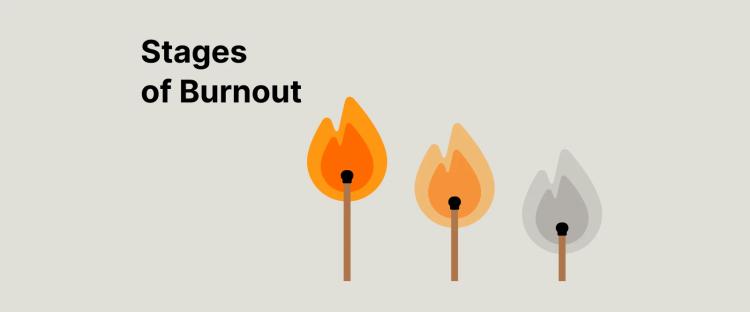
It rarely shows up all at once. Burnout tends to build in stages, starting with pushing a little too hard and ending with feeling empty and checked out. Most people miss the early burnout symptoms because they show up in the body first — poor sleep, headaches, forgetting to eat, more sick days — and feel like the price of being busy. Left alone, it only gets worse.
This isn't only a founder problem, by the way. Burnout hits teachers and students hard too, and if you're caring for people at home on top of work, it helps to know how it differs from compassion fatigue.
Why business owners burn out faster — and what it does to your mental health
Most people who work for someone else have guardrails: a job description, a manager, an HR line, set hours, paid time off. Unlike a salaried career, running your own company comes with none of that. You set your own limits, and most owners set them far too high — there's always one more thing only you can do, so the demands never let up.
Then comes the part that makes entrepreneurial burnout so sneaky: your identity and your business blur together, until your whole world narrows to the company. A slow sales month doesn't feel like a slow month; it feels like proof you're failing. Your money is on the line, the people you lead are counting on you, and you're often afraid the whole thing falls apart if you step back — so you keep working at the computer late into the night.
This toll is real, not imagined. In a study of 242 founders, nearly half reported living with a mental health condition at some point — a notably higher share than among people who don't run a business. The same drive that helps you succeed can quietly wear you down, and at some point the stakes stop being about one bad quarter: for a founder, burnout can take the whole business down.
The warning signs of entrepreneur burnout, from feeling overwhelmed to checked out
Because founders expect to be tired, they tend not to notice the signs until something gives. Watch for these:
You can't switch off. Even on vacation, part of your brain is still running the numbers, and you're checking your phone for problems before you're fully awake.
The basics slip. You're short on sleep, forgetting to eat, and promising yourself you'll rest after the next launch.
The work you loved feels heavy. Decisions that took minutes now drag for days, and the work that once brought you joy has lost its spark.
Your fuse is short. Employees, customers, and the people you'd rather spend your evenings with catch fallout you never meant to hand them.
Your worth rides on the numbers. A down week reads as a verdict on you instead of a normal swing in any business.
If that foggy, can't-think-straight feeling sounds familiar, it has a name — mental exhaustion — and it's one of the clearest flags that your tank is empty.


How to overcome entrepreneur burnout without walking away from your business
The part worth holding onto: you can recover and keep running your company at the same time. If you feel stuck in reactive mode, that's a signal, not a life sentence. Recovery usually moves through stages rather than flipping overnight, so ease off on yourself and start with a few changes you'll stick with.
Put real limits on the day. Pick a hard stop and guard your sleep like a business asset. Rested founders make sharper calls and get more done in fewer, more productive hours.
Delegate and build systems. Your business shouldn't live only in your head. Books like 'The E-Myth Revisited' argue your real job is to work on the company, not just in it. Start creating simple systems, document how things get done, and delegate effectively so you have room to grow.
Separate your self-worth from the P&L. A slow month is business data — try not to read it as a measure of you as a person — and keep your mental health out of every sales report.
Protect your body. Move most days — a walk, a run, a gym session — keep real meals non-negotiable, and stop skipping lunch. Your energy and focus depend on it.
Get support you can be honest with. A business coach, a founder peer group, or friends who get it give you somewhere to connect outside the company. One leader credited daily learning for taking her from reactive manager to strategic leader; another used micro-learning to reshape her coaching practice.
The trick is finding inputs that don't add to your plate. Plenty of owners keep learning in the cracks of the day: one read 20 business books in three months; a developer who's also a triathlete and parent of three fits it around everything else.
With Headway, you can press play on a 15-minute summary during your morning walk or commute — on the same phone you'd otherwise be doomscrolling — and take in a real business idea without carving out an hour you don't have. Be careful to add inputs that help rather than pile on more noise. It's also an easier way to read more without the overwhelm.
📘 Press play on a 15-minute summary on your next walk.
Grow your business without grinding yourself down — with Headway
Recovery isn't a one-time fix. The founders who move past entrepreneur burnout build small, repeatable habits into weeks that never slow down. Headway is made for that: answer a few questions, get a plan built around less stress, and keep a streak going in minutes a day.
With 55M+ downloads, it's a low-lift way to start treating your health and the goals you're pursuing as seriously as your profit. Scale sustainably with Headway today.
FAQs on entrepreneur burnout
How long does it take to recover from entrepreneur burnout?
There's no fixed timeline. Milder cases can ease in a few weeks once you protect your sleep and cut your load; deeper burnout can take several months. Recovery isn't linear, so expect good stretches and setbacks. The earlier you notice the warning signs and act on them, the faster your energy tends to return.
Is entrepreneur burnout the same as depression?
No, though they overlap and can feed each other. Burnout is tied to chronic work stress and often lifts once the pressure eases. Depression is a clinical condition that touches every part of life, not just work, and rarely resolves with rest alone. If low mood, hopelessness, or anxiety stick around, talk to a doctor.
Why do successful entrepreneurs still burn out?
Success doesn't switch off the pressure — it often raises it. The more you achieve, the more people depend on you, and the more there is to lose. Many founders who succeed on paper still feel stretched thin, because the workload and the stakes keep climbing. Left unmanaged, that strain gets worse, not better, no matter how well the business is doing.
How do I take a real vacation when I'm the only one running things?
Start small and plan for it. Write down your core tasks, hand the time-sensitive ones to a person you trust, and set an auto-reply with one emergency contact. Even two unplugged days can reset your energy. The aim is to prove the business runs without you watching every minute.
Can you prevent entrepreneur burnout before it starts?
Often, yes. Block time each month to assess your workload and be careful about what you say yes to. Notice when you start feeling overwhelmed and treat it as data, not weakness. Protect sleep, keep one real day off, and delegate before you're buried. Prevention won't remove the stress of running a business, but it keeps normal pressure from hardening into burnout.
How do I support a co-founder or employee who's burned out?
Start by paying attention. If someone you lead goes quiet, snaps more often, or seems afraid to take time off, name what you've noticed without judgment and ask how they're doing. Offer concrete relief — a lighter week, delegated tasks, a real break — rather than a vague "let me know if you need anything." Connecting them with a coach or peer support helps too.
Can a business coach help with entrepreneur burnout?
Yes. A good business coach can help you see what's draining you, reset your priorities, and build systems so the company leans on you less. A coach won't replace a therapist if your mental health is suffering, but on the operational side — workload, delegation, hard calls — an outside voice often spots what you're too close to notice.