Self-growth
 Apps & Digital Tools
 Business & Career
 Success
 Growth Tools
 Psychology
 Communication
 Relationships

A 2020 academic usability study published in the International Journal of Advanced Science and Technology conducted formal testing of Daylio for effectiveness, efficiency, and reliability.
It concluded the app holds up on all three counts, even while flagging a few specific weaknesses worth knowing before downloading it. Over 20 million users have trusted Daylio since its 2015 launch, establishing it as one of the most prominent digital diaries on the market.
If you are looking for a straightforward Daylio review, you need to know exactly how it functions. Daylio operates as a micro-diary and mood-tracking application designed to build self-awareness through fast, simple daily check-ins rather than long-form journaling.
This article covers how the app works, what the premium tier costs, what the formal research says about its reliability, and exactly what real users report experiencing.
📘 Want to use your phone to build better habits rather than waste time? Try the Headway app to read actionable 15-minute nonfiction summaries.

Quick summary: What this Daylio review found
Here is a fast breakdown of the app's core features and pricing model.
Daylio is a micro-journal and mood tracker using a 5-point smiley system.
A 2020 usability study found the app effective, efficient, and reliable.
The free version covers mood tracking; the premium unlocks advanced stats.
Daylio stores data locally, not on company servers, by default.
Over 20 million users have used Daylio since its 2015 launch.
How does the Daylio app work
The entire platform is built around friction reduction. Daylio uses a quick tap-based interface for data entry. Users can create daily entries in just two taps: first selecting a mood on the simple 5-point smiley system, and then choosing from a pre-set list of select activities for that day.
This specific design means daily mood checks can be performed in less than one minute using Daylio. This low-friction logging encourages long-term consistency, making it particularly suited for people beginning a journaling habit who usually abandon traditional writing after a few days.
The app allows for micro-journaling without requiring traditional long-form writing. However, Daylio allows users to write notes alongside mood entries if they want to record more context for a particular day.
Activity tagging allows users to select custom icons for daily actions, meaning you can customize mood emojis and activity labels to match your specific lifestyle rather than relying on generic categories.
Daylio app features: Mood data, charts, and advanced stats
Daylio offers a robust visual toolkit designed to help users identify behaviors affecting their overall happiness over time.
Visual statistics: The app generates visual statistics about recorded moods over time. This mood chart aggregates your user data to provide a clear picture of how you feel over a specific date range.
Year in Pixels: Daylio provides a visual representation of mood patterns via a 'Year in Pixels'. This color-coded calendar view shows your overall mood for the entire year at a single glance.
Advanced stats: The app compiles weekly, monthly, and yearly statistics about user moods. These advanced statistics allow patterns to be recognized in mood and activity through the app's analytics, visually showing correlations between specific activities and emotional states.
Customization and reminders: Daylio supports adding custom activities and labels for mood tracking, and users can record their moods multiple times a day. Built-in reminders help users maintain consistency in tracking habits and moods, and the app integrates goal setting for routine habits directly into daily tracking.
Privacy and security: Local storage ensures that Daylio data remains secure on the user's device rather than on a remote server. The app supports privacy with device-level PIN locks and biometric verification.
If you are comparing wellness tools, check out the Brain.fm review to see how audio-based focus apps contrast sharply with Daylio's manual data-and-logging approach to mental clarity.
Daylio pricing plans: Free tier and Premium plans
Daylio is available on both iOS and Android. It offers a highly functional free tier, with paid options available for users who want deeper analytics.
| Plan | What it includes | Price |
|---|---|---|
Free version | 5-point mood tracking, basic activity tagging, calendar view, manual backups | $0 |
Premium (monthly) | Advanced stats, Year in Pixels, automatic cloud backup, PIN lock | $4.99/month |
Premium (annual) | Same premium features, billed yearly | $35.99/year |
Premium (lifetime) | One-time payment, no renewal | $59.99 |
Google Play Pass | Premium features are included if you have an active Play Pass subscription on Android | Varies |
*Prices may vary and change. Confirm current prices directly in the App Store and Google Play before publishing, since in-app pricing can vary by region and change without notice.
Does Daylio help with mood tracking? What the research says
The 2020 usability study found Daylio effective, efficient, and reliable in use. However, it also pointed out specific weaknesses, noting that the app lacks detailed correlation analysis between moods and activities, often showing the raw data without interpreting it deeply for the user.
Tracking moods can improve self-awareness and mental health. Consistent mood tracking can help identify triggers for mood disorders, allowing users to spot patterns connected to depression or bipolar disorder by making those patterns visible over time rather than relying strictly on memory.
Daily mood tracking can lead to better life decisions by highlighting exactly which habits consistently result in a positive or negative mood.
However, there is a massive difference between personal self-reflection and clinical care. The American Psychiatric Association notes plainly that no clinical-use studies for Daylio turn up in academic literature.
Daylio is not a substitute for clinical mental health assessment or treatment, and makes absolutely no clinical claims of its own. It is a journal app, not a form of clinical therapy.
📘 Start tracking your personal growth with better reading habits. Download the Headway app to get bite-sized insights from the world's best psychology books.
Daylio vs. other mood tracker apps comparison
Mood tracker apps vary widely in how much writing they require. Daylio's two-tap approach sits at the extreme low-friction end of the market, which suits people who value long-term consistency over deep, detailed daily writing.
Choosing the best mood tracking app often comes down to whether someone wants a quick daily log or a more traditional journal with guided psychological prompts.
It is important to note where Daylio does not compete: it is not built for guided CBT-style programs the way some other wellness apps are.
If you are exploring the broader self-tracking and wellness market, you can see how different tools compare by reading the guides on is Blinkist worth it, Headspace vs Calm, and GrowthDay. For a direct comparison to a highly specialized emotion-tracking tool, check out the Ahead app.
Pros of Daylio
A real usability study backs the app's core claims of effectiveness and reliability, proving the interface actually works as intended.
The free version is genuinely usable on its own, providing full access to the core mood tracker without functioning simply as a stripped-down trial.
Local storage keeps data on the user's device by default, ensuring high privacy for anyone wary of cloud-stored personal mood data.
Low-friction logging allows you to complete an entry in under a minute, making long-term consistency highly realistic compared to longer journaling formats.
Cons of Daylio
Advanced stats and correlation-style insights sit firmly behind the premium version paywall, meaning free users only see raw data without much interpretation.
Some users report serious friction with longer note entries or media attachments. One Google Play reviewer specifically noted that the app slows down heavily with long note entries, and voice recordings are strictly limited to one per entry.
Daylio is not a substitute for clinical mental health assessment or treatment, and users dealing with severe anxiety or mood disorders should not rely on it as a medical tool.



What users say about Daylio (Google Play reviews)
Here is exactly what users have experienced when using the app Daylio, pulled directly from Google Play.
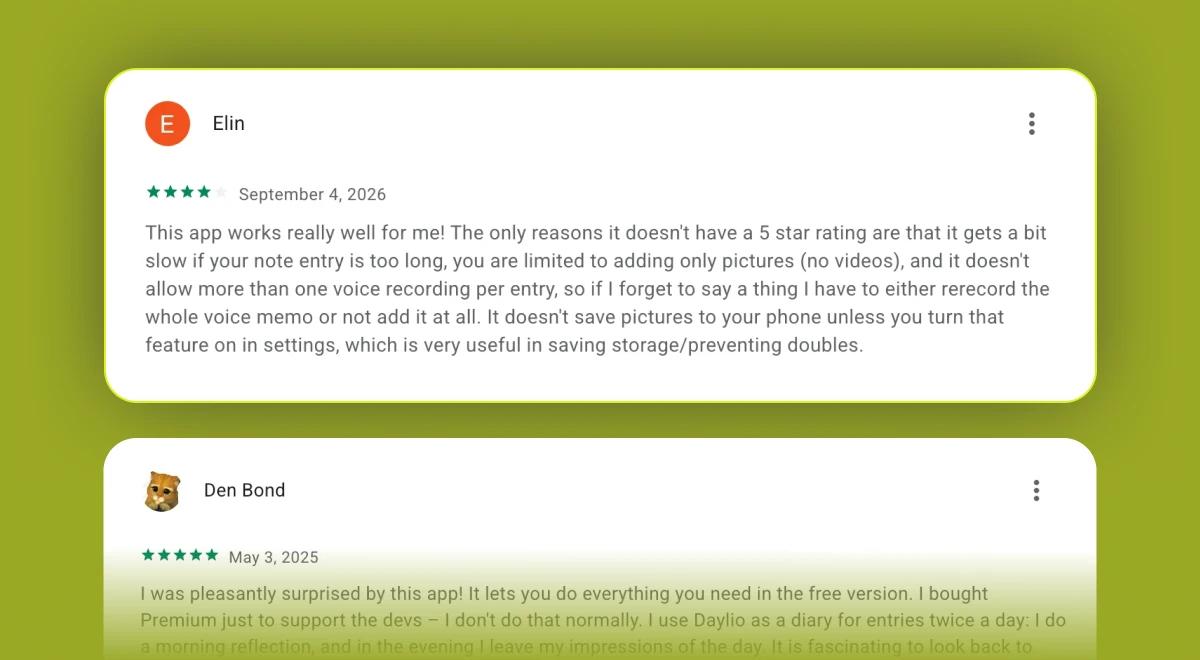
"I was pleasantly surprised by this app! It lets you do everything you need in the free version. I bought Premium just to support the devs – I don't do that normally." — 5/5 stars
"I transfered my data from another app to this. my images are gone, I expected that, what I didn't expect are some entries too. but that's fine. until now I'm quite happy with the app itself." — 4/5 stars
"This app works really well for me! The only reasons it doesn't have a 5 star rating are that it gets a bit slow if your note entry is too long, you are limited to adding only pictures (no videos), and it doesn't allow more than one voice recording per entry, so if I forget to say a thing I have to either rerecord the whole voice memo or not add it at all." — 4/5 stars
*These are selected reviews, not the full rating. Current scores are available on Trustpilot/Google Play/App Store.
Turn your mood data into a daily reading habit with Headway!
Daylio excels at helping you track exactly how you feel, but what do you do with that information once you have it? Headway provides a brilliant next step.
Headway doesn't track moods or activities the way Daylio does. Instead, it offers a massive library of bite-sized nonfiction summaries covering psychology, self-improvement, and stress management topics.
If Daylio helps you identify that stress at work is ruining your mood, Headway provides 15-minute summaries of the world's best books on managing workplace anxiety and building resilience.
They are a natural pairing for someone already building a daily tracking habit. Check out the Headway vs Blinklist guide to see how microlearning platforms compare.
📘 Grab the Headway app today to turn your daily reflections into actionable personal growth.
*This review was prepared by the Headway editorial team and is current as of October, 2026. App prices, ratings, and features can change — check the App Store, Google Play, Trustpilot, and the app's official site for the latest updates.
FAQs about the Daylio app
Is the free version of Daylio actually usable, or just a trial?
The free version is entirely usable and highly functional for long-term use. It allows you to track your moods daily, create basic activity tags, and view your monthly calendar without forcing you into a premium upgrade just to save your basic journal entries.
How does Daylio's mood tracking work day to day?
It relies on a heavily streamlined, two-tap system. When you open the app, you first select your current mood using a 5-point smiley face scale. Next, you tap customized icons representing the specific activities you did that day, taking less than a minute to complete.
What do Daylio's advanced stats show that the free version doesn't?
The advanced stats, locked behind the premium tier, compile your raw data into weekly, monthly, and yearly charts. These visual analytics highlight specific correlations, showing you exactly which repeated activities most frequently trigger your best and worst emotional states over time.
Is Daylio a substitute for therapy or a clinical mental health assessment?
Absolutely not. Daylio is purely a personal self-tracking tool and digital diary. It has no clinical foundation and makes no medical claims. If you are experiencing severe mental health issues, please consult a licensed therapist, psychologist, or medical professional immediately for proper clinical care.
Can Daylio help identify triggers for mood disorders like bipolar disorder?
Yes, by providing a consistent visual record of your daily emotions over many months, Daylio can help individuals spot specific behavioral patterns and environmental triggers that precede major mood swings, providing helpful data you can later share with your actual healthcare provider.
How much does Daylio Premium cost, and is it worth the upgrade?
Daylio Premium typically costs around $4.99 per month or $35.99 annually, though promotional sales are common. The upgrade is highly worth it if you specifically want deep data analytics, the visually appealing 'Year in Pixels' chart, automatic cloud backups, and device-level PIN lock security.
How does Daylio compare to other mood tracker apps and journal apps?
Daylio prioritizes speed and low friction over deep writing. While traditional journal apps encourage long paragraphs and intense self-reflection, Daylio's icon-based, two-tap system is designed specifically for users who want to build a consistent daily tracking habit without spending more than a minute per entry.
Does Daylio store mood data on its own servers, or locally on the device?
By default, Daylio prioritizes user privacy by storing all of your sensitive mood data and journal entries locally on your personal device rather than on their own corporate servers. Premium users can opt to securely back up their local data using their own personal Google Drive.