
 Self-growth
 Apps & Digital Tools
 Business & Career
 Success
 Growth Tools
 Psychology
 Communication
 Relationships

Employers now rank data and AI skills as the fastest-growing capability they look for, according to the World Economic Forum's 2025 Future of Jobs Report. That single stat explains why so many people search for a DataCamp review before they hand over their card.
Data science jobs keep growing as more companies lean on big data, and platforms providing data science courses keep showing up as the fast way in.
This review covers what DataCamp costs, what online courses feel like day to day, and whether the certificates carry any weight with employers. We'll also compare it with Coursera, Udemy, and Codecademy.
Learning to code is one kind of growth. Building the habits, focus, and communication skills that carry a data career forward is another kind.
If you want a 15-minute daily habit that expands your overall knowledge, download Headway and start stacking small wins next to your technical training.

Quick summary: What this DataCamp review covers
Short on time? Here's the honest review before the full breakdown.
DataCamp is a subscription platform for learning Python, R, SQL, and data science skills.
Pricing starts free, with paid plans from about $11/month billed annually.
Courses lean interactive and hands-on rather than relying only on video lectures.
Certificates show practical skill, but they carry less weight than a university degree.
This DataCamp review compares DataCamp with Coursera, Udemy, and Codecademy.
Keep reading for the full breakdown, including a pricing table.
What is DataCamp and how it works
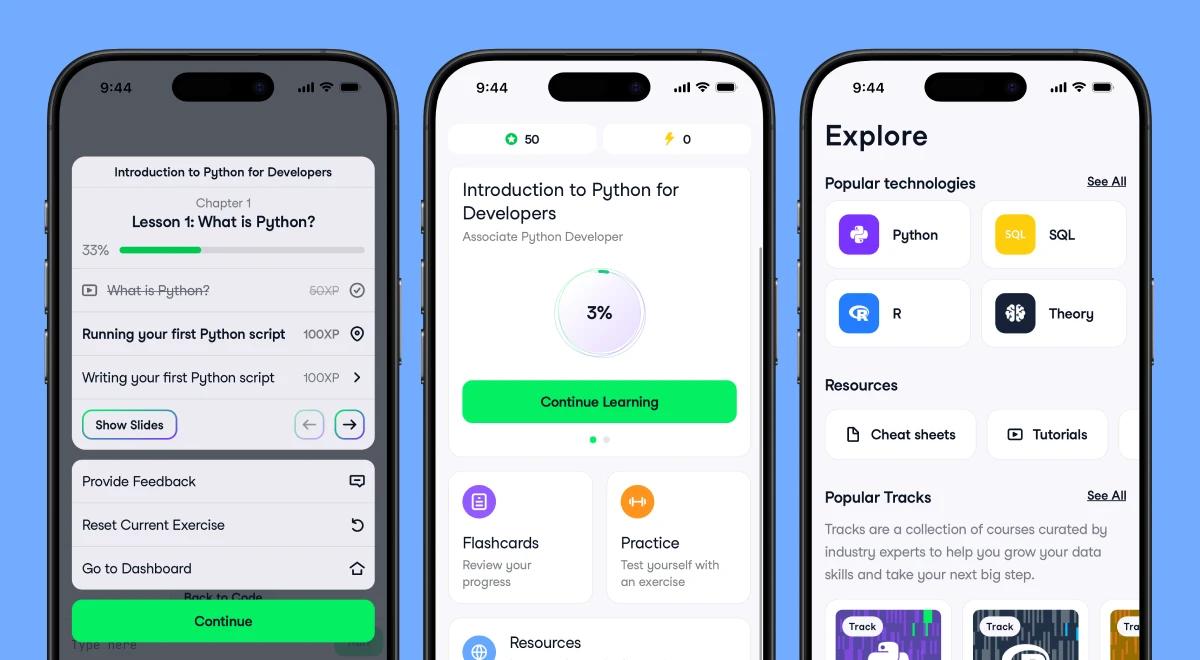
DataCamp started as a company built around one goal: teaching data science skills to people who learn better by doing than by watching. Today it works as an online learning platform with over 790 courses covering data analytics, data visualization, machine learning, and generative AI.
The structure is simple once you see it. Single courses teach one skill, like a specific Python library. Skill Tracks bundle a few related courses around one tool, such as SQL or Power BI. Career Tracks go further, stacking multiple courses into a full path built around a job title, like data analyst or data scientist.
Most people land on DataCamp for one of two reasons. Some want to learn data science on their own schedule without a full degree program. Others already have some data skills and want a structured career track that fills the gaps and looks good on a resume.
📘Start the daily habit that helps new skills actually stick with Headway!
DataCamp courses and features that shape the learning experience
So what do the DataCamp features actually look like once you start clicking around? Here's the rundown of DataCamp courses and tools that shape day-to-day learning, from writing code to reading code.
Interactive, browser-based coding exercises that run without any local software setup.
A library of 790+ DataCamp courses across data science, data analytics, artificial intelligence, and general programming languages.
DataLab, a cloud-based workspace for practicing code and building small real-world projects.
A built-in AI assistant that explains errors and nudges you toward the fix instead of just handing you the answer.
15+ Career Tracks built around specific job titles, including data analyst, data scientist, and data engineer.
Skill Tracks focused on one tool at a time, like Python, R, SQL, Power BI, or Tableau.
A mobile app for short practice questions during a commute or a coffee break, helping you build real Python and SQL expertise over time.
Gamification touches like XP points, daily challenges, and streaks that make the learning process feel a little less like homework. DataCamp also adds new courses regularly, especially in generative AI and machine learning, and that mix of interactive courses and structured tracks sets it apart from a stack of prerecorded videos.
Most learners finish a single Skill Track in a few weeks of steady, hands-on practice. A full Career Track takes longer, often two to three months if you study a few hours a week.
DataCamp cost: Pricing explained from free access to Enterprise
Let's talk about DataCamp cost, since that's usually the first question anyone asks. So, is DataCamp free? Yes, in a limited way: the Basic plan works without a card forever, though full access to all 790+ courses needs a paid plan. DataCamp runs on a tiered subscription model, and the free plan is more generous than a lot of competitors offer.
| Plan | Price | What's included |
|---|---|---|
Basic | Free | Access to the first chapter of every course, a free professional profile, no certificates. |
Premium (Individual) | $11/month billed annually | Access to 790+ courses, projects, and certificates, career tracks in Python, SQL, Power BI, and R, plus course credits. |
Premium Student | $17/month or $125/year | Same Premium access at a discount for verified students at accredited schools. |
Teams | $13.75/user/month billed annually | Everything in Premium, plus group management, activity tracking, and license tools. |
Small Business | Custom, priced by organization size | Everything in Teams, plus one fixed price for organizations up to 500 employees, SSO, and premium service hours. |
Enterprise | Custom, contact sales | Everything in Teams, plus LMS integrations, advanced analytics, and custom-branded learning programs. |
DataCamp runs promotions often, so the price at checkout might land lower than the list price above. It's worth checking the live pricing page before you commit to a plan.
DataCamp vs Coursera, Udemy, and Codecademy: How the career tracks compare
People searching "is DataCamp better than Coursera" or "which is better, DataCamp or Udemy" are usually trying to solve the same problem: too many platform choices and other courses, but not enough time. Here's how the big three stack up on the things that matter most.
| DataCamp | Coursera | Udemy | |
|---|---|---|---|
Focus | Data science, analytics, and AI skill tracks | University-backed courses across many subjects | Broad marketplace, any topic, single-instructor courses |
Format | Interactive, in-browser coding practice | Video lectures with graded assignments | Video lectures, self-paced |
Pricing | Subscription, from $11 a month billed annually | Subscription plus per-course and degree options | One-time purchase per course |
App prices, ratings, and features can change, so check the app's official site for the latest numbers.
Codecademy covers similar ground to DataCamp, though its data-specific tracks are thinner and its career paths lean more toward web development. Pluralsight sits closer to Udemy in format, but it targets IT professionals and software engineering teams more than aspiring data analysts.
Put simply, DataCamp vs Udemy comes down to guided structure against pure flexibility. DataCamp vs Codecademy comes down to a data-first focus against a broader coding curriculum. DataCamp vs Pluralsight comes down to audience, since Pluralsight leans toward IT teams rather than aspiring data analysts.
Is DataCamp worth it for aspiring data analysts and data scientists
So, is DataCamp worth it? For aspiring data analysts and data scientists starting from zero, yes, in most cases. The structured Career Tracks give you a clear order to follow, and the hands-on coding practice for data analysis builds muscle memory that a video lecture alone can't.
Where it falls short is scope. DataCamp doesn't fully cover advanced concepts in statistics or machine learning theory, and some exercises lean on fill-in-the-blank code instead of open-ended problem-solving. If you already work in the tech industry and need graduate-level statistics, this isn't the right fit.
The people who get the most value are complete beginners and career switchers building a foundation, plus working professionals who want a refresher on a specific tool like Power BI or SQL without going back to school.
Are DataCamp certificates worth it for employers
Certificates require an active paid subscription to access, so earning one proves you paid for and finished a course. That's a stronger signal than simply passing a single quiz.
They show specific, practical skills rather than standing in for a full degree. Recognition varies by employer. Some hiring managers know DataCamp well and treat a certificate as a solid signal, while others weigh it far less than a university credential.
Certificates help most in the early stages of a career, like a junior-level application, a portfolio, or a LinkedIn profile that needs some proof behind the words "I know Python."
📘Round out your resume with the soft skills employers actually notice on Headway!
The pros of learning data science and data analytics on DataCamp
What are the pros and cons of DataCamp once you dig past the marketing page? Are DataCamp's guided projects useful, for instance? For building a portfolio piece that showcases all the skills you've acquired, yes. Let's start with what works.
Practice coding directly in the browser without any local setup, on an interface that feels clean and user-friendly even if you've never opened a code editor before.
Choose from 15+ career tracks organized around real job titles.
Learn from courses built by 260+ practitioners across the data analytics field.
Get instant, contextual help from the built-in AI assistant when you get stuck, which users call a real game changer.
Keep up daily practice through the mobile app, even on days you skip your laptop.
Build hands-on guided projects that turn raw data into a portfolio piece.
The cons every aspiring data analyst should know before subscribing
No platform is perfect, and DataCamp has a few real trade-offs worth knowing before you subscribe.
DataCamp doesn't fully cover advanced statistics or machine learning theory.
Many exercises are fill-in-the-blank, which limits independent coding practice.
Certificates carry less recognition than a university credential in most hiring conversations.
Full access depends on staying subscribed, and nothing carries over once a plan lapses.
Guided projects feel more structured than the real world, where data rarely comes pre-cleaned and organized for you.
What real DataCamp users say
What do people think about DataCamp once the free trial ends? The reviews are mixed, which is usually a good sign that they're honest.
Nikki Ness, September 19, 2026
"I've used DataCamp in the past, and the introduction of the AI tutor is excellent. It's like having your own tutor whom you can ask questions to clarify your understanding, or to help you through the practice exercises."
Bill Clark, US, Sep 13, 2026
"This platform and the training provided really helped me to earn a Master's Degree in Data Analytics. I recommend it for anyone from beginner to intermediate skill levels in data-centric skills who wants to build new or enhance existing skills in the data field."
Carp-Bezverhnii Maxim, PT, Nov 13, 2025
"I went to DataCamp mostly to learn Data Fabric and didn't have a good experience. The material is not up to date with the new releases of Microsoft Fabric, and the courses run inside a remote desktop where everything is very slow, and you keep hitting API limits or Power BI license caps."
dhnation, DE, Jul 22, 2026
"I came across several critical bugs and issues during different courses. It's not possible to finish even the most hyped career track, Associate AI Engineer for Developers, since it returns an API timeout error. Whenever I reply to the customer support emails, I never get a response back."
These are selected reviews, not the full rating. Current scores are available on Trustpilot, Google Play, and the App Store.
📘 Explore daily insights that stick long after you close the app, with Headway!
Who should use DataCamp for data-driven decisions
Is DataCamp good for beginners specifically, or does it work better for people who already know the basics? Both, depending on what you're after.
Complete beginners starting from zero coding experience.
Career switchers building toward a data analyst or data scientist role.
Working professionals who need to make data-driven decisions on the job but don't have time for a full degree program.
Teams and organizations that need shared license management, progress tracking, and better business decisions backed by real skill data.
Not the best fit for learners who need a full theoretical grounding for research or advanced machine learning roles.
How long does it take to finish DataCamp? A single Skill Track takes a few weeks, a full Career Track usually takes two to three months of steady, part-time study, and a first course can take as little as an afternoon.
Build a daily learning habit that supports your data career with Headway
DataCamp builds technical, hands-on skills. Headway builds the reading and thinking habits that support a data career in a wider sense, things like focus, decision-making, leadership, and communication.
Not every data professional has time to read a full book on data storytelling, negotiation, or career growth between courses. Headway's 15-minute summaries make that time work harder, during a commute or while waiting for a script to run. If you already lean on audio during a commute, our Audible review covers a related option worth a look.
Headway works as the habit that runs next to a DataCamp subscription, not instead of it. A Headway vs Blinkist comparison shows how it stacks up against other reading apps if you want more detail on that side of things. And if you learn better through visuals, our Imprint app review is worth a look too.
Why Headway works for busy data professionals
Every summary comes in audio and text, so you can listen during a drive or read during a break.
A personalized growth plan adjusts to goals like leadership, focus, and clear communication.
Spaced repetition flashcards and saved highlights help key ideas stick after you close the app.
Offline mode lets you download summaries for a flight, a subway ride, or a spot with no signal.
CarPlay and Android Auto support means you can listen hands-free during a commute.
Daily streaks keep the habit going without turning it into a chore.


What Headway users say about building a daily learning habit
Real people use Headway to build the kind of daily habit that supports a busy schedule. Here's what a few of them had to say.
Learning despite a tight schedule
"Headway is my favorite way to continue reading and learn from books due to my tight work schedule. It is very much worth it for me to have subscribed."
(Headway user, App Store review)
Constant growth without overwhelm
"This app gives me the feeling of constant growth and learning without overwhelming me. The bite-sized summaries of books are brilliant. They're concise yet packed with insightful ideas, allowing me to grasp the essence of a book in just a few minutes."
(Headway user, App Store review)
CEO leadership tool
"This has been a great tool as the CEO of my company. It helps me refocus and fill my mind with tools that make me a better leader. Highly recommend for anyone looking to grow their skills."
(Headway user, App Store review)
Single parent career woman
"As a single parent and a career woman, every minute of the day is already accounted for. This app helps me save time by sifting through the noise, so I have more time to learn while attending to house chores."
(Headway user, App Store review)
Make your data career stick with Headway
This DataCamp review proves that the app is a solid pick if you want structured, hands-on practice in Python, R, SQL, and the tools that power modern data analytics. The pricing is fair, the career tracks are specific, and 790+ courses give you plenty of room to specialize. The certificates won't replace a degree, but they add real proof of practical skill to a resume.
None of that technical training covers the habits that keep a career moving: staying consistent, communicating clearly, and thinking more clearly under pressure. That's where Headway fits in.
Its 15-minute summaries come in audio and text, adjust to your goals through a personalized growth plan, and use spaced repetition to help ideas actually stick. Daily streaks and offline mode make it easy to keep the habit going, even on a packed week.
Download the Headway app and pair your technical training with a daily habit built for the rest of your career.
This comparison reflects publicly available information as of September, 2026.
FAQs about DataCamp
Is DataCamp better than Coursera?
It depends on the goal. DataCamp focuses on data science, data analytics, and hands-on coding practice through short, interactive exercises. Coursera covers a much wider range of subjects with university-backed video courses and degree options. If you want a fast, practical path into data skills, DataCamp usually wins. If you want a recognized credential from a specific school, Coursera is the stronger pick.
Which is better, DataCamp or Udemy?
DataCamp offers a structured, subscription-based path through career tracks, while Udemy sells individual courses you own for life at a one-time price. DataCamp works better for someone who wants a guided order and built-in practice exercises. Udemy suits someone who already knows what they need and wants to pick one course from a huge, varied marketplace instead of paying monthly.
Is DataCamp good for Python beginners?
Yes. DataCamp starts from the very basics, including how to write your first line of code, before moving into data cleaning, data manipulation, and visualization. The interactive, browser-based format means you get immediate feedback on every exercise. Most beginners can finish an introductory Python Skill Track in a few weeks studying a few hours a week.
Is DataCamp good for SQL beginners?
DataCamp's SQL courses walk through queries, joins, and database basics in a browser-based practice environment, so you write real queries from the first lesson. The Skill Track format breaks SQL into small, focused pieces instead of one long course. For someone who's never touched a database, this structure often works better than sitting through hours of video lectures.
Does DataCamp teach real-world skills?
DataCamp includes guided, hands-on projects that use real datasets, and the skills taught, like Python, SQL, and data visualization, are the same tools used in actual data analyst and data scientist jobs. Guided projects follow a set structure, though, and don't fully capture the messier reality of a real job, where the questions aren't already laid out for you.
Can DataCamp replace a coding bootcamp?
Not entirely. DataCamp teaches fundamental skills and specific tools well. Still, a bootcamp usually adds career coaching, live instruction, and a cohort of peers working through the same material at the same time. DataCamp works well as a lower-cost way to test interest in data science or build a foundation before committing to a bootcamp's bigger price tag and time commitment.
What jobs can I get after DataCamp?
DataCamp's Career Tracks are built around specific roles, including data analyst, data scientist, data engineer, and business analyst. Completing a track and building a small portfolio of guided projects can help with junior-level applications in those fields. Landing the job still depends on interview skills, existing experience, and how well a resume tells the story around the certificate.
What is the best DataCamp alternative?
It depends on what you need. Coursera and edX suit anyone who wants a university-backed credential. Codecademy overlaps with DataCamp but leans more toward web development, and Pluralsight targets IT professionals more than aspiring data analysts. None of these replace the career-building habits Headway supports alongside them, like consistency, focus, and communication.


