Self-growth
 Apps & Digital Tools
 Business & Career
 Success
 Growth Tools
 Psychology
 Communication
 Relationships

Only about one in three college students even know their school offers free tutoring, and just 13% use it, according to Inside Higher Ed. That is why millions of students look for help outside class hours. Chegg is one platform that pairs textbook solutions with expert-written answers for higher education.
This review breaks down what you get from Chegg, from pricing and core features to how the platform stacks up against Course Hero and ChatGPT.
If digging through homework tools makes you want a habit that builds you up, Headway turns bestselling nonfiction into 15-minute audio and text summaries you can fit around a packed class schedule.
Download Headway and start stacking small wins that outlast the semester.

Quick summary: What Chegg is, in simple terms
Short on time? Here's the basic rundown before we get into the details.
Chegg is an online homework help platform covering 50-plus subjects, from statistics and calculus to biochemistry and macroeconomics.
It bundles expert Q&A, more than 100 million step-by-step textbook solutions, a Math Solver, and writing tools into a few subscription tiers.
Monthly plans run from about $9.95 for Writing alone up to $19.95 for the full Study Pack, though it's worth confirming the current price at checkout.
Textbook rentals through Chegg can cut costs by up to 90% compared to buying new copies.
Free AI tools like ChatGPT have pulled a real share of students away from paid homework help, and Chegg's own numbers show it.
Keep reading for the full breakdown, including pricing tables, real user reviews, and an honest verdict on whether Chegg still makes sense in 2026.
How Chegg Inc. fits into higher education
Chegg started as something completely different from what it is now. In 2000, a trio of Iowa State students built Cheggpost, a Craigslist-style bulletin board for their campus.
Osman Rashid and Aayush Phumbhra later reworked that idea into a Netflix-style textbook rental business, and the company officially became Chegg in December 2007.
For the modern student weighing a $15 or $20 monthly bill against free AI chat tools, that history actually matters.
Here's the short version of how Chegg Inc. grew from a rental site into the higher education platform it is today:
2005: Chegg Inc. is formally incorporated in California, initially testing scholarship searches and college advice tools.
2010: Dan Rosensweig takes over as CEO and steers the company toward its current subscription model.
2013: Chegg goes public on the NYSE at $12.50 a share, raising $187.5 million and valuing the company near $1.1 billion.
August 2014: A partnership with Ingram Content Group hands off physical textbook logistics so Chegg can focus on digital tools.
Today, Chegg Inc. is a publicly traded company that describes itself as a student-first connected learning platform, and it has grown well beyond textbooks into expert Q&A, math help, writing support, and career tools for higher education.
📘Turn a homework habit into a lifelong learning one with Headway!
How Chegg works for the modern student, step by step
Getting help through Chegg follows a simple flow, whether you're stuck on a calculus problem at midnight or double-checking an essay citation.
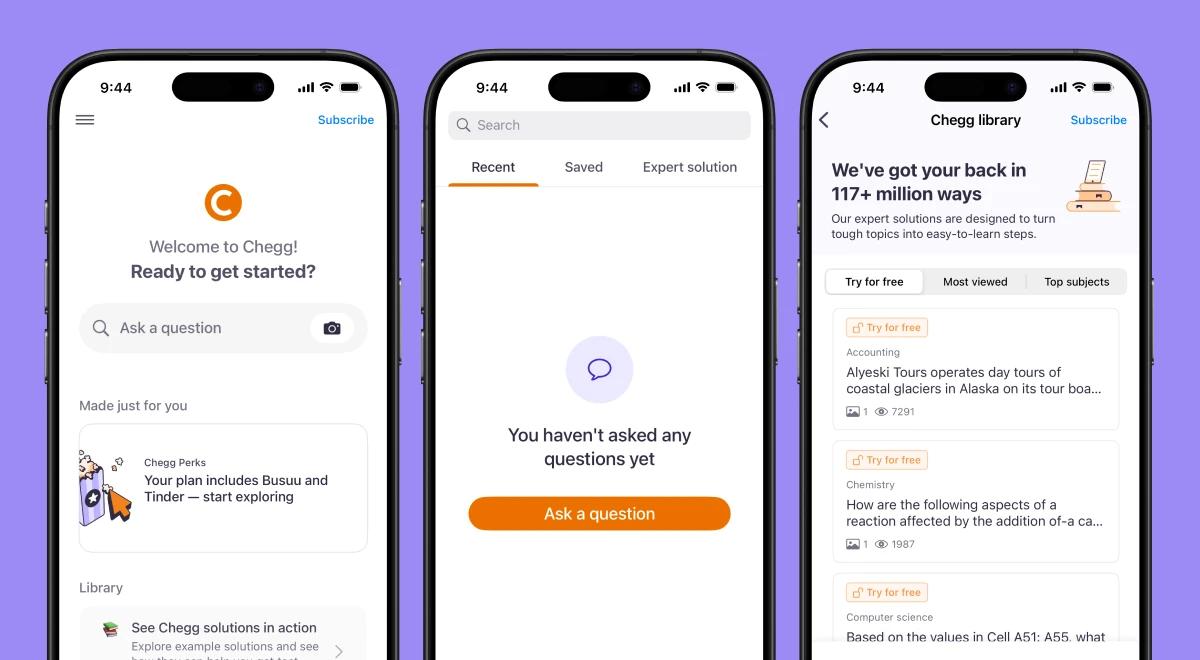
Create an account and browse Chegg's free tools before you pay for anything.
Choose a subscription tier that matches how much help you actually need each month.
Snap a photo of a tricky problem with the mobile app, or type your question directly into the search bar.
Get a written answer from a subject expert, or pull up one of the 100 million-plus step-by-step textbook solutions already in Chegg's library.
The subject coverage is broad. Chegg spans more than 50 subjects, and the Math Solver tool, which runs on Mathway, handles everything from algebra to calculus without needing an expert to weigh in. Whichever path you take, the goal is the same: turn a stuck moment into a finished assignment as fast as possible, while still building a real understanding of the method behind the answer.
What you get: Chegg's core features
A Chegg subscription bundles more tools than most people expect from what started as a textbook rental site. Here's what's actually inside:
Expert Q&A homework help, where subscribers submit questions and get written, step-by-step answers from subject specialists, not just a final number.
A library of 100 million-plus step-by-step textbook solutions, searchable by book title, chapter, or ISBN.
The camera-based question tool, letting you photograph an assignment instead of typing it out word for word.
Math Solver, powered by Mathway, for equations and problem-solving across algebra, geometry, and calculus.
Writing tools, including grammar checking, a plagiarism checker, a citation generator supporting 7,000-plus styles, and expert proofreading with a roughly 48-hour turnaround.
Chegg Skills and an internship-matching experience that help students develop workforce-ready skills and connect them with organizations looking to hire.
CheggMate, the platform's AI-powered study companion that ties search, solutions, and Q&A together in one chat-style interface.
That's a fairly wide feature set for one subscription, though how much of it you use depends heavily on your major and how you like to study.
📘 Trade five separate tools for one daily reading habit with Headway!
Chegg pricing plans explained
So how much does Chegg cost per month? It depends on which tier you pick, and the answer isn't quite as simple as one flat subscription fee.
Plan | Price | What's included |
Chegg Study | $15.95/month | Step-by-step textbook solutions and a set number of Expert Q&A questions per month |
Chegg Study Pack | $19.95/month | Everything in Chegg Study, plus Math Solver, writing and plagiarism tools, and exam prep |
Chegg Writing | $9.95/month | Grammar and plagiarism checks, a citation generator, and expert proofreading |
Textbook Rentals | Varies by title | Up to 90% cheaper than buying new, with physical rentals over $35 often shipping free |
A quick heads-up before you subscribe: pricing on Chegg's own checkout page can shift with promotions, region, and back-to-school offers, and some third-party listings still show the base Study plan closer to $14.95. Confirm the current number directly on Chegg's website before you enter your card details.
Chegg vs. Course Hero vs. ChatGPT: How the three stack up
Chegg isn't the only name in this space, and the two comparisons students search for most are Chegg vs. Course Hero and Chegg vs. ChatGPT. Here's a quick side-by-side.
Chegg | Course Hero | ChatGPT (Free) | |
Core focus | Expert Q&A and textbook solutions | Study documents and course-specific Q&A | General-purpose AI conversation |
Starting price | $9.95/month for Writing alone | Free tier, with paid plans from roughly $9.95 to $39.99/month | Free, with paid tiers for advanced models |
Subject coverage | 50-plus subjects with named experts | Broad, largely user-uploaded document library | Any topic, with no subject-specific verification |
Best for | Verified, textbook-specific answers | Course notes and study guides from other students | Fast, general explanations |
If your course load leans heavily on specific textbook editions, Chegg's tie to exact page numbers and problem sets often matters more than a free chatbot's general knowledge. Our full Course Hero review breaks down that platform in more depth if you're weighing it against Chegg directly.
The pros of using Chegg
Chegg has stuck around for two decades for real reasons, not just brand recognition. Here's where it holds up:
Broad subject coverage across more than 50 fields, so most students can find something relevant to their course load.
A camera-based question tool that saves time on typing out long or formula-heavy problems.
Math Solver integration through Mathway for equations, without waiting on a human expert.
A writing and citation suite bundled into one subscription instead of paying for separate tools.
Meaningful textbook rental savings, up to 90% compared to buying new copies.
Chegg Skills and internship resources aimed at longer-term career readiness, not just the current semester.
The cons of using Chegg
The trade-offs are just as real, and picking the right tier can be a genuine challenge before you commit to a monthly charge.
The base Study tier limits step-by-step solutions weekly and monthly, which pushes many users toward the pricier Study Pack.
Stacking Study Pack and Writing separately can add up fast if you need both toolsets.
Content quality can vary by subject, since expert response quality isn't perfectly uniform across every field.
A declining subscriber base as free AI tools gain ground with cost-conscious students.
Ongoing academic integrity scrutiny in some markets, which we cover in detail below.
Occasional billing issues when a subscription doesn't cancel as cleanly as expected, so double-check your account after canceling.


Is Chegg considered a cheating tool?
This is a question many reviews skip, and it deserves a straight answer. Chegg has consistently positioned its service as a study aid, not a shortcut, and points to tools like Honor Shield, which lets instructors restrict access during exam windows, as evidence of that stance.
The record is more mixed than Chegg's own framing suggests, though. A 2020 study from Imperial College London found that requests to Chegg for exam-style questions jumped nearly 196% during the shift to remote learning, concentrated in subjects like computer science, mechanical engineering, physics, and chemistry.
Some universities explicitly prohibit its use, and cheating incidents tied to Chegg were widely reported during COVID-era remote exams.
More recently, Australia's higher education regulator, TEQSA, brought Federal Court proceedings over Chegg's Expert Q&A service, and in March 2026, the court found three contraventions of the country's anti-cheating law tied to exam questions from Monash University students.
Chegg was ordered to pay roughly A$650,000 in penalties and costs combined, and TEQSA has since encouraged students and institutions to share information about suspected cheating services, a sign of how seriously regulators are now enforcing this.
The UK's proposed Higher Education Cheating Services Prohibition Bill has also named platforms like Chegg directly in parliamentary debate over academic integrity legislation. None of this makes Chegg illegal to use for legitimate homework help, but it's worth knowing before you rely on it during an actual exam.
Is Chegg still worth it in the ChatGPT era?
Chegg's traffic and subscriber numbers have taken a real hit since ChatGPT's late-2022 launch. In May 2025, the company cut 22% of its staff and closed its physical offices in the US and Canada, and in October 2025 it went further, cutting 45% of its workforce, or 388 employees, as web traffic kept sliding.
Chegg also filed a lawsuit against Google that February, arguing that AI Overviews in search results were siphoning off the traffic that used to land on its site.
That same October announcement brought a leadership shift: Dan Rosensweig, who had led Chegg for 14 years before stepping back to executive chairman in 2024, returned as CEO to steer the restructuring through its ongoing organizational issues.
Should you subscribe to Chegg amid all that turbulence? The honest answer is that the core product still works, and its language-learning business, Busuu, continues to grow at a healthy clip.
By August 2025, Chegg reported that Busuu's revenue had grown 15% year over year, and the company also tends to run short free-trial windows around the back-to-school season in July and August, though these promotions come and go.
Chegg is leaning harder into skills-based learning alongside homework help. Still, it operates in a far more competitive market than it did five years ago, and free tools like Khan Academy now cover much of the same ground for students on a tighter budget.
📘 Keep growing after the semester ends with Headway!
A better way to build a learning habit beyond homework help
Chegg is built for a specific moment: when you're stuck on a question and need a verified answer fast. That's a real, useful thing. But it doesn't do much for the broader habit of learning once the semester's assignments are turned in and the subscription lapses.
The Headway app, however, is built for the part of learning that happens outside a single assignment, and a few features make that easy to stick with.
Every summary comes in both audio and text, so you can listen on a walk between classes or read on a break without switching tools. A short onboarding quiz builds a personalized growth plan around your goals, whether that's career skills, focus, or communication.
Spaced repetition cards and saved highlights help ideas actually stick instead of fading after one read. Offline mode means downloaded summaries work on flights or in dead zones, and support for Apple CarPlay and Android Auto turns a commute into a study session. Daily streaks add a gentle nudge to keep the habit going without any pressure attached.
Keep building past the last final exam with the Headway app
Chegg has a clear place in a student's toolkit: fast, expert-checked answers when a specific assignment has you stuck at 11 p.m. Two decades in, it's still one of the more recognizable names in homework help, even with free AI tools chipping away at its edge and its own leadership working through a real restructuring.
But homework help and a lasting learning habit are two different things, and that's where Headway comes in. With 15-minute audio and text summaries, a personalized growth plan built from a short quiz, spaced repetition to help ideas stick, offline downloads, and daily streaks that make consistency feel easy instead of forced, Headway is built for the stretch of time between assignments, not just the assignment itself.
If Chegg gets you through tonight's homework, Headway can help you build something that outlasts the semester.
Download Headway and turn a few spare minutes a day into a real, growing habit.
This review was prepared by the Headway editorial team and is current as of September, 2026. App prices, ratings, and features can change, so check the App Store, Google Play, Trustpilot, and Chegg's official site for the latest information before you subscribe.
FAQs about Chegg
What is Chegg used for?
Chegg is used mainly for homework help. Students submit tricky questions and get written answers from subject experts, search a library of more than 100 million step-by-step textbook solutions, or use built-in tools like Math Solver and citation generators. It also covers textbook rentals, writing support, and career resources through Chegg Skills and internship matching.
How much does Chegg cost per month?
Chegg Study runs $15.95 a month for step-by-step solutions and a set number of expert questions. Chegg Study Pack, which adds Math Solver and writing tools, costs $19.95 a month. Chegg Writing alone is $9.95 a month. Prices change with promotions and region, so double-check the price at checkout before you commit.
Is Chegg better than ChatGPT for homework help?
It depends on what you need. ChatGPT is free and fast for general explanations, but it isn't verified against a textbook or checked by a subject expert. Chegg's Expert Q&A and 100 million-plus textbook solutions are tied to specific course materials, which matters more for STEM classes where an exact method counts.
Do universities consider Chegg a cheating tool?
Some do. Chegg has tools like Honor Shield that let instructors restrict access during exams, and the company positions itself as a study aid. Still, a 2020 Imperial College London study found requests jumped sharply during remote exams, and in March 2026, an Australian court fined Chegg for helping students cheat at Monash University.
How do you cancel a Chegg subscription?
Log in to your Chegg account, go to My Account, then Manage Subscriptions, and select Cancel on the plan you want to end. If you subscribed through the App Store or Google Play, you'll need to cancel there instead, since Chegg can't process those cancellations directly. Do this at least a day before your renewal date to avoid another charge.
Is Chegg better than Quizlet?
They solve different problems. Quizlet is built around flashcards, practice tests, and spaced repetition for memorizing terms and concepts, and it has a solid free tier. Chegg focuses on helping you get unstuck on a specific homework question or textbook problem with expert-written answers. Many students actually use both for different parts of studying.
What are the best study apps for college students?
It depends on the task. Chegg and Course Hero cover homework help and textbook solutions, Quizlet and Anki handle memorization through flashcards, and Notion or Todoist keep assignments organized. To build a broader, lasting knowledge habit beyond class material, Headway turns nonfiction books into 15-minute summaries you can fit into a packed schedule.
What can I use instead of Chegg for cheaper homework help?
Free options like Khan Academy cover core subjects at no cost, and ChatGPT's free tier handles general explanations reasonably well. Course Hero has a free tier plus paid plans similar to Chegg's pricing. None of these replace expert-verified, textbook-specific answers exactly, but they can cut costs if you only need occasional help.